
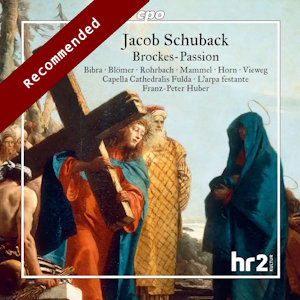
Jacob Schuback (1726-1784)
Brockes-Passion
Capella Cathedralis Fulda, L’arpa festante/Franz-Peter Huber
rec. live, 8 March 2024, Fulda Cathedral, Germany
Texts and translations included
Reviewed as a download
cpo 555 705-2 [136]
Passiontide is one of the most important stages in the ecclesiastical year. This has resulted in large numbers of compositions of different kinds, reflecting the religious and national traditions. In the Baroque era, these differences are more distinct than in the Renaissance, especially before the Reformation. The latter resulted in a marked difference in what was written for this time of the year. Obviously, the Stabat mater, which was frequently set by composers from the Roman Catholic part of Europe, was not something the exponents of the Lutheran Reformation were interested in. They also largely ignored the Lamentations of Jeremiah, which were frequently set in the 15th and 16th centuries, and continued to be performed in France and in Italy. On the other hand, in Protestant Germany, it was especially the narrative of the gospels which attracted composers. This was in line with the doctrines of Martin Luther. His theology was called theologia crucis, as the Passion and death of Christ were the key of his doctrines. Every human being needed salvation for his sins, and that could only come through Christ, paying for them in his place.
This has resulted in a large number of Passions of different shape. During the Renaissance Passions had the form of the motet: the entire text was set polyphonically, including the words of single characters, such as Jesus, Peter and Pilate. During the 17th century the genre was undergoing a stylistic development. The words of the various characters were sung by solo voices (either one or several of them) and non-biblical texts were inserted: hymns or arias. This development came to an end in the so-called oratorio Passion. The most famous specimens of this genre are those of by Johann Sebastian Bach, of which only two have survived. Georg Philipp Telemann also wrote many oratorio Passions: as Musikdirektor in Hamburg it was part of his duties to compose one Passion every year, alternating the Gospel accounts of the four evangelists in fixed yearly rotations.
However, shortly after 1700 a new genre emerged, known as the Passion oratorio. Such a work did not include the literal text of the biblical accounts of the Passion story, but rather a paraphrase. The first of these – which also has become by far the best-known – is the so-called Brockes-Passion. Brockes had been educated in law and philosophy and travelled across Europe before settling in Hamburg where he led a relatively prosperous life. He was strongly attracted to the Enlightenment and stood in close contact with its representatives. The libretto of the Brockes-Passion was published in 1714. It cannot surprise that a composer from Hamburg was the first who set this text: Reinhard Keiser, who played a key role in the Oper am Gänsemarkt, wrote his Brockes-Passion in 1712. Georg Philipp Telemann, always open to the fashions of his time, was the second (1716). His friend Handel, although living and working in England at the time, also set this text; his work may also date from 1716. Another composer from Hamburg, Johann Mattheson, wrote his version in 1718. He organized a cycle of performances of the respective settings in 1719.
In later times other composers turned to the same text, among them Johann Friedrich Fasch and Gottfried Heinrich Stölzel. Bach apparently did not feel so much attracted to it that he wanted to contribute a setting of his own. However, it is likely that he did perform Telemann’s Brockes-Passion; he also copied large parts of Handel’s setting. Lastly, parts of the text he incorporated in his St John Passion (although he adapted the texts).
The production which is the subject of this review is another setting of the Brockes-Passion, written by a composer most lovers of baroque music may never have heard of. The first time I encountered Jacob Schuback was through a live performance of his Easter oratorio Die Jünger zu Emaus, under the direction of Martyna Pastuszka (Cracow, 2022; broadcast by Polish radio). With him we are back in Hamburg, where the story of this Passion started.
Strictly speaking, he was not a professional composer. He was the son of a mayor of Hamburg, attended the Johanneum Lateinschule, where Telemann was his teacher of composition, and then the academic Ratsgymnasium. Next, he studied law in Göttingen, where he became actively involved in the music scene, organizing concerts at his private residence. After his return to Hamburg, he took up the position of secretary and archivist and from 1760 of Ratssyndikus in the service of the senate. In the latter capacity he represented the city on diplomatic missions. In Hamburg he again played a role in music, now also as composer. His works were performed in Hamburg and in near Mecklenburg-Schwerin. He stood in contact with the librettist Pietro Metastasio in Vienna; he set two of the latter’s librettos (Betulia liberata and La Passione di Gesù Cristo, which he himself translated). A token of the respect for his compositional work is that compositions of his pen were performed by Telemann and his successor Carl Philipp Emanuel Bach.
The Brockes-Passion is one of Schuback’s earliest works, dating from 1754. No performance during his lifetime is documented. Julia Huber and Steffen Voss, in their liner-notes, ask: “Was it perhaps a compositional exercise in the oratorio style?” They point out that it is strongly influenced by Telemann. Given the year of composition, it is still remarkably ‘baroque’ in style, especially if one compares it with, for instance, the oratorio Der Tod Jesu by Carl Heinrich Graun, first performed in 1755.
If it was an ‘exercise’, one has to conclude that Schuback succeeded with flying colours. I am quite impressed by this work. One of the reasons is, indeed, the dominating baroque style, but also that – as the liner notes put it – “[the] trim declamatory setting tightens the luxuriant text and heightens it in dramatic respects”. It is notable that some text passages which Brockes intended as arias, are set as accompagnati or ariosos by Schuback. In this respect this work reminds me of Bach’s St John Passion, which is more concise and hence more dramatic than his St Matthew Passion. Among the most dramatic episodes in Schuback’s Passion are the scourging of Jesus and the earthquake, described and reflected upon by the Faithful Soul.
Many arias are rather short and have no da capo. The shortest is 36 seconds. A typical feature of oratorio Passions is that the arias are connected to characters. Some are part of the story, including Jesus. The latter even has two duets, one with Mary and one with the Daughter of Zion. The latter is one of the allegorical characters; the other is the Faithful Soul. Another feature is that the arias are often addressed to the audience; this shows that the Brockes-Passion is a product of the Enlightenment.
The scoring is modest: solo voices for the sixteen roles (some of which very small), four voices tutti (singing the opening chorus, the turbae and the hymns) and an instrumental ensemble of strings and basso continuo. Only in four arias Schuback adds an obbligato wind instrument: a transverse flute, an oboe, a bassoon and a horn. He uses them very effectively. The bassoon plays in the aria of the Daughter of Zion: ‘Was Bärentatzen, Löwenklauen’ (What paws of bears, claws of lions, despite their wrath, do not dare to do, you do, cursed human hand), following the scene where a soldier slaps Jesus in the face. The horn participates in the aria of the Faithful Soul mentioned above, referring to the earthquake.
As I mentioned, I am quite impressed by this work. It makes one wonder why Schuback’s works have hardly been performed before. His extant oeuvre is not large, but apart from the oratorios mentioned above, the work-list in New Grove includes cantatas and ceremonial music and some instrumental works. This recording has made me curious for those parts of his output. If the quality of this work and the Easter oratorio mentioned before is anything to go by, there are good reasons to further explore his oeuvre.
As far as the performance is concerned, this is one which has hardly a weak spot. The team of soloists is top class. It is nice to hear Hans Jörg Mammel once again in the role of Evangelist; thanks to his excellent diction and declamatory skills it fits him like a glove. The role of Jesus is relatively light – more in the baritone than the bass range. Matthias Horn takes care of it impressively. Matthias Vieweg, in the other bass roles, is his usual self: reliable, always interpreting the parts of different characters on the basis of the text. It is one of those voices I enjoy listening to. The other voices were new to me. I am especially impressed by Theresa von Bibra, who sings the role of the Daughter of Zion. What a beautiful voice and what an outstanding interpretation of a character which is subject to so many contrasting emotions. She has some rather demanding arias to sing, and she does so brilliantly. Franziska Blömer as the Faithful Soul is just as good in her description of and reflexion on some of the most dramatic events. These are two names to remember, as is Christian Rohrbach, another beautiful voice. His account of the role of Judas is incisive. The instrumental ensemble is well-known from many recordings and acts at its usual high level. The choir is a bit too large; a smaller ensemble would be preferable, for historical and stylistic reasons, and also in the interest of transparency. Even so, it sings very well. The level of this performance is all the more impressive, if one takes into account that it was recorded live.
To sum up: Schuback’s Brockes-Passion is a major discovery, which deserves to be treated on equal footing with the better-known versions of the likes of Telemann and Handel.
Johan van Veen
www.musica-dei-donum.org
twitter.com/johanvanveen
https://bsky.app/profile/musicadeidonum.bsky.social
Buying this recording via the link below generates revenue for MWI, which helps the site remain free
Soloists
Daughter of Zion, Third Maid Servant: Theresa von Bibra (soprano); Faithful Soul, Mary, First Maid Servant: Franziska Blömer (soprano); Second Maid Servant: Leonie Domesle (soprano); James, Judas, Soldier: Christian Rohrbach (alto); Evangelist, John: Hans Jörg Mammel (tenor); Jesus: Matthias Horn (bass); Caiaphas, Centurion, Peter, Pilate: Matthias Vieweg (bass)













