
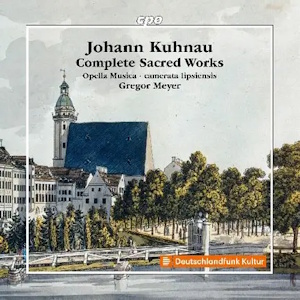
Johann Kuhnau (1660 – 1722)
Complete Sacred Works
Opella Musica; Camerata Lipsiensis/Gregor Meyer
rec. 2013-2021, St Georgen and St. Marien, Rötha, Germany.
CPO 555 774-2 [8 CDs: 537]
The CPO label’s edition of Johann Kuhnau’s Complete Sacred Works launched in 2015 and was completed with its eighth and final volume in 2022. Almost every volume has been reviewed and praised elsewhere on this site, and the whole collection can now be had in a nicely presented box set with a chunky booklet that contains the original booklet notes for each CD, though there are no sung texts or translations included.
Something of a Renaissance man, Kuhnau is best known as a composer today, and remembered as the Leipzig ThomasKantor from whom J.S. Bach took over the post in 1723. Rather than being a kind of proto-Bach, Kuhnau exists in a longer line of cantata composers, with his predecessor in Leipzig being Johann Schelle who was a pioneer in setting German rather than Latin texts. Kuhnau was also a fascinating character who practised law and wrote novels, and it is a genuine tragedy that so much of his work has been lost.
Past reviews include Vol. 1 in which Mark Sealy summed up Kuhnau as “not Bach but worth getting to know”, and Vol. 5 which Johan van Veen stated was “of major importance, for historical and musical reasons.” Kuhnau’s cantatas have popped up on recordings elsewhere which give us an idea of the riches on offer, including a nice pair of Christmas Cantatas on the Christophorus label from Arpa festante and the Karlsruhe Church of Christ Chorus directed by David L’Erler. This contains the cantata Uns ist ein Kind geboren which comes up later in this review, and it is interesting to hear the differences between this and the more defined contrasts in the CPO edition, delivering greater intimacy in the arias while still presenting a grand scale for the instrumental tuttis and choruses.
Of the previous reviews on the MWI site volume 7 seems to have been left out, so as a representative of the rest we can give it some attention now. This consists of a collection of five cantatas, including some with texts by the innovative Erdmann Neumeister, who declare that “a cantata does not look any different than a piece from an opera, put together from the stylo recitative and arias.” Nicht nur allein am frohen Morgen is a piece written for the day after Christmas, and in its extensive recitatives, arias and chorus is already aligned with the 18th century standard adopted by Telemann, Graupner and others. The season’s festivities are here tempered by reflection on Christ’s future, but with a brightly lit and energetic final chorale. The more compact Und ob die Feinde Tag und Nacht has pared-down instrumentation and a solo female singer whose text covers Jesus replying to the Phasirees about taxes, “Give to Caesar what is Caesar’s and to God what is God’s!”
Wie schön leuchtet der Morgenstern is a more spectacular work with horns and recorders and strings, with five vocal parts. The heart of this cantata is a tenor aria, O Wundersohn, dein überirdisch Wesen which, with its weaving recorder parts and harmonically rich but gentle organ accompaniment equals similar pieces by J.S. Bach in its expressive qualities. Our tenor soloist is subsequently put through his virtuoso paces with Kommt, ihr Völker, kommt mit Haufen, and the whole thing ends with an inspired and animated chorale setting Zwingt die Saiten in Cythara.
Uns ist ein Kind geboren gives an even broader sonic perspective with added oboes, but this is a work whose attribution to Kuhnau “rests on very shaky ground.” It was in fact once ascribed to J.S. Bach and was given reference number BWV 42 in the first catalogue of Bach’s works. Composed for Christmas Day, the symbolic morning star shimmers with the subtle instrumentation of this cantata, and whoever wrote it this is a highlight of the programme. Das Alte ist vergangen is the final cantata here, and while its origins also seem obscure it was clearly intended for the feast of New Year. This works well as a closing piece as it dispenses with recitatives, moving forward at a decent pace with arias and choruses towards a final jubilation, Gottes Denken.
No mention is made of remastering these recordings but, while I don’t have any of the originals to hand for comparison, no improvements seem to be desired or required. The editing issues mentioned in the review of Vol. 3 are not a problem on the CD, but there remains a minor glitch 22 seconds into track 24 on CD 8 – not something that anyone really need worry about but there it is.
Wherever I’ve sampled the remaining discs I’ve encountered nothing but the finest quality music making, both compositionally, and in terms of instrumental and vocal performance. If you are keen on J.S. Bach’s cantatas and period vocal music in general then you should certainly consider acquiring this box.
Dominy Clements
Buying this recording via the link below generates revenue for MWI, which helps the site remain free

Reviews of single disc releases:
Vol. 1 review
Vol. 2 review
Vol. 3 review
Vol. 4 review
Vol. 5 review
Vol. 6 review
Vol. 8 review
Contents:
Es steh Gott auf
Mein Alter kömmt, ich kann nicht sterben
Daran erkennen wir
Welt adieu, ich bin dein müde
Tristis es anima mea
Wenn ihr fröhlich seid an euren Festen
Lobe den Herren, meine Seele
Christ lag in Todes Banden
Gott der Vater, wohn uns bei
Lobe den Herren, meine Seele
Schmücket das Fest mit Maien
Magnificat
O heilige Zeit
O heilige Zeit
Frohlocket, ihr Völker, und jauchzet, ihr Heiden
Ich hebe meine Augen auf
Missa brevis
Ach Gott, wie lässt Du mich verstarren
Muss nicht der Mensch auf dieser Erden in stetem Streite sein?
In te, Domine, speravi
Gott hat uns nicht gesetzt zum Zorn
Was Gott tut, das ist wohlgetan
Gott sei mir gnädig nach deiner Güte
Ich habe Lust abzuscheiden
Erschrick, mein Herz, vor dir
Weicht, ihr Sorgen, aus dem Herzen
Singet dem Herrn ein neues Lied
Ihr Himmel, jubilieret von oben
Bone Jesu, care Jesu
Ich freue mich im Herrn
Laudate pueri Dominum
Lobet, ihr Himmel, den Herrn
Nicht nur allein am frohen Morgen
Und ob die Feinde Tag und Nacht
Wie schön leuchtet der Morgenstern
Uns ist ein Kind geboren
Das Alte ist vergangen
Kommt, ihr Musen
Music from the play ‘Von Jacobs doppelter Heyrath’
Spirate clementes
Music from the play ‘In einer Parodie eines neuen Peter Sequenzens von lautern Absurdis Comicis’
Ach Herr, wie sind meiner Feinde so viel
Ende gut und alles Gut
3 Arias:
Was der Himmel selbsten liebt
Entferne sich, was Unruh macht
Sacra pellat taeda bella













