
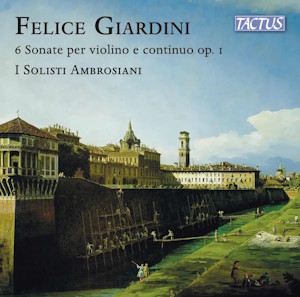
Felice Giardini (1716-1796)
6 Sonate per violino e continuo op. 1
I Solisti Ambrosiani
rec. 2023, Sala consiliare, Gavirate, Varese, Italy
Reviewed as a download
Tactus TC710704 [74]
London was an international hotspot for performing musicians and composers from the late 17th century onwards. There were many opportunities to perform, for instance in the orchestras of opera and theatre, and in private and semi-public concerts, at the court and in the homes of aristocrats and the higher bourgeoisie. This lasted well into the 19th century. No wonder that composers from across Europe were attracted to London, and performed there for some time or settled there for good.
Many Italian composers made their way there to further their career. We know several of them from the late Baroque period, but their peers from the second half of the 18th century are largely unknown. One of them is Felice Giardini; although he is represented on several discs, he is certainly not a household name, and his music is not part of the standard repertoire of orchestras and chamber music ensembles. That is all the more surprising, as his chamber music in particular includes many pieces in scorings that fit the line-up of today’s chamber music ensembles rather well.
He was born in Turin, but was of French descent. Although he showed talent for the violin at an early age, his father sent him to Milan Cathedral to become a choirboy and study singing, composition and harpsichord with Giuseppe Paladini. After his return, he studied the violin with Giovanni Battista Somis. He then went to Rome to play in the opera orchestra, but only for a short period of time: soon he moved to Naples, where he quickly advanced to deputy leader of the orchestra of the Teatro San Carlo. After a few years he decided to make a career as a travelling virtuoso. He performed in Berlin, and then moved to England, where in 1751 he performed to great acclaim. In the next years he led a series of subscription concerts, made appearances at the Bach-Abel concerts, and also played outside London. He played a major role in the London music scene, and Charles Burney called him “the greatest performer in Europe”. However, his relationships were difficult; according to New Grove he became “embittered and quarrelsome”. In 1784 he returned to Italy. In 1790 he made an unsuccessful attempt to return to the English operatic scene. Later he moved to St Petersburg, then to Moscow, where he died in poverty.
As far as his oeuvre is concerned, four stage works are known, but three of them are lost, and one has been preserved only in excerpts. Giardini also contributed to an oratorio (Ruth, together with Charles Avison), but again that is lost. The largest part of his extant oeuvre consists of instrumental music. As one may expect, most of that is for violin, either with basso continuo or with obbligato keyboard. In addition, he composed trios, sometimes for unusual combinations, such as violin, guitar and fortepiano, duos for two string instruments, and some violin concertos. Giardini was also an early composer of string quartets.
It seems fair to say that Giardini’s music has two faces. The violin sonatas that are the subject of the present disc are his first collection that was printed, in 1751 in London. In that time, the galant style was the dominating force across Europe. The sonatas Op. 3 for harpsichord and violin or transverse flute are specimens of that style (review ~ review). My colleague Glyn Pursglove reviewed a recording of the violin duets Op. 2. He writes that “the music in these six duets does nothing to suggest that they are the work of a great virtuoso.” I haven’t heard them, but this seems entirely logical, as such pieces were intended for amateurs. Likewise, the fact that the sonatas Op. 3 mention flute and violin as alternatives, explains why Giardini avoids violin techniques, such as double stopping.
The sonatas Op. 1 (available at Petrucci Music Library) are very different and certainly are the work of a virtuoso, as they are beyond the capabilities of amateurs except those with an advanced technique. They are still firmly rooted in the baroque style, although they include elements which point in the direction of early classicism. They are in all three movements, in the order fast-slow-fast and always open with an allegro. The second movements are marked differently: in the first sonata it is called ‘grazioso’, in the second andante. The third, fourth and fifth sonatas have an adagio. The closing movements are marked allegro, with the exception of the first, which is a minuet. The last sonata – as so often in baroque sonata collections – is different from the others. The second movement is called ‘musette’, the last is a giga. It is also musically different from the rest, being even more virtuosic. In the second and third movements we find the indication “sons armoniques” (upper harmonics). In New Grove we read that “[upper harmonics] are often used for special effects on string instruments and on the harp. In the violin family, the use of harmonics of open strings, ‘natural’ harmonics (‘flageolet tones’), was introduced by Mondonville in Les sons harmoniques: sonates à violon seul avec la basse continue op. 4 (c1738). In his preface he explained how to obtain harmonics nos.2, 3, 4, 5, 6, 8 and above by lightly fingering at a node on any string.” In the musette and the giga this technique is used to good effect, in combination with strictly legato playing.
However, these are not the only movements which indicate the level of Giardini’s skills. Throughout these sonatas he frequently makes use of double and multiple stopping. He also explores the entire range of the violin. There are many passages where the violin plays at the highest positions. In some passages the violinist is facing intervals of two and a half octaves, or has to play demisemiquaver slurs of two octaves. In the Sonata IV we find the indication that the violin has to play an octave above what is written down. And then there are passages which look and sound like cadenzas. This may be a token of his habits during his career. Once Niccolò Jommelli slapped him in the face during an opera performance in Naples for over-embellishing violin lines and inserting cadenzas where they were not indicated.
However, we should not get the impression that these sonatas are mere demonstrations of violin technique. The slow movements especially have a more lyrical character, and even the fast movements are never dull as far as the melodic aspect is concerned. If one only knows the more ‘popular’ stuff, like the collections mentioned above, this is an entirely different Giardini, who deserves to be known. Charles Burney was highly impressed for a reason. The Giardini of the Op. 1 is the man who, according to Burney, “threw into astonishment the whole company” during a private performance preceding his first public concert in London.
In recent years I have heard and reviewed several recordings of I Solisti Ambrosiani, both with vocal and instrumental music. I have rated all of them positively, and was often impressed by their quality. That is the case here again. Davide Belosio is a virtuosic violinist and meets the requirements of Giardini’s sonatas with impressive ease. His technique is impeccable, but he does not forget to make music. The more lyrical aspects come off just as well as the most virtuosic and theatrical pages. The basso continuo part has its own challenges and is quite differentiated. Its realization by Claudio Frigerio (cello) and Nicola Bisotti (harpsichord) is excellent.
This disc is a worthy monument for a composer whose oeuvre deserves a thorough exploration.
Johan van Veen
www.musica-dei-donum.org
twitter.com/johanvanveen
https://bsky.app/profile/musicadeidonum.bsky.social
Buying this recording via the link below generates revenue for MWI, which helps the site remain free
Contents
Sonata No. 1 in G
Sonata No. 2 in F
Sonata No. 3 in E minor
Sonata No. 4 in A
Sonata No. 5 in E
Sonata No. 6 in G minor













