
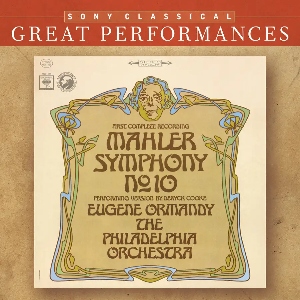
Gustav Mahler (1860-1911)
Symphony No. 10 (original performing version by Deryck Cooke)
Philadelphia Orchestra/Eugene Ormandy
rec. 1965, Town Hall, Philadelphia, USA
Sony Classical 82876 787422 [70]
I had not intended to re-visit any more recordings of Mahler’s Tenth Symphony, having recently reviewed versions by Vänskä, Chailly, Harding, López-Cobos, Sanderling, Barshai, Rattle, Levine and Wigglesworth, it seemed perverse to ignore this grandaddy of commercial issues, responsible for having introduced the world at large to this masterwork – although strictly speaking, that honour is accorded to the studio performance by the Philharmonia Orchestra conducted by Berthold Goldschmidt of the incomplete version, broadcast on the BBC Third Programme on 19 December 1960 following Deryck Cooke’s illustrated talk. The full-length version was recorded live on 13 August 1964 at the Proms. I refer you to my colleague John Quinn’s detailed and comprehensive 2016 review of the talk and both performances on the Testament label.
Regardless of its historical status, this recording has obvious aesthetic virtues. Those are covered fully in Tony Duggan’s survey and PCW’s review of 2006, so I will add but a few thoughts from the perspective of twenty years on. First, I am immediately struck by the power and beauty of the orchestral playing and the excellence of the sound; they do not sound in the least dated. I share TD’s view that Ormandy was a great – indeed, underrated – conductor, as he was at the helm of so may favourite recordings, especially of Strauss, Sibelius and Rachmaninov. Whether he was a great conductor of Mahler specifically is more debatable but this performance exudes a confident mastery over the flow and tension of the work. The outer movements are swifter than most and Ormandy does not quite “dig in” to their Angst and emotional depth as deeply as some more reflective, considered interpreters but that permits a momentum and directness which delivers the score without any fussiness. I have read suggestions that the “Scream” chord lacks the chilling intensity of some recordings but I do not find it so – and the coda is delicately, serenely played, with great purity of tone from the strings and harp.
The execution of the first scherzo is not as dour and menacing as some, or indeed as frantic; the opulence of the orchestral sound and Ormandy’s relaxed beat renders it more lilting and bucolic than some – in fact, I think it is the most cheerful and uplifting account I know. The “Purgatorio” is similarly rhythmically emphatic and rural – almost jolly. The second scherzo conforms to that pattern; some might find that there is too much highlighting of detail such as with the first xylophone intervention early on, but having just attended a superb live performance in Birmingham where I was seated not far from the percussionist, I can confirm that the ear picks it up very acutely amid the hubbub, so this recording is not necessarily so artificial. Again, this movement comes across as less menacing than in some subsequent accounts – which is not a criticism; Ormandy’s emphasis is more on a kind of Bacchanalian chaos – at least until its muttering, chuntering conclusion leading into the bass drum thwacks.
I am with TD when he opines, “I believe the more recent trend of getting the percussionist to hit his drum as hard as possible is quite mistaken.” Too many of the recordings I have recently revisited to review make that mistake. We know that Mahler was inspired to replicate what he had heard in the funeral procession beneath his hotel window of a New York fireman, killed in the line of duty, so something far and dim but huge, like distant thunder, is required, not a blow to knock the front row of the audience out of their seats. This gets it right. The playing is then sumptuous and not noticeably rushed. The primal chord is more shattering than in the first movement, then in the soloists in the second half – trumpet, clarinet, horn, in turn – are all ideally smooth, sonorous and flawless; among all those I have reviewed, I don’t think any other orchestra sounds better. The cascading chords and the key changes which make you catch your breath in the concluding minutes are exquisitely managed. Yes; subsequent recordings might be in more modern sound and do things…differently? – but not perhaps, better. This still deserves a place in every Mahlerian’s collection.
Ralph Moore
Other review: Patrick C Waller
Buying this recording via a link below generates revenue for MWI, which helps the site remain free














