
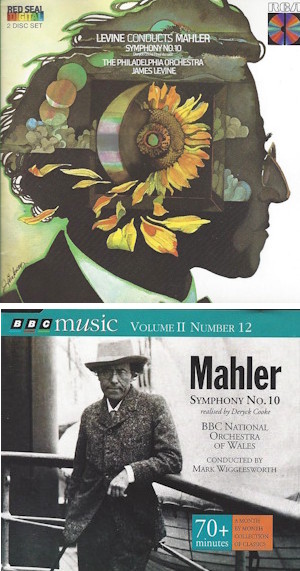
Gustav Mahler (1860-1811)
Symphony No. 10 in F Sharp (1910-11, third performing version by Deryck Cooke (1976/1989)
The Philadelphia Orchestra/James Levine
rec. 1978/80, Scottish Rite Cathedral, Philadelphia
RCA Red Seal RC 650 [2 CDs: 82]
BBC National Orchestra of Wales/Mark Wigglesworth
rec. live, 26 November 1993, Royal Concert Hall, Nottingham, UK
BBC Music Vol II No. 12 [74]
You know how it is: sometimes certain works take hold of you for a while. I have recently been going through “a Mahler 10 phase”, listening to the some slightly more obscure or neglected recordings of its reconstruction – or simply issues I had missed – prompted by the re-posting of two excellent “Déjà Review” responses to Daniel Harding’s account which I followed up with my own review of that. I have since moved on to two which are currently unavailable except in the used market (and therefore not normally the subject of a MWI review): James Levine’s recording in Philadelphia and Mark Wigglesworth’s first, live recording with the BBC National Orchestra of Wales.
Though he was an excellent Mahlerian who produced a sterling, almost complete, set of Mahler symphonies with the Philadelphia, Chicago Symphony and London Symphony orchestras, Levine’s Tenth has never been especially highly regarded; my colleague Mark Jordan writes that he is “is just ponderous [in the fourth movement]. The end of the movement is always tricky sonically. Levine’s recording sorts out the pitches of the various timpani and plucked bass notes by garishly spotlighting.” Likewise, a certain YouTube pundit dismisses it as a failure and you can find accusations that it is “emotionally neutral”, sluggish”, “episodic”, “too smooth”, “averse to risk-taking”, and so on.
I disagree; I think it’s great – but especially if you are of the Celibidache school which likes to hear a conductor take his time over the finale in particular – which here is some four or five minutes longer than most recordings. It goes without saying that the orchestral playing is beautiful – although I find the recording level rather low and have to crank it up a bit. There is tenderness and passion aplenty in the first movement, no lack of Angst in the searing (dis)chords, swing and slancio in the outbursts such as the almost joyous conclusion to the first Scherzo and the lilting waltz passages in the powerfully executed second, and a really nasty edginess to the Purgatorio. Contrary to some opinion, I think the finale is a great success, beginning with really baleful, thunderous hammer blows and a wistful, other-worldly flute solo. Of course, it is somewhat reminiscent of the mood of the ‘Abschied’ from Das Lied von der Erde; the extended violin romances are tenderly played, contrasting vividly with the returning drum thwacks, the passages of jagged turmoil, the screaming chord and the melancholy brass solos. For me, the daring slowness of the concluding lament, beginning at 16 minutes in, only intensifies its heart-breaking poignancy. If it’s a wallow, then I am a happy hippo. In my estimation, this matches and maintains the high standards of Levine’s partial survey of the Mahler symphonies issued in the aforementioned bargain RCA box set.
Mark Wigglesworth’s live performance has become something of a cult recording despite not being a commercial release and copies are still widely available. Dan Morgan compared it with the later studio recording he made with the Melbourne Symphony Orchestra (review), concluding that both have their strengths and weakness: “the earlier performance seems much earthier and more spontaneous, the later one tonally more refined and much wider in terms of emotional and dynamic range.” I have not heard that ABC recording but would observe that even if Wigglesworth is more released in Nottingham, he is nonetheless cooler, more analytical and objective there than more emotive exponents such as Rattle and Ormandy. He has a firm grasp of pacing and structure and the performance as a whole emerges as admirably detailed and controlled, but the famous nine-note chromatic chordal “Scream” is still really chilling and the bass drum strokes opening the finale likewise baleful. The Welsh orchestra hasn’t the sumptuous sound of the VPO or the Philadelphians but is more than adequate. In all honesty, I was expecting the bronchial intrusions by the audience here to be more irritating but I have heard worse and the sheer amplitude of Mahler’s/Cooke’s orchestration masks much of it except in a few of the quieter passages – unfortunately, especially during the soaring, arcing string passage in the sublime conclusion.
Ralph Moore
Availability
Not available new. While we don’t normally publish reviews of recordings that are only available second-hand, the Levine, in particular, has been referred to in several past reviews.













