
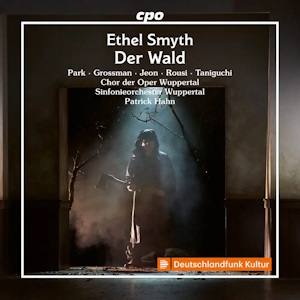
Dame Ethel Smyth (1858-1944)
Der Wald (1902)
Mariya Taniguchi (soprano) – Röschen
Edith Grossmann (mezzo-soprano) – Iolanthe
Samgmin Jeon (tenor) – Heinrich
Oper Wuppertal Chorus
SinfonieOrchester Wuppertal/Patrick Hahn
rec. 2024, Opera Wuppertal, Germany
Texts and translations only available (?) online
cpo 555650-2 [62]
Dame Ethel Smyth’s second opera had its premiere in 1902 at the Court Opera in Berlin. It was not regarded as a success at the time. Neither was it much welcomed when it made it to the Metropolitan the following year, where it only achieved a single performance in which it was strangely paired with Il Trovatore. It has rarely been seen or heard since. There was a previous recording of the work in an English translation which appeared on the market about a year ago. My colleague Jon Woolf did not find much to enjoy about it (review). John Quinn, in a more recent review of the same release, was only slightly more kind to the opera than Mr Woolf was. Now from cpo comes a recording of the opera in its original German text. Possibly this is the better way to hear this opera at home where the text will matter less to an English speaking audience.
The first thing one can say about Der Wald is that it is brief, lasting just over 60 minutes. The composer’s musical inspiration is often melodic and tuneful in a semi-Wagnerian way. This music reminds one of some of the compositions of Alexander Zemlinsky or Engelbert Humperdinck. Perhaps the main musical flaw is that the often attractive melodies never seem to develop into anything much. This mainly seems to be due to the insistence on brevity. Had the composer allowed herself more playing time, the opera might have evolved into something with even greater musical substance that it attains. Certainly the composer shows herself to be an expert in the art of orchestration in the manner of Humperdinck. Time and again the richness of the melodies in the orchestra drew my attention away from the voices.
The opera is most unusual for its time in that the story involves a romantic predatory female role, in this case a woman named Iolanthe. An opera this short really needs to be seen on a double bill with another work, perhaps an opera which shows the shoe on the other foot (so to speak) with a romantic male predator. Puccini’s early one act opera Le Villi would do the job splendidly. Jon Woolf related the musical shortcomings of Der Wald so I won’t reiterate them here. I don’t actually find the opera to be as worthless as he did in any case. Possibly that has to do with my hearing it in German also. One flaw that does strike me is that the opening and closing chorus of the forest spirits is just wrong. Their music is too close to the sound of the human world which the chorus explains to the audience it is so separate from. I think Leoš Janáček got this aspect so right in The Cunning Little Vixen with the eerie wordless chorus depicting the elements of nature so apart from the humans, and human-like animals of that opera. More of that sort of thing is needed in Der Wald to frame the central action.
cpo’s set comes with a remarkably consistent cast of principals who are contracted to the Wuppertal Opera. The two female leads are confidently sung by Edith Grossmann and Mariya Taniguchi respectively. Grossmann is a fine mezzo who copes beautifully with the very high-lying phrases of Iolanthe. There are times that Grossman sounds distinctly like a young Deborah Voigt to my ears. Taniguchi sings the more traditionally romantic heroine of Röschen. Her tone is both brighter and more penetrating. At times she almost approaches shrillness only to pull back before that happens. Both singers give satisfying portrayals.
Among the male singers Samgmin Jeon provides impressive steadiness and clarity to the woodcutter Heinrich. In this he is matched by Samueol Park’s seamless baritone in the role of Langrave Rudolf. This is a young baritone to keep one’s eye upon in future. Zachary Wilson and Erik Rousi also provide admirable support in smaller roles.
Patrick Hahn leads the Wuppertal Symphony with a steady guiding hand, finding many orchestral delicacies along the way. The musicians seem to be really entranced by his baton, showing possibly more care for this score than many listeners might think it deserves. The audio engineering courtesy of the Deutschlandfunk Kultur is of a very high standard. The opera house in Wuppertal, thankfully recovered from the massive floods of 2021, offers an ideal recording studio. The orchestra has been captured with warmth and reasonably spacious sound whereas the principal singers are presented in a closer, more intimate sonic stage perspective. The offstage effects are well-managed such as a few horn calls and some choral interjections. It all gives this recording a very real sense of theatrical presence.
The only black mark that I have to give this recording concerns the booklet, which doesn’t include the German text or translation of the opera. cpo provides a non-functioning weblink to an external commercial site. As I don’t use a smartphone, the QR code was useless to me and I was required to go searching the site for the CD listing in order to be able to locate the libretto (with full English translation). I am not able to tell if the QR code provided in the booklet works any better for smartphone users. This seems to be a recent policy change on the part of cpo and it makes their recordings a less attractive option to purchase I think. cpo does provide a booklet that has several articles about the opera in German and English.
Mike Parr
Buying this recording via the link below generates revenue for MWI, which helps the site remain free

Other cast
Zachary Wilson (baritone) – A Peddler
Samueol Park (baritone) – Count Rudolf
Erik Rousi (bass) – Peter
Mira ilina (soprano) – A Youth
Hak-Young Lee (baritone) – A Huntsman













