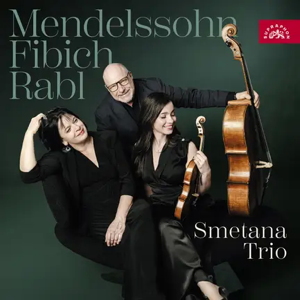
Felix Mendelssohn (1809-1847)
Piano Trio No. 2 in C minor, Op. 66 (1845)
Walter Rabl (1873-1940)
Fantasiestücke, Op. 2 (1896)
Zdeněk Fibich (1850-1900)
Piano Trio in F minor, H 174 (1872)
Smetana Trio
rec. 2026, St. Anne’s Church, České Budějovice, Czech Republic
Supraphon SU43832 [69]
The Smetana Trio – the ensemble, not the composition! – are a fine group, who over the years have built up a very impressive discography of core piano trio repertoire and interesting rarities. They are consistent in the quality of their collective, and in individual virtuosity and musicianship, if not the line-up of players. Pianist Jitka Čechová and cellist Jan Páleniček have been ever-presents but there seems to have been something of a revolving door for violinists; Markéta Janoušková is the latest incumbent. Successful and long-lived ensembles usually have relatively stable membership, so this seems unusual but, on the evidence of this new disc, the fine qualities endure.
Indeed, this programme embodies the umbrella values of all of the trio’s performances I have heard: a core repertoire work by an established ‘great’ composer, a Czech trio by a less famous one, and a relative unknown. I am not quite sure what binds together the three works here, except for an attractive Romantic sensibility. This also is an appealing but not demanding listen.
Mendelssohn’s Piano Trio No.2, which opens the programme, is the undisputed masterpiece here. To place it first risks leaving the other two pieces to play a kind of creative catch-up. Whenever I return to Mendelssohn’s chamber music, I find a life-affirming and uplifting quality that never fails to impress and move me. Mendelssohn was never an angst-ridden high Romantic. Allied to his compositional fluency and his gift for simple but attractive melodies, his music is often marginalised as somehow emotionally shallow and even glib. But this trio shows his genius in full flow. The four movements are perfectly constructed. Immediately attractive musical material is beautifully crafted and instantly memorable.
Mendelssohn makes considerable demands on all the players. This music requires a technical clarity and precision that is almost Mozartian yet at a far higher level of virtuosic execution. All three instruments need to play with total control and poise, yet with expressive intensity too. In the opening Allegro energico e con fuoco,this spotlight falls especially on the pianist. Jitka Čechová is a fine player, with a perfect balance between dynamism and lucidity. I did wonder if the Supraphon recording slightly favours the keyboard, with the cello seemingly backward in the overall mix. Jan Páleniček is another naturally dynamic player but his role does not register here as much as I would expect.
The second-movement Andante espressivo is – as the liner notes suggest – one of those “songs without words”, a kind of melodic flowering that Mendelssohn made very much his own. Critics may find this style of writing somehow superficial and obvious, but I love the simplicity and directness of the music – especially for the unaffected elegance and beauty as it is played here. This is a perfect example of music that has sentiment without being sentimental.
The third-movement Molto allegro quasi presto is one of those miraculous Mendelssohn scherzi: playful, gossamer-fine and a joy to hear. The work is formally well balanced – a perfect embodiment of the archetypal sonata form – while the performance here is wonderfully energetic and bustling. The playing is fractionally more muscular than some I have heard but with exactly the required rapier-like precision. Indeed, this combination of qualities characterises the entire performance. To my ear, it embodies more the perfect balance of robust early Romanticism than a too-neatly polite post-Classicism. Clearly, such a genuine masterpiece means that the catalogue offers multiple impressive and compelling versions. Suffice to say, I enjoyed this new version as much as any.
The real curiosity in this collection are Walter Rabl’s eight brief Fantasiestücke Op.2. They date from a full half century after Mendelssohn’s piece, but in all honesty they inhabit a very similar emotional landscape. Add Rabl’s name to the list of composers I had never heard of either in person or in terms of music. Fortunately, IMSLP – that repository for many a lost and neglected composer – has the music immediately available for perusal. The eight pieces were published in two volumes, Nos.1-5 and then Nos.6-8, but marked as “comprising one unified whole”.
Rabl, born in Vienna, had a Bohemian mother. He studied music in Salzburg, then in Vienna and then at the German University in Prague. When he was in his early twenties, some of his compositions gained attention, but his career in music was defined by work as an opera house repetiteur and then conductor. His career in America after 1929 led him to be considered an important Wagner interpreter. His Op.1, a quartet for piano, violin, clarinet and cello, won a prize from a panel chaired by Brahms. In the Fantasiestücke, there is a fairly clear, even undigested, homage to the senior composer. They also look further back to Mendelssohn and Schumann. As a conductor, Rabl championed scores by Gustav Mahler, Karl Goldmark, Franz Schreker, Erich Korngold and Richard Strauss. As a composer, he wrote very conservative stuff – but attractive and eminently listenable, especially in as convincing and committed performances as here.
The eye following the IMSLP score confirms what the ear initially suggests. These essentially straightforward pieces cover a range of moods from lyrical to dramatic using pretty standard harmony, melodic shapes and musical gestures. There is a certain comfort of familiarity even at a first listen. Interestingly, “book 1” comprises five briefer works – none longer than 2:49 – while the three pieces of “book 2” range from 3:34 of No.7 Largo to 4:57 for the closing Allegro vivace con brio.
This is music that teeters on the edge of salon sentimentality. Yet when you hear it played with the complete sincere conviction as here – the No.7 Largo is a perfect case in point – it is very hard not to take pleasure in music that is unpretentiously attractive and appealing. The closing extended movement rounds off the work with a flourish that shows Rabl as a competent craftsman. There is much to enjoy as long as the music is accepted for what it is: direct and effective but without trying to storm any great emotional mountains.
Unsurprisingly, I see that cpo have produced a disc which places this work alongside Rabl’s Op.1 quartet and a slightly later violin sonata; I have not heard that collection. There is enough to enjoy here that I am curious to hear those other works. IMSLP also has the score of Symphony Op.8. I wonder, however, if that is a genre too far for this modest composer.
Zdeněk Fibich’s fame lives firmly in the shadow of Dvořák and Smetana. The former especially, whose dates are similar, was the far greater composer. Yet, whenever Fibich’s music is considered in isolation – as here in the Piano Trio in F minor– it emerges as genuinely attractive and effective. This is the most compact work of the three, just 16:38 across its three movements. As the liner notes rightly say, Schumann is a clear influence. This is the first of Fibich’s two piano trios but apparently the second is lost. IMSLP once again offer the curious listener the chance to follow the score.
The Smetana Trio compete with themselves and their 2007 recording. Jana Vonášková-Nováková was the excellent violinist; she seems to have been the longest-serving violinist in the trio as far as I can tell. Timings across all three movements are a fraction broader in the new performance but in essence this is a very similar interpretation. The older recording is not quite as full – with the piano is set a fraction further back – but it really is nip and tuck. The older performance coupled Fibich’s work with trios by Antonín Dvořák and Bohuslav Martinů, again in impressive performances.
Given the appeal and compact scale of the work, again it is no surprise that the catalogue offers several alternatives by ensembles of differing nationalities, none of whom I know except for the earlier Smetana iteration. But it strikes me that Fibich’s greatest strength as a composer lies with his chamber and smaller-scale works. Whatever the appeal of his symphonic or stage compositions, they do not achieve the mastery in those forms of his famous Czech contemporaries. This is a work well-worth hearing, especially – again – in a performance as committed and convincing as on this disc.
Here is, perhaps, the unifying theme across the three works: these compositions celebrate a kind of unforced, trauma-free Romanticism where clean textures and warm lyricism are paramount. This makes for a wholly enjoyable programme, performed to the usual exalted musical and technical levels by the consistently impressive Smetana Trio.
Nick Barnard
Previous review: David Barker
Buying this recording via the link below generates revenue for MWI, which helps the site remain free