
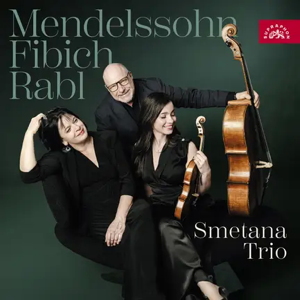
Felix Mendelssohn (1809-1847)
Piano Trio No. 2 in C minor, Op. 66 (1845)
Walter Rabl (1873-1940)
Fantasiestücke, Op. 2 (1896)
Zdeněk Fibich (1850-1900)
Piano Trio in F minor, H 174 (1872)
Smetana Trio
rec. 2026, St. Anne’s Church, České Budějovice, Czech Republic
Supraphon SU43832 [69]
The Smetana Trio was founded in 1934, and you don’t need me to tell you that it is like that old shovel, still going strong after 92 years, but with a new handle and new blade. Its heartland is central Europe in the 19th century, and this programme comprises three works from there: one repertoire staple, one with a number of recordings but not widely known, and one real rarity.
Mendelssohn’s second trio, written two years before his death, is, despite its many recordings, a slightly under-appreciated work, indeed something that might be said of much of his chamber music. It has a depth of emotion that one does not always associate with him, as well as the characteristic overflowing of beautiful melodies and infectious rhythms. You will have your favourite recordings, mine is the Sitkovetsky Trio (BIS – review). The Smetana Trio provide a very good reading here, but where the Sitkovetskys are intense and dazzling, the Smetanas are more relaxed. At 29:55, theirs is one of the slowest in my collection, only exceeded by the underwhelming Pentatone recording by Julia Fischer and partners.
Vienna-born Walter Rabl was a new name to my collection. He was best known as a conductor, and stopped composing at the age of thirty. There is one other recording of his Fantasiestücke, that from a decade ago on cpo (review). My colleague described the music as “comfortable, assured … conservative” and those adjectives are most apposite. He also concluded that Rabl ceasing to compose at that young age might have been a matter of knowing his limitations. I feel that is being rather unkind, as these eight pieces are very enjoyable miniatures, none longer than five minutes, with plenty of variety, ranging from deeply melancholic to delightfully playful.
Given that the Fibich Trio has three other versions on the Supraphon label alone, it is probably a stretch to call it a rarity, but I suspect that not many of you will recall listening to it recently (unless you happen to live in the Czech Republic). Among those competing versions is one by the Smetana Trio itself, from 2007 and coupled with Dvořák 1 and Martinů 2. At that point in its long history, the Smetana Trio comprised the same pianist Jitka Čechová and cellist Jan Páleníček as it does today; current violinist Markéta Janoušková joined in 2024. In my Piano Trio survey of “F” composers, I commented that the Fibich Trio was “a charming, unpretentious work that certainly has as good a claim on being in your collection as do the first two Dvořák trios”. That remains a fairly good description; at any moment in its sixteen minute duration, you will find enjoyable melodies, energy and warmth, but I don’t think you will be humming any of those melodies an hour later. I compared the two Smetana Trio versions, and the most obvious difference is that the 2007 one is around a minute quicker, and while it is a relatively small decrease in tempo in this new recording, I don’t think it is to the work’s advantage.
The togetherness of the playing of the Smetana Trio is superb, and these are certainly good performances, though they might luxuriate a little too much in places for my liking. Often I grumble about wiry, harsh violin timbres, but that is not so here. The sound quality is excellent, plenty of detail but no extraneous noises, while the notes are better for historical than musicological information.
If you don’t own either the Fibich or the Rabl, this new recording is definitely worth a listen, and while the Mendelssohn probably won’t replace your favourites, it is still a very good one.
David Barker
Buying this recording via the link below generates revenue for MWI, which helps the site remain free













