
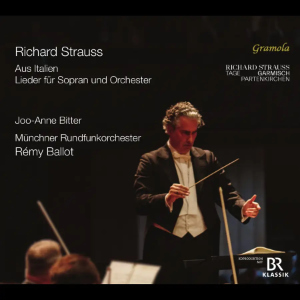
Richard Strauss (1864-1949)
Aus Italien – Symphonic Fantasy Op.16 (1886)
Ich liebe Dich Op.37 No.2
Mein Auge Op.37 No.4
Meinem Kinde Op.37 No.3
Winterweihe Op.48 No.4
Morgen! Op.27 No.4
Joo-Anne Bitter (soprano)
Münchner Rundfunkorchester/Rémy Ballot
rec. 2025, Studio 1, Bayerischer Rundfunk, Munich, Germany
Gramola 99368 [61]
I have something of a fixation with Richard Strauss’s Aus Italien. For all its youthful flaws and occasional misjudgements – look no farther than the ‘folksong’ finale – I love great swathes of this joyful, heartfelt score. One can legitimately argue that his tone poems teetered on the edge of artistic pretension. Should you really try to embody everything from Nietzsche, your own life and career, death (and transfiguration) or the life of man expressed as a mountain?! Many would say an emphatic “no”. Yet in this 45-minute score Strauss is at his least pretentious and most pictorial. In painting those pictures in sound of Italian countryside or the beach at Sorrento or the history of Rome embodied in its ruins, he can exploit his undoubted skills in melody, orchestration and warmly Romantic harmony.
This is the fourth time I have reviewed a recording of this work for MusicWeb – see Poschner on cpo, Weigle on Oehms and Roth on Hanssler. (I also reviewed a box that included the piano four-hands version.) I refer to those reviews simply because my comparisons with the famous older performances – Kempe, Järvi, Luisi, Kraus – are still valid. Note, too, the great Strauss conductors who chose not to record the work commercially, Reiner, Karajan, Szell amongst others.
Interestingly, this performance by Rémy Ballot and the Münchner Rundfunkorchester and three recordings I reviewed share certain characteristics, which set them certainly in a stylistic group if not completely apart. The orchestral playing is very fine, technically polished and sensitive. Interpretations are clean and unfussy, sensitive but in no way indulgent. There is a kind of objectivity which avoids excesses in the work but reduces some of the emotional effect. Revisiting my reviews, I find it striking that over more than a decade I consistently find Kempe’s classical EMI/Warner/Dresden account the most satisfying.
Kempe was a great opera conductor, and Strauss was a great writer for the voice. I feel increasingly that the handling of Strauss’s melodic lines, even in his orchestral works, benefits greatly from a kind of vocal pliability. Not only does this nuanced rubato bring about flexibility to the sometimes fairly square melodic lines; it also gives an emotional charge where otherwise there might be ‘just’ a beautiful melody. The great unfolding ‘dawn’ melody of the opening Auf der Campagna is a perfect example. Rémy Ballot is dignified, noble even, but relatively straight in the presentation of one of Strauss’s most affecting tunes. In its own right, this is a perfectly valid, indeed attractive presentation of this passage but in greater hands it is lifted to greatness.
There is another notable factor in putting Kempe against many newer versions. His timings are consistently quicker across movements than seems to be the modern trend. In no sense does this result in a sense of haste, but rather in flow. Rémy Ballot’s steady tempo for In Roms Ruinen suggests a rather pleasant dance in a salon rather than invoking the might of the Roman legions. There is a distinct lack of urgency or tension in the music that is not simply a factor of tempo. This is a perfect example of a technically admirable performance – well played and in total control – that simply fails to evoke the intended atmosphere by being too well mannered; this is a dull performance of this movement. For modern conductors, it seems that quite often the detailed filigree of the orchestration in the third movement Am Strande von Sorrent gives the engineers and the fine players a chance to shine. That is true here but this is again a rather literal reading of some achingly beautiful melodies by Strauss – I am thinking of the paired clarinets around 3:30; that reduces the emotional effect of the passage. There are other sections where I wondered at the string strength of the orchestra. They play perfectly well, indeed very well, but at no point do they produce the weight of collective tone that the finest German orchestras do. This is, I am guessing, in part down to the number of players in each section.
The Funiculi, funicula finale is a challenge for any conductor. The main tune is genuinely banal, and the young Strauss had to try too hard to reprise material from the earlier movements in an effort to give the work coherent symphonic form. One solution is just to blast through the music in ‘orchestral showcase’ mode. This was something Järvi was adept at doing, and it certainly works there. In fairness, though, this is the one movement where Ballot is much the same as the others by stopwatch alone. The result sounds neat and tidy, and the Munich strings acquit themselves very well in the far-from-easy passagework, but the result is not rousing. Since I last reviewed this work, I have picked up Riccardo Muti’s version with the Berlin Philharmoniker, predictably impressive. In this finale, he shows (at some forty seconds quicker, quite a margin in a nine-minute movement) how to make the music sound more impressive than it probably is. Ashkenazy in Cleveland – another more recent acquisition – is faster still; although by no means my favourite performance, it is simply more exciting here than the good-mannered Ballot.
Back in the days of LP, Aus Italien would rather ungenerously fill the disc alone. Now it is partnered by any number and types of work. Rémy Ballot chooses five songs for soprano and orchestra, much as Järvi did (each tone poem was accompanied by songs sung by the great Felicity Lott). Ballot’s soprano is Joo-Anne Bitter. According to the biography in the notes and her website, she is a specialist in the earlier Wagner roles while she is now “increasingly dedicating herself to the repertoire of Richard Strauss”. Interestingly, Lott sang two of the five songs here: Mein Auge and Winterweihe. In direct comparison of these two, Lott takes the lighter, more fluent. even lyrical approach, and the Chandos recording warmly envelops her voice in a comfort blanket of orchestral richness. Bitter has a weightier tone, capable, you can imagine, of riding the waves of a Wagnerian orchestra. With the exception of the drama of Ich liebe Dich, the songs here have lighter, more translucent scoring, but she makes a powerful impression in that first song.
The set is completed by Morgen!, one of Strauss’s most famous solo songs with orchestra after the Vier Letzte Lieder. It appears in just about every collection of the orchestral songs given by famous sopranos. Bitter is very good and the Munich orchestra accompany sensitively. Yet compared to artists such as Jessye Norman with Kurt Masur and the Gewandhaus or Renée Fleming with Jeffrey Tate and the ECO – whatever one might individually prefer in terms of vocal allure – it is hard not to feel that both sopranos invest the song with a greater personal engagement. Felicity Lott sang Morgen! as one of the couplings to Järvi’s Alpine Symphony.Again I find her lyrical artless poise deeply moving. She included it as one of the six songs coupled with Armin Jorndan’s Don Quixote and the L’Orchestre de la Suisse Romande – another performance full of poise and tenderness. By that measure, Joo-Anne Bitter is a little heavy-handed. (Not that these songs are rare in the recorded catalogue, but it is disappointing that the Gramola booklet does not include texts or – as far as I could see – links to online sources.)
This disc is Ballot’s second collection released under the auspices of the Richard Strauss Tage – Garmisch-Partenkirchen – although the first was not well received by RMo (review). Recording location and dates suggest a studio recording, perhaps linked to live performances as part of that festival. Any audience member would be delighted to hear Aus Italien – very rare in the concert hall – in a caring and well-played performance such as this one. I can also imagine that Bitter is a striking presence on stage. For the domestic listener, however, who can pick and choose the finest performances that most closely align with their own personal tastes, this disc remains good but not great.
Nick Barnard
Buying this recording via the link below generates revenue for MWI, which helps the site remain free













