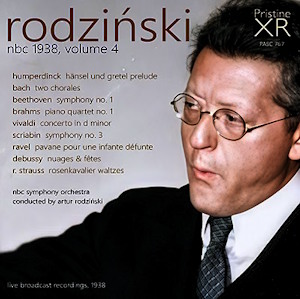
Artur Rodziński (conductor)
NBC 1938 Volume 4
NBC Symphony Orchestra
rec. live, December 1938
Pristine Audio PASC767 [2 CDs: 149]
I’d always associated the New York end of Artur Rodziński’s career with the Philharmonic – or, as it was then, the Philharmonic-Symphony – where he served as Music Director, and, once, reportedly brought a holstered pistol to rehearsal. But RCA also chose him to take the hand-picked NBC Symphony on its “test run” before Toscanini’s arrival in late 1937, and he would make further guest appearances the following season. Here, Pristine Audio has unearthed his final two programmes, on Christmas Eve and New Year’s Eve 1938.
The Christmas Eve program, on the first disc, is the more successful. The Hänsel prelude, after a slightly arthritic horn entry, offers a fervent children’s prayer, a fleet “witch’s ride,” and a crisp, hearty dance. Respighi’s orchestrations of the two chorale preludes are solemn and dignified; the second, the familiar Wachet auf, perhaps restrains the tune excessively.
Rodziński brings his distinctive stamp to Beethoven’s First Symphony, which was, of course, mainstream Toscanini repertoire. It begins with refined, well-balanced chords, transparent in a way that wasn’t part of Toscanini’s “matrix.” The Allegretto moves with dignity and weight, and there’s just enough drive to move the Scherzo., with a more relaxed Trio. In odd spots in the faster movements, the music loses momentum in an un-Toscaninian way.
At the start of the Brahms quintet transcription, the clean woodwinds and warm, expansive strings don’t constitute a standard NBC sound, either. The string interjections later on are incisive, and the development more emotionally ambivalent than would have been Toscanini’s wont. The quietly edgy, agitated scherzo, with its bouncy, pastoral Trio – yes, you read that right – goes well, with a charming finish, though earlier on the horns’ high line strains. In the flowing, occasionally brisk Andante, there seems insufficient space really to feel the harmonic and textural shifts. The Finale, however, with crisp Zigeunische accents, wraps it all up convincingly.
The concert a week later, on New Year’s comes off less well, for several reasons. For one thing, the sound quality is less impressive, more granulose in tutti; in the Scriabin symphony, which really needs stereo, the NBC engineers seem to have limited and compressed the dynamic range. Then, ensemble seems more tentative – understandably, in the relatively unfamiliar Scriabin, but Ravel’s Pavane turns uncoordinated in spots, and Rodziński has trouble getting the players to relax sufficiently for the recap.
No complaints at all, however, about the Vivaldi string concerto that opens the program, though I’m unclear about the need for a Siloti arrangement. There’s nothing “Romantic” about it, as the album notes imply, unless it’s the full-sized string body, which produces a lovely transparent sonority. The Scriabin begins effectively, with incisive bassi; the first subject suggests the right questioning fluidity without quite achieving it, but the second has a nice affirmation, and the development is buoyant. In the central Volupté movement, the low flute solo and long woodwind theme are characteristic, but Rodziński’s tempo is perhaps too rigid for the bird effects later on. The finale’s vaulting opulence, however, is effective.
In contrast with the somewhat nervous Ravel, two of Debussy’s Nocturnes work nicely – it was the custom then to play just the orchestra-only pieces, omitting the Sirènes with its wordless female chorus. The flowing Nuages conjures a nice mystery; in the bright, alert Fêtes, the conductor maintains the established tempo through the brass “procession,” a detail that other maestri regularly fumble.
The First Sequence of Waltzes from Der Rosenkavalier isn’t quite the suite I know, though it does include most of the usual music. It goes with a winning zest and élan.
A couple of single-beat drop-outs in Wachet auf and the Beethoven symphony don’t crop up anywhere else – none at all on New Year’s Eve. Two of Gene Hamilton’s radio announcements – before the first concert, after the second – are as clear as any modern broadcast, but, for timing, they’ve been reduced to a line each.
Stephen Francis Vasta
stevedisque.wordpress.com/blog
Contents
Engelbert Humperdinck (1854-1921)
Hänsel und Gretel: Prelude (1893)
Johann Sebastian Bach (1685-1750)
Two chorales from the Orgelbuchlein (1713-17, arr. Respighi 1930)
Ludwig van Beethoven (1770-1827)
Symphony No. 1 in C, Op. 21 (1799-1800)
Johannes Brahms (1833-1897)
Piano Quartet No. 1 in G minor, Op. 25 (1859-61, orch. Schoenberg 1937)
Antonio Vivaldi (1678-1741)
Concerto Op. 3, No. 11 (1712, arr. Siloti)
Alexander Scriabin (1872-1915)
Symphony No. 3 in C minor, Op. 43 (The Divine Poem) (1902-4)
Maurice Ravel (1875-1937)
Pavane pour une infante défunte (1899, orch. 1910)
Claude Debussy (1862-1918)
Two Nocturnes (1897-9)
Richard Strauss (1864-1949)
Der Rosenkavalier: First Waltz Sequence (1909-10)