
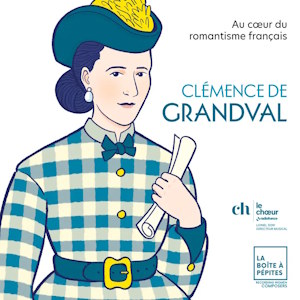
Clémence de Grandval (1828-1907)
Au cœur du romantisme français
rec. 2024-2026, Maison de l’Orchestre national d’Île-de-France; l’Auditorium de la Maison de la Radio et de la Musique, Paris, France
Reviewed as lossless download
La Boîte à Pépites BAP13-16 [277]
The Chamber Music
The La Boîte à Pépites label concentrates on French women composers, generally little known, from the late 19th and early 20th centuries, and in its relatively short lifetime – its first release was in 2022 – the label has already established a reputation for excellence, both in performances and production values.
Now it turns its attention to Clémence de Grandval, a name new to me, but Presto lists more than a dozen releases that include her music. When I looked at the works list, the chamber works appealed greatly, but I knew I had neither the expertise or interest to be able to review the 21 songs properly. Kindly, my colleague John Quinn agreed to divide the labour; he would do the vocal works in one review (published yesterday) and I would cover just the chamber music. In his review, he has written about the life of Clémence de Grandval, so I will direct you there, rather than duplicate his work.
The chamber music presented here comprises a dozen works, across nine different combinations of instruments. The booklet notes, a phrase that is scarcely adequate to describe them, don’t claim that this is her complete output of chamber music, and certainly the absence of a “Première Grand Trio” to accompany the Deuxième would tend to confirm that. The notes do describe the difficulty in assembling manuscripts of her music, so it may be that this is all that is currently available.
The dated works range from the 1850s to just into the new century, so unsurprisingly, her musical style is firmly in the world of Saint-Saëns, Schumann and Brahms. Sadly, despite the reputation she gathered during her lifetime, I struggled to find a single work of the twelve that I enjoyed throughout.
Let me take the Romance et Gavotte for oboe, cello and piano as an example. The Romance begins wistfully, and with a lovely melody passed between the three instruments. Suddenly, in the middle of the four minutes, there is a sudden outburst with each of the instruments playing as loud as possible (it seems). The oboe and cello are, of course, swamped by the piano, which sounds like the pianist is jumping up and down on the keyboard. Perhaps it is supposed to depict passion, but it felt more like a fight. Afterwards, the music returns to the calm of the opening. The Gavotte begins as though a funeral march is about to take place, but after four heavy, ominous notes from the piano, there is an abrupt change to the tripping rhythm one would expect from such a title. The other instruments join in and it is all lightness and jollity. Were those first four notes supposed to be humorous? The booklet notes would seem to think so, but it just seemed silly.
The Suite for flute and piano, written for the great flautist Paul Taffanel, is not a piece I would normally seek out, but for much of the time, was quite lovely – flautist Mathilde Calderini is very impressive – but again here, the piano becomes briefly but annoyingly intrusive in each of the five movements.
The Trio de Salon, for oboe, bassoon and piano, is perhaps the only work which I managed to get through without gritting my teeth at some point. Putting “salon “ in its title does rather sell it short. Yes, it’s not the deepest work, but it has some lovely melodies, and it does not start with a huge crash on the piano.
It will come as no great surprise that the Valse mélancolique, for flute and harp, did not suffer from the same problems as elsewhere, given the nature of the two instruments. It has a touch of Impressionism, but is mainly a gentle meander for its four minutes.
There is a rare outing in chamber music for the cor anglais in the Quatre Pièces,and there are some enjoyable moments, not least in the Andante espressivo, where the piano restrains “itself”, and maintains a balance between the instruments. The cor anglais is miked a little closely, as the clicking of the keys is quite evident at times.
The Deuxième Grand Trio is definitely grand, clocking in at over thirty minutes, and has all the hallmarks of a big Romantic trio. However, the same problem found elsewhere rear its ugly head again, exacerbated by a very wiry violin timbre, in the first two movements particularly. The Minuetto is another movement that begins in an absurd, overly dramatic way, totally unrepresentative of the rest of the movement. This time the piano’s “funeral march” is accompanied by a bagpipe-like drone from the strings. Once the silliness is out of the road, the rest is quite lovely, and here the violin timbre is much warmer. The final movement goes back to all the bad elements, and I don’t think I’m exaggerating in feeling that it almost seemed like a caricature of what a Romantic piano trio finale should be.
The rather galumphing, heavy-handed and clangorous piano seems to be a common thread in her writing, spoiling some potentially attractive pieces. It is particularly obvious at the very start of a movement, even if what immediately follows is gentle – it’s as though she felt the need to get the audience’s attention. Given that the workload is spread across four different pianists, it would seem that the fault lies at Grandval’s door more than the performers. The recording studio acoustic, which was very dry, didn’t help. Cellist Héloïse Luzzati is the only performer to feature here as well as in the Rita Strohl release I had in my Records of the Year in 2025. She contributes the biographical essays to the extraordinarily good booklet notes, and I’ve just learned that she is the founder of the label. I’m not convinced that the performances in general here are as good as in the Strohl recording, and I feel that the pianists should have looked at the scores and said “we need to scale these crescendos down”.
John Quinn quite liked Grandval’s songs and the Stabat Mater, without being totally enraptured, but I’ve listened to this across a week without my opinion changing. Yes, there is plenty that is enjoyable, but just as much really rubbed me the wrong way, but it may be that I’m in a minority of one. That’s the great thing about this age of streaming: you can check for yourself, but please don’t listen to just a 30 second sample because that can be misleading, as I have found.
David Barker
Buying this recording via the link below generates revenue for MWI, which helps the site remain free

Contents
Chamber
Andante et Intermezzo (1889)
Sébastien Surel (violin), Héloïse Luzzati (cello), Théo Fouchenneret (piano)
Romance et Gavotte (1884)
Alexandre Gattet (oboe), Héloïse Luzzati (cello), Théo Fouchenneret (piano)
Deux Pièces (1885)
Raphaël Sévère (clarinet), Jean-Frédéric Neuburger (piano)
Trio de salon
Alexandre Gattet (oboe), Julien Hardy (bassoon),Théo Fouchenneret (piano)
Suite (1876)
Mathilde Calderini (flute), Guillaume Bellom (piano)
Valse mélancolique (1891)
Mathilde Calderini (flute), Constance Luzzati (harp)
Lamento et Scherzo (1877)
Alexandre Gattet (oboe), Théo Fouchenneret (piano)
Quatre Pièces (1885)
Alexandre Gattet (cor anglais), Théo Fouchenneret (piano)
Sonate op. 8 (1851)
Deux Pièces (1882)
Raphaëlle Moreau (violin), David Kadouch (piano)
Trois Pièces pour violoncelle et piano (1883)
Héloïse Luzzati (cello), Théo Fouchenneret (piano)
Deuxième Grand Trio pour violon, violoncelle et piano (1853)
Trio Zeliha
Vocal
Chanson d’autrefois [Guillaume Costeley] (1890)
La Source [Anna Maria Lenngren, trad. Xavier Marmier] (1851)
Pensée d’amour
Menuet [Fernand Gregh] (1901)
Hébé, scène lyrique [Paul Collin] (1892)
Camille Chopin (soprano), Célia Oneto Bensaid (piano)
Villanelle [Jean Passerat] (1877)
Fiona McGown (mezzo-soprano), Raphaëlle Moreau (violin), David Kadouch (piano)
Au bord de l’eau [Sully Prudhomme] (1884)
À l’hirondelle [Sully Prudhomme] (1884)
Le Vase brisé [Sully Prudhomme] (1884)
La Chute des étoiles [Charles Marie Leconte de Lisle]
Fiona McGown (mezzo-soprano), David Kadouch (piano)
Sacrifice [Sully Prudhomme] (1885)
Le Galop [Sully Prudhomme] (1884)
La Délaissée [Jean Du Boys] (1867)
Chanson laponne [Armand Silvestre] (1893)
Soupir [Sully Prudhomme] (1884)
Scrupule [Sully Prudhomme]
Prière [Sully Prudhomme] (1884)
Les Trois Oiseaux [François Coppée]
En Automne [François Coppée]
Les Lucioles [Ernest-Wilfrid Legouvé] (1866)
Chanson d’exil [François Coppée]
Coline Dutilleul (mezzo-soprano), Flore Merlin (piano)
Stabat Mater (1870) Chœur de Radio France/Lionel Sow
Gabrielle Philiponet (soprano), Aude Extrémo (contralto), Julien Henric (tenor), Nikolay Borchev (baritone)
Anne Le Bozec (piano)
Sarah Kim (harmonium)













