
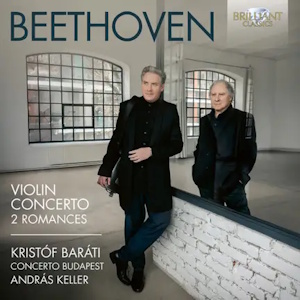
Ludwig van Beethoven (1770-1827)
Violin Concerto in D op. 61
Romance in G Op. 40 (1800-01)
Romance in F Op. 50 (1798)
Kristóf Baráti (violin)
Concerto Budapest/András Keller
rec. 2023, Phoenix Studio, Diósd, Hungary
Brilliant Classics 97750 [60]
I have so many favourite recordings of this work, from vintage versions by Milstein with Steinberg in mono and Francescatti with Walter in stereo, to two conducted by Karajan with Mutter and Ferras to the more recent recording by Thomas Gould in Riga (review). Thus, as ever, a new issue of a standard classic is up against it and I trot out the tired question, “Do we need another one?”
Tempi here are middle-of-the-road: not as driven as Milstein’s but less leisurely in the first two movements than both Karajan’s recordings, although the finale is surprisingly slow at eleven minutes when around ten minutes is more the norm. The sound is superb: spacious, airy and slightly reverberant, lending a heroic manner; at the risk of stating the obvious, it really makes both the Steinberg and Walter recordings sound antiquated and certainly outperforms the two Karajan recordings, too, even the digital ones with the young Mutter and the live Gould performance, which is fine but not as detailed or atmospheric. That recording employs the cadenzas Beethoven wrote for his piano version of the concerto, transcribed for violin; here, Baráti uses the standard and more familiar Kreisler cadenzas, flawlessly delivered with great élan. As such, the two modern recordings by Gould and this by Baráti are sufficiently different to merit inclusion in anyone’s collection as complementary – assuming of course, that their artistic standard is comparable.
Which it is. The orchestral playing is quite lean and clean, sparing of vibrato but never thin of tone and it matches Baráti’s interpretative approach, which, to quote the label’s own website “is marked by clarity of line, purity of tone, and a sense of respectful freedom. In the Allegro ma non troppo he finds an elegant balance between classical poise and Romantic impetus; in the Larghetto he offers a deeply lyrical calm; and in the Rondo he embraces spirited vitality without ever sacrificing musical integrity.” The symphonic quality of the music is underlined by the sense of the orchestra and soloist being equal partners, there is no reliance upon “star quality” or showmanship but instead unfailingly mutually attentive musical execution. The central Larghetto is poised and the clarinet, oboe and, in particular, bassoon, acquit themselves nobly. The segue into the rondo finale is seamless and the transition of mood from serenity to stomping dance and double-stopped exuberance deftly managed; despite my noting above that Baráti and Keller take this movement somewhat more slowly than usual, there is nothing sluggish about it; rather, it is slightly weightier but the dexterity of the cadenza provides a counteractive brilliance.
The two Romances are the makeweight habitually encountered on recordings of the concerto and they are always welcome, being so melodic and engaging. Again, the long passages of double-stopping in the G major are lovely and Baráti’s tone luscious, generously supplemented by Keller’s considerate accompanied. The notes speculate about the possibility of these having originally been conceived as slow movements of larger works and indeed when they are played so feelingly one can imagine that being the case, as their melodies match the profundity and lyricism of the slow movement of the concerto.
The author of the full, informative notes is not credited but they are indeed apt and helpful. So I would answer my opening question with an affirmative; I am as likely to turn to this recording as any when I want to hear a fine modern account in perfect digital sound.
Ralph Moore
Buying this recording via the link below generates revenue for MWI, which helps the site remain free













