
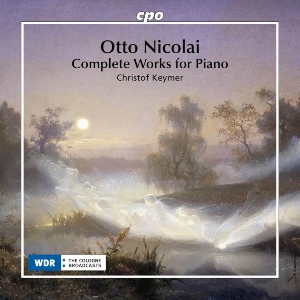
Otto Nicolai (1810-1849)
Complete Works for Piano
Christof Keymer (piano)
rec. 2024, Klaus-von-Bismarck-Saal, WDR Köln, Cologne, Germany
cpo 5557802 [2 CDs: 120]
Otto Nicolai may be remembered almost exclusively for his opera The Merry Wives of Windsor,especially the overture, though it is only one of six operas he completed. There is also church music, some songs, a handful of orchestral pieces and the piano music on these discs. His was not a vast output. Many pieces remain in manuscript or were not published until more than a century after his death, and that cannot have helped his wider appeal.
Nicolai, born in what was then Prussia, was taught piano by his father. He fled his overbearing parent when he was 16, eventually reaching Berlin where he studied with Ludwig Berger. He also benefitted from the mentorship of Carl Friedrich Zelter, a composer of Lieder who maintained a thirty-year correspondence with Goethe. In 1834, Nicolai was employed as an organist in Rome and began to admire and adopt the qualities of Italian opera. His first five operas, in Italian, were performed to acclaim in several cities around the country. In the 1840s, he achieved success in Vienna. It was there in the mid-1840s that he wrote The Merry Wives of Windsor, his only opera originally in German. He returned to Berlin in 1849, but died of a stroke there just two months after the city had seen the opera’s premiere.
Much of Nicolai’s piano music is undated. The earliest would appear to be the Sonata in E flat. Its two movements are very classical in style, echoing Mozart in particular, and they do not yet seem to reflect any individual voice of Nicolai. Its inclusion is welcome in the sense of completeness and for the second movement, a charming rondo. The later four-movement Sonata in D minor is much more substantial. From its insistent repeated-note opening motif to its moto perpetuo finale, it is passionately romantic. The scherzo may hark back to Beethoven’s orchestral scherzi but it is highly effective, engaging and too short. The serious nature of its slow movement, Adagio con molto serietà, is captured in a funeral march, but it is not long before the operatic Nicolai appears in an Italianate cantilena. The moto perpetuo finale has a rather stern face but smiles a little in a staccato chordal section; it requires a virtuoso skill to bring it off.
The same can be said of Nicolai’s posthumously published Rondo capriccioso, though it is altogether more light-hearted; it brings to mind the moto perpetuo finale of Weber’s first sonata or his rondo brilliante. The virtuosity here reminds us that Nicolai was a gifted pianist – he had, after all, intended to fund his flight from home with piano recitals. A clear and large-scale example of his talents is the Fantaisie et Variations brilliantes based on Vincenzo Bellini’s Norma. The piece opens with a long reflective introduction based on Casta diva, ubiquitous now but absent from Liszt’s more famous Réminiscences de Norma. The fireworks really begin with the Druid’s chorus Dell’aura tua profetica upon which a series of variations are based, full of the tricks of the early 19th century piano virtuoso. The obligatory slow variation introduces a new theme, Deh! Non volerli vittimi in a beautiful arrangement. The work closes with a humorous scherzo-like final variation on the Druid’s chorus.
Staying with opera, Christoph Keymer plays Nicolai’s arrangement of Ah quel guardo from his opera Il Templario, a once very successful setting of Sir Walter Scott’s Ivanhoe. The opera faded after its initial popularity. Its 2008 revival by Chemnitz opera was the first performance since the late 1860s. There is an operatic feel to the three excellent études presumably written during his Vienna years: they were published in 1846. The first is based on a duo from his first opera Le retour du proscrit or Il Proscritto. It is in the style of an operatic fantasy with a whole section written for just the left hand. Its difficulties are in independence of the fingers, with trills inside the texture, and the importance of melodic line played against some complex accompaniment.
The second étude, Romance, has the same challenges; it may rise to passionate heights but in essence it is a simple song without words whose triplet accompaniment occasionally adds chromatic inner voice runs into the mix. Nicolai as melodist is found in all these études, especially the third which becomes a bittersweet duet as it progresses. There are also strong hints of Nicolai’s exact contemporary Chopin, particular the Chopin of the nocturnes. In a final piece with operatic connections, Keymer plays Nicolai’s piano arrangement of his Gran marcia funèbre written in memory of Vincenzo Bellini who died in 1835 aged just 33. Nicolai incorporated themes from Norma in this not wholly mournful march. It was first performed in its orchestral version during a performance of La Sonnambula a month after Bellini’s death.
On a lighter note, there is the Mondwalzer, a sequence of five waltzes. After a forlorn introduction, the energetic first waltz comes as something of a surprise. The rest of the waltzes are quite joyous and offer a satisfyingly contrasting suite. Two tiny pieces, the eight-bar thirty-second-long Albumblatt and the only slightly longer Capriccioso are a touching miniature and staccato waltz, respectively. Finally, the original works include the Bühnenmusik, stage music, probably intended as incidental music but it remains unknown for what stage work. It must have had an international feel, because the introduction leads to versions of the Rakoczy March, Haydn’s Emperor’s Hymn and La Marseillaise before ending in a graceful minuet.
Nicolai’s Merry Wives inspired other composers. There are pot-pourris and fantasies by the likes of Richard Hoffmann, Henri Cramer and Fritz Spindler, but Keymer includes two superior arrangements. Alfred Jaëll, a pupil of Carl Czerny and Ignaz Moscheles, made a formidable team alongside his pianist-composer wife Marie. His Caprice is an evocative and virtuosic arrangement of themes from the overture – from the hushed, almost bell-like opening with its cello melody to the bravura octave work that brings the piece to a close. Alessandro Longo, the musicologist famed for his extensive research into the keyboard music of Domenico Scarlatti, was also a gifted pianist and composer. Among his many arrangements is this simple but effective version of Fenton’s act I aria Wenn eure Seele je empfunden.
In a release of Moszkowski’s complete piano transcriptions (Berlin Classics 0016402BC), I found Keymer to be a excellent pianist, and that is confirmed here. He impresses with ample virtuosity when called for, but he also has a great sense of style, clear from the opening of the very first étude. Whle Nicolai’s piano works are unlikely to appear in concert any time soon, it is good to appreciate his Italianate and Germanic voices through this medium. This is an excellent release.
Rob Challinor
Contents
Trois études Op.40 (publ.1846)
Rondo capriccioso in F Major Op.posth
Mondwalzer
Cavatine Ah quel guardo from the opera Il Templario
Albumblatt in F Major (1843)
Gran marcia funèbre (1835)
Fantaisie et Variations brilliantes
Op.25 on themes from Norma by Bellini
Piano Sonata in D Minor Op.27
Piano Sonata in E Flat Major
Capriccioso in D Major (1842)
Bühnenmusik for piano
Melodia from Le vispe comari di Windsor (arr. Alessandro Longo)
Alfred Jaëll (1832-1882)
Caprice on themes from Die Lustigen Weiber von Windsor Op.137 (after Otto Nicolai)
Buying this recording via the link below generates revenue for MWI, which helps the site remain free













