
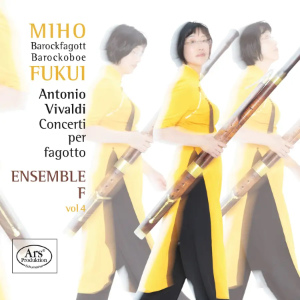
Antonio Vivaldi (1678-1741)
Bassoon Concerti Volume 4
Bassoon Concerto in E-flat, RV 483 (1720s?)
Bassoon Concerto in C, RV471 (1730s?)
Bassoon Concerto in G minor, RV 496 (1720s?)
Sinfonia “La Sena festeggiante” in C, RV 693 (1726?)
Bassoon Concerto in C minor, RV 484 (1720s?)
Oboe Concerto in A minor, RV 463
Bassoon Concerto in F, RV 490 (1720s?)
Miho Fukui (bassoon, oboe)
Ensemble F
rec. 2025, Fujikawa Town Masubo Cultural Hall, Japan
ARS Produktion ARS38379 [69]
Remember the early days of HIP, for “historically informed performance”? Not only were the instruments “different” – museum-quality originals or painstaking reconstructions – but the players had the difficulty of maneuvering through the music on them. Vibratoless gut strings, ironically “gutless,” could wheeze; valveless trumpets didn’t regularly “speak” dead center. The reeds, save for bright, pungent oboes, tended to be – shall we say – unassertive. (Harnoncourt’s pioneering 1968 recording of the B minor Mass, which Warner Classics seems to have reissued, offers examples of all of these.)
The bassoon sound in these Vivaldi concertos brought echoes of those old recordings to mind. Not that Miho Fukui plays badly; but she, or her instrument, produces an oddly diffuse, “swallowed” tone that collapses in on itself, without the forward projection we’d expect from a double-reed. This makes the downward runs in RV 471 blur slightly; in the Larghetto of the F major, each note of the scales comes out in a different colour, which I’m not sure was intentional.
But Fukui also brings a great deal to the table, especially in the slow movements. She phrases with character in the mournful Larghetto of the E-flat and the searching Andante molto of Le Sena festeggiante, with its unexpectedly edgy passing chords. Fukui is also quite adept in the opening movement of the C minor, and projects the finale’s sort-of-cantus-firmus with assurance. And her trills can be smooth and liquid, depending on the notes involved.
The soloist’s transfer to the oboe for the A minor concerto is a surprise, though that move is really no stranger than the clarinet-saxophone doubling standard on Broadway. Fukui’s oboe tone, like her bassoon tone, seems slightly swallowed – is it the way she shapes her reeds? – but the instrument projects better in its higher range. Still, while she brings good control to the Largo‘s long-breathed, embellished line, she can’t quite inflect it expressively.
The best thing about the album, in fact, is the playing of Ensemble F. The Allegros are bustling: brisk and driving in the finale of La Sena festeggiante, agitated in the same movement of the G minor. Attacks are mostly incisive – which renders the finale of the E-flat severe, rather than rollicking — and, even with just one player to a part, the sonorities are full and well-balanced. And the sonics reproduce all the playing vividly.
As matters stand, I already own two volumes of the Daniel Smith set on MMG; despite a polished, modern bassoon and chamber orchestra – the ECO under Ledger – the effects pall after a few concerti. So, much as I love the bassoon, these concerti may best be sampled in smaller doses. Up to you, now.
Stephen Francis Vasta
stevedisque.wordpress.com/blog
Buying this recording via the link below generates revenue for MWI, which helps the site remain free













