
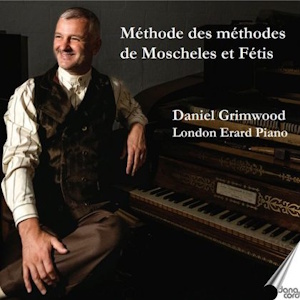
Méthode des méthodes de Moscheles et Fétis
Daniel Grimwood (piano)
rec. June 2026, Sir Jack Lyons Concert Hall, York, UK
Danacord DACOCD 1021 [79]
Daniel Grimwood’s webpage tells us that his current research project at the University of York concerns the Méthode des méthodes (1840). This is a cosmopolitan, conservatoire‑scale survey of nineteenth‑century piano technique.Ccomposers Ignaz Moscheles and François-Joseph Fétis combine historical scholarship with contemporary virtuoso practice, comparing major methods and assembling exemplary studies. The work’s contemporary significance lies in its collective authorship and the consistently high artistic calibre of its musical contributions.
The following quote from Grimwood’s liner notes presents three sections of Méthode des méthodes: Principes de musique, Exercices élémentaires et études progressives and Études de perfectionnement:
The first, with a preface by Fétis dated November 1, 1840, deals with matters of music theory; the second is a “cradle to grave” guide to the piano starting with purpose-written duets for the beginner to play with their teacher and progressing rapidly to Études and pieces of advanced difficulty via reams of finger drills; the third section comprises the 18 or 20 (depending on the edition) Études de Perfectionnement commissioned from many of the most famous pianists of the day.
It would be disingenuous to discuss all the pieces recorded here. That said, one of the delights of the programme is its sheer variety. The Moscheles items show a composer‑teacher thinking practically and imaginatively about technique. The Chopin Nouvelles études sit like bright gems among more utilitarian numbers. Thalberg’s contributions remind us why his “three‑hand” illusion fascinated contemporaries. The rarities – Rosenhain, Döhler, Wolff, Taubert – are valuable precisely because they reveal the technical preoccupations of pianists who were once central to the repertoire but are now largely ignored. One important note: the improvisations are far from being decorative interludes. They function as bridges that restore something of the method’s original pedagogical flow – a teacher guiding a student from one technical idea to the next. They also underscore Grimwood’s interest in improvisation as a historically grounded practice.
The liner notes give a good introduction to this massive project. Dates for each individual piece are not included; it would be a considerable task to find this information out.
This is not a disc to hear straight through. It is a sequence of thirty‑two self‑contained studies and lessons by a broad roster of Romantic composers, interleaved with Daniel Grimwood’s own improvisations. Although the Méthode des méthodes is nominally a pedagogical compendium, Grimwood’s recording makes clear that it is also a document of pianistic culture. We see a snapshot of how a generation of composer‑pianists understood technique, expression and the instrument itself. Heard in sequence, the disc is a sort of “walk through” of mid‑nineteenth-century pianism, exploring its idioms and its technical imagination.
I am not usually drawn to historical pianos (or harpsichords); I tend to prefer the modern concert grand. Yet Grimwood’s handling of the 1856 Erard gives the instrument a clarity, colour and immediacy that make its character feel not like a compromise but an advantage. It is perfectly suited to this repertoire and to the exploratory nature of the project. Its quick attack, transparent bass and lightly ringing treble clarify textures that modern grands often present differently. In the Mendelssohn and Liszt studies, the Erard’s clarity keeps the passagework articulate; in the Henselt and Thalberg, its painterly palette feels entirely idiomatic. Grimwood uses these qualities with care, never overstating the instrument but letting it speak in its own voice.
In sum, this disc is the most substantial engagement with the Méthode des méthodes yet attempted. It gives listeners access to material that is usually encountered only in archives or scholarly writing. More significantly, it restores the method’s original spirit: a collective endeavour, a shared attempt to classify and refine the art of piano playing at a moment when the instrument itself was rapidly evolving.
John France
Availability: DanacordContents
Ignaz Moscheles (1794-1870)
Prélude op. 73 no. 1 in C major. Allegro con fuoco:
From Exercices Élémentaires et Études Progressives
Rondino in C major for 4 hands (with Emily Worthington)
Exercice in doubles
À la Valse et Trio in C major
Prélude op. 73 no. 38 in E flat major. Presto- Adagio
Étude progressif no. 1 in E flat major. Allegro energico
Étude progressif no. 2 in B flat major – dans le style lié. Allegro energico
Prélude op. 73 no. 46 in G major. Animato
Étude progressif no. 23 in G major. Morceaux Expressive pour l’étude de la cadence
Prélude op. 73 no 5 in A major. Maestoso
From Études de Perfectionnement
Étude in A major L’Enjouement. Andantino quasi allegretto
Daniel Grimwood (b.1976)
Improvised modulation
Ignaz Moscheles
Étude in G minor l’Ambition. Con moto, agitato
Daniel Grimwood
Improvised modulation
Frédéric Chopin (1810-1849)
Étude in F minor. Andantino
Étude in D flat major. Allegretto
Étude in A flat major. Allegretto
Daniel Grimwood
Improvised modulation
Sigismond Thalberg (1812-1871)
Étude in E flat major. Allegretto moderato
Daniel Grimwood
Improvised modulation
Sigismond Thalberg
Étude de la Cadence in A minor. Allegro
Daniel Grimwood
Improvised modulation
Felix Mendelssohn (1809-1847)
Étude in F minor. Presto agitato
Franz Liszt (1811-1886)
Étude in E major. Presto impetuoso
Daniel Grimwood
Improvised modulation
Jakob Rosenhain (1813-1894)
Étude in D major. Allegro molto e con agitazione
Theodor Döhler (1814-1856)
Étude in F major. Allegretto
Daniel Grimwood
Improvised modulation
Theodor Döhler
Étude in B minor. Allegro
Daniel Grimwood
Improvised modulation
Stephen Heller (1813-1888)
Étude in E flat major. La Chasse. Prestissimo
Édouard Wolff (1816-1880)
Étude in E flat minor. Allegro passionato
Daniel Grimwood
Improvised modulation
Édouard Wolff
Étude in C sharp minor. Allegretto
Adolf von Henselt (1814-1889)
Étude in G flat major. La Gondola. Allegro non troppo
Daniel Grimwood
Improvised modulation
Julius Benedict (1804-1885)
Étude in A flat major. Allegro assai
Jean-Amédée Lefroid de Méreaux (1802-1874)
Étude in C sharp minor. Élégie. Andante patetico con moto
Wilhelm Taubert (1811-1891)
Étude in F sharp minor op. 49 no. 1. Allegro serioso
Étude in F sharp major op. 49 no. 2. Molto presto e sciolto
Adolf von Henselt/Vladimir de Pachmann (1848-1933)
La Gondola in G flat major
Wilhelm Taubert
La Nayade. Pièce concertante in F major op. 49. Andante con moto













