
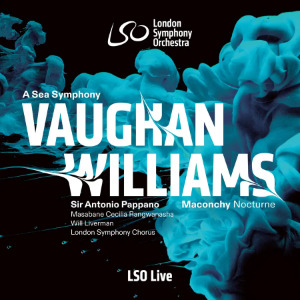
Ralph Vaughan Williams (1872-1958)
A Sea Symphony (Symphony No.1) (1903-09)
Elizabeth Maconchy (1907-1994)
Nocturne for Orchestra (1950)
Masabane Cecilia Rangwanasha (soprano), Will Liverman (baritone)
London Symphony Orchestra & Chorus/Sir Antonio Pappano
rec. live, 9 & 12 February 2025, Barbican Hall, London
Texts included
LSO Live LSO0910 SACD [70]
Here is the third instalment of LSO Live’s cycle of the Vaughan Williams symphonies; we’ve already had a memorable pairing of the Fourth and Sixth symphonies (review) and an equally distinguished coupling of the Fifth and Ninth symphonies (review).
Before I consider the performance of A Sea Symphony I think it’s appropriate to say something about the short work (8:05) by Elizabeth Maconchy which comes after the symphony on the disc. Maconchy’s Nocturne for Orchestra was new to me; though LSO Live don’t claim this as a premiere recording I’ve not been able to trace a performance on disc. Its inclusion is appropriate, not least because the composer was a pupil of Vaughan Williams for part of her time at the Royal College of Music. As Alexandra Wilson comments in her programme note, the piece “depicts a moonlit night that is superficially tranquil, with an underlying ominous mood”. The piece seems to be very well imagined for orchestra. As Ms Wilson suggests, a lot of the music is quite calm, though there is a more assertive passage between about 4:15 and 5:30. The work is very atmospheric and I liked it very much. If this is indeed its first recording then it has been presented to best advantage through this sensitive performance. One thing puzzles me slightly. I discovered, from a Seen and Heard review by John Rhodes of the 9 February concert at which the Maconchy was recorded, that it was the opening work on the programme. I wonder why the decision was made to reverse the programme order on the disc?
Perhaps the thinking was that the disc should open with the proud, assertive fanfare and proclamation ‘Behold, the sea itself’ with which VW throws down the gauntlet in A Sea Symphony. If so, that’s understandable. Pappano and his forces launch the symphony boldly and I was struck, as I always am, by the confidence that VW showed in opening his first symphonic utterance in such a fashion. It’s not long before we hear the American baritone, Will Liverman. I don’t think I’ve heard him sing before but he makes a favourable first impression; his voice is clear and firm. His solo partner is Masabane Cecilia Rangwanasha, who announces herself incisively at ‘Flaunt out, O sea’. I was delighted here – and elsewhere – with the clarity of her words. She’s imperious at ‘Token of all brave captains’, and in the thoughtful passage that follows I very much admired the sensitive singing of the London Symphony Chorus; they respond well to Pappano’s expressive conducting. When he gets to the ‘Emblem of man’ section, Pappano impels the music forward in an exciting fashion until the movement’s majestic climax is reached (‘One flag above all the rest’). The movement’s quiet close is most atmospherically managed by everyone, though I had the impression that a few bars from the end Liverman’s long, quiet top A was not entirely secure.
The opening of ‘On the beach at night alone’ is mysterious and solemn, as it should be. Liverman sings very well in this movement though, if I’m honest, I don’t think he quite matches the expressiveness or the smooth legato that we hear from the likes of John Shirley-Quirk on the André Previn recording (review) or Roderick Williams for Sir Mark Elder (review). Comparisons notwithstanding, Liverman’s firm, evenly produced voice is well suited to this music and I enjoyed his performance. The London Symphony Chorus do very well, not least the semi-chorus of altos who respond to the soloist’s lines in the early part of the movement. The LSO’s playing is marvellous, both in the subdued passages in which the movement abounds and also at its sonorous climax.
I’ve had the good fortune to sing in a few performances of A Sea Symphony so I know what a test the third movement, ‘The Waves’ is for the choir. Nothing less than absolute rhythmic precision and confidence in entries will do; complete conviction and commitment is required. Needless to say, the London Symphony Chorus passes this test with flying colours. They’ve clearly been prepared assiduously by their Director, Mariana Rosas. Every entry is incisive and when they get the chance to sing more expansively (‘Where the great vessel sailing and tacking’) they seize the opportunity. The first performance of the symphony took place on 12 October 1910 at the Leeds Festival, with the composer conducting – a memorable way to spend his 38th birthday! As I listened to this present fine performance I wondered how well equipped the Leeds chorus was to do justice to this challenging movement in particular; I bet the music gave them some sleepless nights beforehand.
If I remember correctly, the late Michael Kennedy said of the lengthy finale, ‘The Explorers’, that it contains the finest music in the symphony and is also the most discursive of the movements. I’d certainly agree with that judgement. Pappano gets the opening pages just right; there’s the appropriate degree of space and mystery. The extended opening paragraphs are expansive and expressive; both the orchestral playing and the choir’s singing do full justice to VW’s visionary music. A little later, the contribution of the female semi-chorus (‘Wherefore unsatisfied soul’) is delicately voiced, the singers sounding to be nicely remote. Pappano builds the tension splendidly, until it’s released at ‘Finally shall come the poet worthy that name’); it’s a marvellous moment and here it comes off really well. The soloists are released (’O we can wait no longer’) at which point their singing is suitably impassioned. Hereabouts, I like the way that Pappano, his soloists and orchestra make the music sound impetuous without it being rushed off its feet. ‘O thou transcendent’ is a great moment of affirmation but shortly thereafter Will Liverman rather disappoints me at ‘Swiftly I shrivel at the thought of God’; here, surely, he is too forthright and lacking a sense of awe. Nor do I hear the dolce that’s marked in the score when he sings ‘But that I, turning, call to thee O soul’. That’s a pity when so much else that he does is very good. The LSO and LSC bring great urgency to ‘Away, O soul’ and it’s not long before Captain Pappano and his crew are sailing for the deep waters as VW conjures up in the closing minutes a vision of the far horizon. This conclusion, which requires great control from all concerned, is accomplished very successfully – and poetically – here.
This is a very fine addition to Sir Antonio Pappano’s Vaughan Williams cycle. I enjoyed it very much. I wonder what will come next. I understand from a look at Seen and Heard that A London Symphony was given in December 2025 (review); maybe it won’t be too long before a recording of that loveable work appears. And might I put in a plea that Pappano will include Job. A masque for Dancing in his cycle with the LSO. A recording of that great masterpiece from this formidable partnership of conductor and orchestra would be a mouthwatering prospect.
The present performances have been well recorded by the LSO’s regular audio partners, Classic Sound Ltd. That said, there were occasions when I felt the London Symphony Chorus didn’t register as powerfully in loud passages as I’d have liked. I heard them sing live not all that long ago and noted no lack of strength (review); I suspect, therefore, that perhaps they’ve not been balanced quite forwardly enough in the recording. The documentation is up to the label’s usual very good standards.
John Quinn
Buying this recording via the link below generates revenue for MWI, which helps the site remain free













