
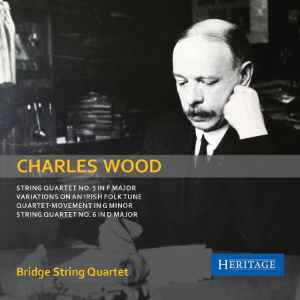
Charles Wood (1866-1926)
String Quartet No.5 in F major (1915)
Variations on an Irish Folk Tune (1916)
Quartet-Movement in G minor (1916-1917)
String Quartet No.6 in D major (c.1916-1917)
Bridge String Quartet
rec. 2026, St George’s Church, Harrow, London, UK
Heritage HTGCD113 [66]
The recent appearance of recordings of the string quartets of Charles Wood has been a very welcome development. Though none is remotely ground-breaking, all that I’ve heard points to an astute tunesmith, an imaginative contrapuntalist, and a warm-hearted explorer of Irish folkloric elements.
Thus far, the discographic pioneers have been the London Chamber Ensemble Quartet, who have given us Nos. 2, 4 and the Variations on an Irish Folk Tune on a Somm disc and No. 6, coupled with Herbert Howells’ In Gloucestershire Quartet, on another disc by the same label. The disc under review is by the Bridge String Quartet, energetic and sensitive explorers of the British repertoire whose discs will be known to many, and who add Quartet No.5 and the Quartet-Movement in G minor to the Wood discography, whilst presenting their own versions of Quartet No. 6 and the Variations on an Irish Folk Tune. Such welcome duplication was simply unimaginable in years gone by when Wood was known almost wholly for his choral music.
Quartet No.5 is the earliest work in this selection dating from 1915, though all were written in a compressed period of composition between 1915 and 1917. Its gently unfolding fugue shows formal mastery in its use of modality and the succeeding Allegretto – a kind of Intermezzo – is both genial and full of attractive unforced warmth. Each movement lightens in tone and by the time we come to the finale, the shackles are off, the music erupting in a folk theme using the tune ‘The Devil in Dublin’ to earthy and witty effect.
One of the most characteristic and surely constructed works in the disc is the Variations on an Irish Folk Tune (1916). As I wrote in my review of the Somm disc ‘there are ten variations which are, perhaps unusually, grouped by key and mood but this gives a kind of structural density and resolution to the variations which otherwise might crisscross between fast and slow writing. Instead, Wood allows his material enough time to develop in terms of mood before contrasting it. There’s much melodic distinction to be heard here – once again he proves a minor master of string quartet variation form – and he ends, with a flourish, with a vibrant Reel.’ The more I hear this superficially (from its title) light and cheerful piece, the more I admire its constructive and expressive power.
The generous church acoustic of St George’s Church, in Harrow, London vests all the music with a most attractive veil but it’s not a swimmy acoustic – detail registers sharply. That’s true of the Quartet-Movement in G minor, whose Irish influence moves with elegant warmth in this very fine performance. Quartet No.6 was greatly admired by Wood’s first biographer, Ian Copley, and it is indeed a compound of many of Wood’s great virtues in its balancing of folklore and dance. The Scherzo’s Reel contrasts pizzicato with lyrical legato, and the Adagio is a set of variations which composer and writer Ernest Walker thought was one of Wood’s greatest achievements. The finale is one of his vivacious Jigs, driving and exciting.
The Bridge String Quartet prove just as adroit as their competitors in this repertoire which was recorded in Wood’s centenary year. The expert notes are by Peter Marchbank who studied at Gonville and Caius College in Cambridge, for whose college choir Wood wrote much of his sacred choral music. Producer and engineer Michael Ponder has done an excellent job too and this disc is warmly welcomed.
Jonathan Woolf
Buying this recording via the link below generates revenue for MWI, which helps the site remain free













