
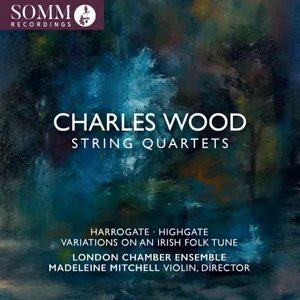
Charles Wood (1866-1926)
String Quartet No.4 in E flat ‘Harrogate’ (1912)
Variations on an Irish Folk Tune (1916)
String Quartet No.2 in E flat ‘Highgate’ (1893)
London Chamber Ensemble Quartet
rec. 2025, St Silas Church, Kentish Town, London, UK
SOMM Recordings SOMMCD0723 [69]
Charles Wood’s String Quartets are gradually emerging into the sunshine. A previous release by the London Chamber Ensemble Quartet, also on this label, presented Wood’s Quartet No.6 which is reckoned by some to be his finest creation in the chamber realm. It was coupled with music by Herbert Howells. The release under review shows much more confidence in the composer, presenting an all-Wood disc containing three works for quartet.
It was an astute decision, programmatically, to open the disc with Wood’s String Quartet No.4 in E flat ‘Harrogate’ which dates to 1912 as it’s a more personal and assured work than the significantly earlier quartet, the Second of 1893. Both quartets adopt a conventional four-movement scheme but the Fourth Quartet offers more mellifluous and fluid lyricism which it contrasts with stormier contrapuntal writing to maximum benefit. Wood has recourse to some discreet whole tone scalar writing in the Scherzo and he ensures there are some stylistic surprises in store, whilst the slow movement is a series of variations on an Irish Melody. Wood was adept at variation form as he shows in the Sixth Quartet, and the deceptively simple but effective variations of the Fourth convey enough veiled melancholy and liveliness to ensure maximum contrasts. High spirits return in the finale, a fast Reel, entertaining, athletic and full of resourceful verve.
The earlier quartet is a well-planned work – its span is not dissimilar to the Fourth – with a rather stern Minuet functioning as a Scherzo, the irregular phrasing and abrupt syntax of which are novel features. Some might find the effect disconcerting. The slow movement is a kind of Passacaglia, the unfolding elements of which move from relative austerity to intensity to a sweet unshackling from the tight bonds of formality. By comparison the finale is attractive, sprightly and full of buoyant, uncomplicated energy. One can at times in this quartet feel Wood straining against the stylistic confines of the genre but not quite overcoming them.
The final work is the Variations on an Irish Folk Tune (1916). There are ten variations which are, perhaps unusually, grouped by key and mood but this gives a kind of structural density and resolution to the variations which otherwise might crisscross between fast and slow writing. Instead, Wood allows his material enough time to develop in terms of mood before contrasting it. There’s much melodic distinction to be heard here – once again he proves a minor master of string quartet variation form – and he ends, with a flourish, with a vibrant Reel.
The London Chamber Ensemble Quartet’s first violinist and director is Madeleine Mitchell who, with her colleagues violinist Gordon McKay, violist Bridget Carey and cellist Joseph Spooner, plays these works with expert skill, fine intonation and warm corporate tone.
Jonathan Woolf
Other review: John Quinn
Buying this recording via the link below generates revenue for MWI, which helps the site remain free













