
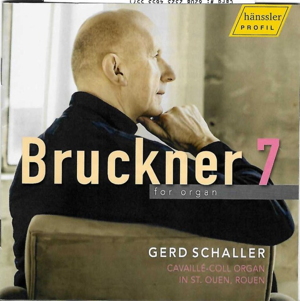
A splendid arrangement for organ of Bruckner’s Seventh Symphony, vibrant and thrilling [RMo]
Anton Bruckner (1824-1896)
Symphony No. 7 in E Major (arr. G. Schaller for organ)
Gerd Schaller (organ)
rec. 2025, Orgue Cavaillé-Coll de l’église de Saint-Ouen, Rouen, France
Hänssler Profil PH26030 [67]
Gerd Schaller has already recorded his arrangements for organ of Bruckner’s Ninth Symphony (review)in Ebrach, the Eighth (review) in Rouen and the Fifth in both those locations (review; review); for this recording of the Seventh for organ he returns to the mighty French instrument. Its majestic sound is particularly suited to the grander moments of the symphony; I recommend that organ buffs sample the coda to the first movement, whose peroration, following the sustained pedal and the return of the opening theme, is especially imposing.
The sheer scale of the Cavaillé-Coll organ and the reverberance of the recorded acoustic means that it is slightly less suited to conveying the delicacy of more intimate moments such as in the second-movement Adagio but not too much need be made of that if one remembers that it is marked “Sehr feierlich uns sehr langsam” (Very solemn and very slow), so demands space and nobility. The quiet ending is beautiful but the climax of the passage beginning fifteen minutes in at 16:35 is as striking as the end of the first movement. The Scherzo is hard to shape deftly on such a large wind instrument; its rhythmic snap is somewhat lost but it accrues plenty of menace; indeed, hearing this arrangement has reminded how much of a Grand Guignol element there is in this music – perhaps because I inevitably – if a tad crassly – associate organ music with The Phantom of the Opera…
The finale – Bruckner’s most compact and the shortest apart from Die Nullte – is, in contrast to what precedes it, exuberant and propulsive; it means that nothing outstays its welcome and Schaller pulls out all the tricks to vary its impact, exploiting the remarkable resources of the stops of the Rouen organ dynamically and tonally. Yet again, the conclusion is extraordinarily vibrant and thrilling.
This will appeal to both organ buffs and Bruckner enthusiasts: the former will primarily revel in the range of colours and textures Schaller draws from the instrument and the latter will enjoy hearing how this familiar music had been so skilfully adapted for this medium – and of course listeners who are both organophiles and Bruckner devotees will be in heaven.
Schaller makes it clear in his note that this arrangement is not a mere note-for-note transcription; his aim was to create “an independent organ work…with wide-flowing lines a rich palette of sounds…playable…with pleasure and joy.” I think he succeeds admirably.
(I must complain again about the design choice on the reverse cover of pink type on a light buff background, rendering the text completely unreadable. Oddly, the CD notes do not provide a recording date but I am told by Maestro Schaller that it was 13-15 October 2025.)
Ralph Moore
Availability: Bruckner Archive
Please note that this is a link to a limited (and exclusive) presale through the Bruckner Archive site. The recording will be available at normal retailers from November 20.













