
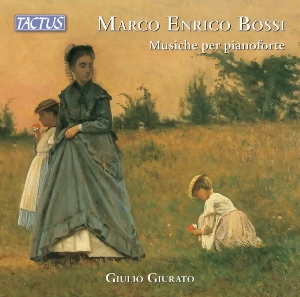
Marco Enrico Bossi(1861-1925)Quatre pièces pour piano en forme d’une Suite Ancienne Op.103 (1895)
Trois Morceaux en forme d’une Suite pour Piano Op.106 (1896)
Quatre morceaux pour piano Op.109 (1897)
Cinque pezzi per pianoforte Op.137 (1914)
Giulio Giurato (piano)
rec. 2025, Sala Maffeiana, Verona, Italy
Tactus TC860205 [65]
I confess that Bossi was little more a name in an encyclopedia until this disc came along. I had only heard his Venus Valse (review). I apologise to those organists who are tut-tutting me at this point, but at least I am now just a little wiser about this Italian organist, composer and teacher. Marco Enrico Bossi was born in Salò, a town in Lombardy on the banks of Lake Garda. His father was organist at Salò cathedral. Bossi studied in Bologna and Milan; Amilcare Ponchielli was amongst his tutors. He went on to become the organist at Como Cathedral, taught at institutions in Naples, Bologna, Venice and Rome, and made many tours as a concert organist. He was a prolific composer. Not surprisingly, there is a great deal for the organ, including a concerto, a concert piece with orchestra and nearly one hundred solo works. There is also, however, a good deal of vocal, chamber and piano music.
Bossi began writing for the piano at fourteen, but we pick up the story a decade later with Four pieces in the form of an Ancient Suite. Bach is the clear inspiration for the preludio, though wrought in a gigantic piano framework. With Lisztian virtuosity and octave cadenzas, it comes across as an extravagant piano transcription in the style of Liszt or Tausig. The opening of the gavotte is similarly grand; it has gentler moments but it is hardly a study of a courtly dance. It has a musette at its heart with an interesting blurred effect behind its pastoral theme that, true to its bagpipe origins, stems from a single pedal note lying under the melody. A stately sarabande is the basis of a theme and four variations; they remain relatively restrained, making full use of the slow chromaticism of the aria. The final chordal variation is a sudden challenge to this calm but it soon gives way to a reprise of the aria. The presto toccata finale is in the form of a courante, dazzling and self assured. Bossi dedicated the suite to English pianist Fanny Davis.
Bossi evidently thought the suite a good idea: he collected his three pieces op.106 into the same form but with modern genres. Tendresse, akin to Schumann or Mendelssohn, is an attractive song without words, with some harmonic changes along the way that add a little variety without upsetting the serenity of the piece. Histoire douloureuse has a little of Schumann’s enigmatic prophet bird in its questioning melody but Bossi contrasts it with a quirky march. The suite closes with enjoument, a vivacious and lilting waltz.
Bossi channels his inner Chopin in the first of the four pieces that make up his op.109, a mazurka marked melancolicamente. He has more than enough individuality of style to avoid becoming a clone of the Polish composer. Yet one can hear aspects of Chopin’s writing, none more so than the change to the lyrical middle section which drops a semitone. Bossi simply plays a bass note in the new key, much as Chopin does in the F sharp minor polonaise op.44. It is altogether a rather beautiful piece. Fileuse belongs to that group of spinning songs whose familiar examples include Mendelssohn, Raff, Wagner, Moniuszko and Flotow; it is a short staccato study in perpetual motion. Bossi demonstrates his gift for melody in Ultimo canto, an elegiac nocturne that visits Liszt in the second theme, set below a syncopated triplet accompaniment with its passion and surging lyricism. The toccata that closes the collection is rather capricious; its jaunty staccato theme is full of effervescent humour.
We leave the composer in his mid-thirties for the last set here. He wrote five piano pieces op.137 when he was 53 years old. He adds impressionist and whole-tone harmonies to his still generally romantic textures. The opening Prelude immediately reminds one of early Debussy, La cathèdrale engloutie mixed with the toccata Pour le piano. The second piece, also a prelude, plays with chords around a single note that is left hanging in the air after each group of chords. This mysterious bell-like timbre soon gives way to more energetic and busier writing that suggests these solitary bells are being taken up elsewhere, all joining in a clangorous discourse.
The first of two intermezzi that follow was recycled from an earlier composition. Its title, momento appassionato, is apt for this surging and sweeping piece that lies between Chopin’s final cataclysmic prélude and the restlessness of a Rachmaninov étude-tableau. The second intermezzo, a slow waltzwith the title sogno (dream), has a melody that emerges from its chordal texture. There is certainly a dream-sequence feel to much of the writing. It is a lovely piece that Bossi dedicated to the then 22-year-old Mieczysław Horszowski. The final étude is characterised by rising and falling triplets, divided between the hands in a dizzying cascade of octaves. The whole-tone harmonies heard in the opening prelude of the set, which have mostly lain dormant through the remainder of the pieces, return in this étude that is remorseless in its intensity even when the occasional sostenuto passage attempts to calm the storm.
Pianist Giulio Giurato studied with Jörg Demus. Through his studies at the Bologna Conservatory, he perhaps has a connection to Bossi. He has recorded for Tactus what appear to be his complete chamber workss (violin and piano – review; piano trios – review; assorted chamber works – review). He makes a good impression in this album, ably capturing the richness and imagination of Bossi’s music. The music may not really stray from well-trodden paths, but Bossi was a gifted writer for the piano. The album is well worth exploring for those who search beyond the mainstream.
Rob Challinor
Buying this recording via the link below generates revenue for MWI, which helps the site remain free













