
Johann Sebastian Bach (1685-1750)
French Suites 1-6, BWV 812-817
Wolfgang Brunner (harpsichord)
rec. July & November 2024, Commend Privatstiftung, Salzburg, Austria
Gramola 99376 [2 CDs: 106]
Wolfgang Brunner has been part of the early music scene since the late 1980s and has become a familiar name at major European festivals. His previous recordings include fortepiano sonatas by Lodovico Giustini (review), and directing the likes of C.P.E. Bach’s Die Israeliten in der Wüste with his Salzburger Hofmusik ensemble (review), both on the CPO label. These credentials alongside a deep interest in the history of dance music promise a good set of Bach’s Französische Suiten.
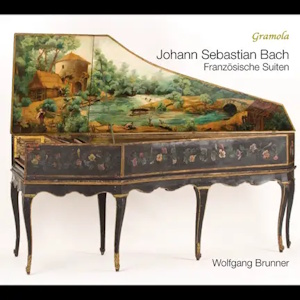
Brunner’s instrument here is a richly decorated harpsichord from 1628 by Andreas Ruckers, and probably the only surviving instrument from this maker to be located in Austria. This was restored in 2015 so the sound and mechanism is by no means a hair-shirt exercise in artistic suffering, and the strings have been beautifully tuned for this recording. This is a full and rich sounding three manual instrument and a joy to behold through decent quality equipment. To apply further authentic synergy to these performances Brunner uses early sources for this music, including the Clavier-Büchlein für Anna Magdalena Bach from 1722, and Bach’s son in law and pupil Johann Christian Atnikol’s Leipzig copy from around 1744. This avoids “adding overly gallant embellishments from later copies”.
Brunner’s admirably detailed booklet notes go into aspects of style when it comes to playing these pieces, balancing the Italian traditions Bach would have learned from his elder brother Johann Christoph against the French education he acquired at school in Lüneburg. There is a certain amount of ‘unequal’ or dotted rhythm in Brunner’s playing which gives a nice ‘swing’ to some movements, such as the Gavotte in BWV 816, but this to my mind does not distort or harm the music in any way. This is a valid approach towards French stylistic character, and adds freshness without being over-done. Brunner’s legato touch is delicious in movements such as the opening Allemande of BWV 815, and his handling of quicker dances such as the following Courante balance a decent amount of rhythmic bounce with a sense of flow that prevents things becoming spiky. He will anticipate sometimes with the left hand against the right for expressive effect, and this is an effect that prevents the music becoming too vertical and clunky and also enhances harmonic clarity, in a similar way to a good continuo player who will spread their chords at appropriate moments rather than hitting them all at once. Brunner’s expressiveness doesn’t distort Bach’s rhythmic patterns and shapes, phrasing with natural breaths and enough flexibility to prevent things becoming mechanical. The contrasts with the various manuals available on this instrument are well chosen and again, as with everything else here, not over-done.
In terms of comparisons, I had a listen to Masaaki Suzuki on the BIS label (review) who plays a very nice sounding Ruckers copy instrument in a fine acoustic. Suzuki delivers benefits in terms of elegance and lyrical lines, but for some reason I prefer to take this set in small doses, finding my attention wandering after too long. Mahan Esfahani on the Hyperion label (review) mixes things up by playing clavichord and harpsichord so is not a fair comparison, but his admirable musicality and sensitivity of touch creates worlds of fascination if you are looking for something new from this repertoire. More intimately recorded on the Dynamic label, Alessandra Artifoni (review) has a nice sound and a fine touch, but lacks ‘magic’ somehow. Christopher Hogwood’s Decca recording is very fine and a safe bet if you can find a copy. Coming back to Brunner after a few excursions makes clear where his qualities bring out some of the best of Bach’s music in these French Suites, with his sense of solidity and grounded reliability in his handling of rhythm, and his lack of pretension allied to expressive grace in those all-important Sarabande movements.
As ever with J.S. Bach, there are many ways to play these seemingly indestructible masterpieces, and if you prefer them on piano then there is no end of choice. If you seek a harpsichord version then Wolfgang Brunner on the Gramola label is a very solid choice indeed.
Dominy Clements
Buying this recording via the link below generates revenue for MWI, which helps the site remain free













