
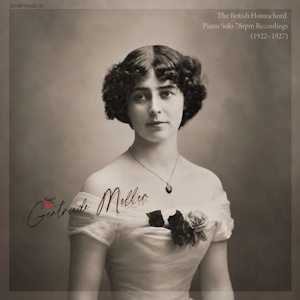
Gertrude Meller (piano)
The British Homochord Piano Solo Recordings (1922-1927)
rec. 1922-1927, location not given
Sakuraphon SKRP78026/27 [73+74]
Gertrude Ethel Meller is hardly a household name even among pianophiles. I would have considered her unlikely to attract the attention of historic piano labels, so I am very pleased to have been proved wrong by Hisao Natsume and his wonderful label Sakuraphon. These are not Meller’s complete recordings, but two generously filled discs give an excellent picture of her art. Sakuraphon have impressed lately with some unusual but welcome releases, such as George de Lausney’s complete recordings, and works of Jacques Dupont and Leo Paul Schramm. Two important series are underway: Pupils of Leschetizky, six discs so far, and the Leo Sirota Archive, the first really comprehensive exploration of his pianism. It is Sirota that gives a little clue to the interest in Meller. She was his label mate for a while in the mid-1920s. In her six years with Homochord, she recorded more discs than Sirota, and across a wider repertoire.
Meller, born in Bedford in 1879, studied at the Guildhall School of Music with Francesco Berger, a pupil of Ignaz Moscheles. Her career took her to the Promenade Concerts twice. On the first occasion, she programmed Rubinstein’s grandly romantic D minor piano concerto and both of Liszt’s Polonaises. Liszt’s E flat concerto and the solo version of Chopin Grande polonaise op.22 were the focus of the second. The booklet gives little biographical information beyond the fact that she was married for nine years and that after the first world war mostly devoted herself to teaching in her hometown.
Meller made her Homochord discs in the mid-1920s, and broadcast on the BBC from 1927 to 1931. Ill health curtailed her playing after 1935. She died in 1945. The booklet contains pen portraits by her teacher Francesco Berger, James Methuen-Campbell and that of a young Sybil Thorndike who aspired to be a concert pianist before life took her in another direction. She heard Meller at Berger’s class and wrote: “There was a girl […] older than me, awfully pretty and a tiny waist. Well, she was playing some Chopin thing. Oh! Russell, I’ll never be able to play like her; she’s glorious. She can lift her hand higher than her head and it always comes down on the right note and all the time she looks as if it’s awfully easy.”
Like many pianists, Meller recorded a decent amount of Chopin’s music. Disc two contains all of her Chopin, but a swift glance at the contents of disc one shows that she went far beyond this, even while remaining firmly in romantic territory. Some of the pieces she recorded remain the sole recordings, such as Poldini’s and Godard’s études and Heller’s transcription of Mendelssohn’s On wings of song.In addition to the pieces here, Meller recorded music by Robert Newland, Paul Pabst, Samuel Coleridge-Taylor and Ignacy Jan Paderewski, more Moszkowski and MacDowell, and so on.
What of her playing? Like Una Bourne, the Australian pianist who was recording a similarly eclectic repertoire in the 1910s and 1920s, Meller favours fast tempi and for the most part avoids sentimentality. Her Chopin Nocturnes err on the playful side, to good effect in op.32 No.2 but less successfully in the familiar F sharp major which becomes rather skittish. It shares a side with a breezy if a little perfunctory A major prelude. The A flat prelude op.28 No.17 has a fine singing line, much like that found in Meller’s passionate Liszt Liebesträume, but there is also an occasionally individual approach to rhythm. Her op.64 waltzes are rushed, especially the second which must be the fastest I have ever heard it played. Admittedly, she does not return to the opening section but it still breaks records at 1:29, leaving no time for lyricsim along the way. The first impromptu is somewhat the same, though the third and fourth receive a better treatment.
The time limits imposed by disc length mean that many of the pieces are trimmed or, in some cases, chopped to bits. The Polonaise in C sharp minor from Meller’s final sessions omits the return to the polonaise after the central section. This does at least mean that she does not have to rush through phrases; she shows that – while her lyrical playing is still rather jaunty – she had a clear sense of style. The second scherzo and Polonaise op.22 leave out repeats, any phrases that repeat and whole sections, so there is still lots to enjoy but it is all a bit breathless. It is rather a shame because one can hear playing that is effortless and, it must be said, rather dazzling; just take Liszt’s Polonaise that combines wonderful verve and swagger with passages of the utmost delicacy and transparency.
The Rigoletto paraphrase has these same excellent qualities, as does the once popular Soirée de Vienne No.6, though again time restraints mean some of the lilt is lost in the rather driven early passages. The latter sections show the charm that Meller had at her disposal, a charm also found in Friml’s Chanson In Love, a piece I loved as a child; I often heard it on the radio, though admittedly in its later vocal arrangement as the Donkey Serenade. Before we leave familiar territory, or at least major composers, there is Schubert’s fluent and remarkably mannerism-free Impromptu in E flat, Mendelssohn’s elfin Rondo capriccioso, highly enjoyable if you ignore the wholesale cuts, and two song without words. Melle plays Spring song the fastest I have heard it, spring evidently eager to get on with all things springy and a whirling and clean-fingered spinning song.
The remainder of the first disc is mostly what would today be classed as salon music or encores. Actually, this repertoire stands up extremely well when played with commitment and character. Meller has character by the bucketful, even if she is not in the top class of players of the golden age. How nice it is to make discoveries, too. Hungarian composer Stephen Heller’s take on Mendelssohn’s On wings of song is not as subtle as Liszt or Thalberg’s versions but worth an outing. Tambourine by Meller’s teacher Berger is a swaggering waltz full of fast repeated notes and generally frothy figuration. Anton Arensky’s melodious impromptu is played with wonderful flexibility and phrasing; it is coupled on one 78rpm side with his comparatively well-known étude in F sharp minor full of pearly scales and, as this is Arensky, more melodiousness.
Godard’s music is not heard that often. Meller makes an excellent case for re-evaluation with his A major étude, a stunning tour-de-force, and his rollicking second mazurka, essentially a concert piece in disquise. While we are on the subject of études, take the two engaging examples from Ede Poldini’s concert études op.19, a staccato study and a vertiginous valse that Meller throws off with insouciant ease, sounding like she was born to play this music. Poldini may have been a minor composer writing in a romantic idiom long after it was fashionable, but these two gems show that there is more to his piano music than la poupée dansante. I hope someone commits some of his piano music to disc soon.
Meller now shows that speed was at least not always determined by limits of recording length. She gives us an unhurried and marvellously defined Turkish March from Beethoven’s Ruins of Athens in Anton Rubinstein’s transcription, once a favourite of Rubinstein’s pupil Josef Hofmann. She stays with Rubinstein for the high-kicking Galop from his set of dances Le Bal, well worth a visit when played with abandon like this; Meller rather leaves modern-day performers of this piece eating her dust. This disc continues in this fashion with MacDowell’s bravura étude and Saint-Saëns’s finger-twisting Étude en forme de valse, trimmed but dazzling.
There is more of Meller’s impressive playing: two popular miniatures by Chaminade, out of five Meller recorded (one is on APR, review ~ review); Eduard Schütt’s fragrant Waltz À la bien-aimée; and Moszkowski’s sweeping Valse in E major op.34, elegantly played and slightly rewritten in the grand reprise. A surprising rarity is the complete Pensées fugitives, three short pieces by Moszkowski whose once immense popularity was fading in favour of composers like Scriabin, Schoenberg, Debussy and others – “artistic madmen” as Moszkowski described them. He remained popular with many pianists, however, and many recordings appeared in the 1920s. Meller recorded this set in 1922. It has waited over a century to be revisited, receiving its second recording just a month ago (Silvia Carlin plays them on Da Vinci Classics C01182). They have all the charm and easy elegance characteristic of Moszkowski’s writing. Meller captures their moods, agitated in the first, buoyant in the gentle tarantelle of the second, and this and more in the scurrying final piece.
For all the occasional issues, mostly timing (outside Meller’s control), this is a wonderful collection of recordings. As usual, Hisao Natsume, Sakuraphon founder, transfers the audio and designs the sleeves. The sound is more than acceptable, just losing some clarity at times through the crackle. Yet this is not a problem because the recordings remain vivid and, as Natsume explains, as natural as possible. Corrections are only made in regards to instability of the pitch on the original discs. I like Sakuraphon’s design, each cover printed like a little 78rpm disc, each in its own plastic sleeve and cardboard case with booklet in English and Japanese. There is a beautiful photograph of Meller on the front cover. Her portrait, painted by Paul Ayshford Methuen in the early thirties, is reproduced alongside images of several of her 78s. I enjoyed this release immensely, especially the first disc where Meller seems to shine brightest. I hope that one day Sakuraphon can bring us the balance of her solo and chamber recordings.
Rob Challinor
Availability: Sakuraphon Sound StoreContents
Disc 1
Felix Mendelssohn (1809-1847), arr. Stephen Heller (1813-1888)
Improvisation on On wings of song Op.67
Francesco Berger (1834-1933)
Tambourine
Anton Arensky (1861-1906)
Impromptu Op.25 No.1
Étude in F Sharp Major Op.36 No.13 (marked as No.8 on the sleeve)
Ludwig van Beethoven (1770-1827), arr. Anton Rubinstein (1829-1894)
Turkish March from The Ruins of Athens
Anton Rubinstein
Galop from Le Bal Op.14 No.9
Camille Saint-Saëns (1835-1921)
Étude en forme de Valse Op.52 No.6
Benjamin Godard (1849-1895)
Concert étude in A Major Op.149 Cahier 4 No.1
Deuxième Mazurka in B Flat Major Op.54
Ede Poldini (1869-1957)
Études de Concert Op.19 Nos.2 and 5
Cécile Chaminade (1857-1944)
Automne, No.2 from Études de concert Op.35
Arlequine Op.53
Moriz Moszkowski (1854-1925)
Pensées Fugitives Op.66 complete
Grande Valse in E Major Op.34 No.1
Edward MacDowell (1860-1908)
Étude de Concert in F Sharp Major Op.36
Eduard Schütt (1856-1933)
A la bien-aimée Op.59 No.2 Papillons d’amour
Franz Schubert (1797-1828)
Impromptu in E Flat Major Op.90 No.2
Felix Mendelssohn (1809-1947)
Spring Song Op.62 No.6
Spinning song Op.67 No.4
Andante and rondo capriccioso Op.14
Disc 2
Christian Sinding (1856-1941)
Rustle of Spring Op.32 No.3
Frédéric Chopin (1810-1849)
Nocturne No.10 in A Flat Major Op.32 No.2
Nocturne No.5 in F Sharp Major Op.15 No.2
Prélude in A Major Op.28 No.7
Prélude in A Flat Major Op.28 No.17
Impromptu in A Flat Major Op.29
Impromptu in G Flat Major Op.51
Fantaisie-Impromptu in C Sharp Minor Op.66
Scherzo No.2 in B Flat Minor Op.31
Valse brilliante in A Flat Major Op.34 No.1
Grand Valse in A Flat Major Op.42
Valse in D Flat Major Op.64 No.1
Valse in C Sharp Minor Op.64 No.2
Grande Polonaise Brilliante in E Flat Major Op.22
Polonaise in C Sharp Minor Op.26 No.1
Rudolf Friml (1879-1972)
Chanson In love
Carl Maria von Weber (1786-1826)
Piano Sonata No.1 perpetuum mobile Op.24
Giuseppe Verdi (1813-1901), arr. Franz Liszt (1811-1886)
Rigoletto paraphrase S.434
Franz Schubert,arr. Franz Liszt
Soirée de Vienne in A Minor S.427 No.6
Franz Liszt
Étude de Concert No.3 in D Flat Major Un Sospiro S.144 No.3
Liebesträume S.541 No.3
Polonaise in E Major S.223 No.2













