
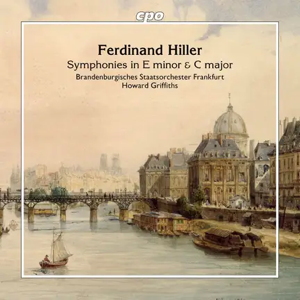
Ferdinand Hiller (1811-1885)
Symphony in E minor HWV 2.4.3 (1830/31)
Symphony in C major HWV 2.4.6 (1876/77)
Brandenburgisches Staatsorchester Frankfurt/Howard Griffiths
rec. 2024, Konzerthalle Carl Philipp Emanuel Bach, Frankfurt (Oder), Germany
cpo 555 682-2 [63]
Ferdinand Hiller’s music went out of fashion after his death and is not well-known today, but the cpo label has already released a recording of the Symphony op. 67 and Symphony in F minor (555 625-2), alongside further discs with chamber and piano works. Hyperion includes his three piano concertos in its huge Romantic Piano Concerto series, and it seems he was a key figure in 19th century musical life in Germany, being close friends with the likes of Rossini, Liszt, Berlioz and particularly Mendelssohn.
Hiller was the son of a wealthy industrialist from Frankfurt, and he had the good fortune to be a pupil of Johann Nepomuk Hummel in Weimar from the age of ten. He lived for several years in Paris and finally settled in Cologne in 1850, taking over directorship of the Gürzenich Orchestra and the municipal conservatory, becoming organiser of the Lower Rhine Music Festival and generally playing a leading role in the Cologne music scene.
The Symphony in E minor was a relatively early work but rode upon Hiller’s successes in Paris after he moved there in 1828. It was initially completed in 1829 and subsequently revised into the version performed here. It was admired by Mendelssohn as containing “the prettiest things in the world”, and in general it has plenty of youthful spirit, reinforced with a lively and energetic final movement titled Chant des Pirates. Formal innovations and a certain amount of stylistic character can be related to Berlioz, and the booklet notes go into plenty of analytical detail for each movement. While lacking memorable themes, this is a work filled with surprise and a precocious approach to orchestration, and even just a cursory listen to samples online had this ageing and jaded reviewer on full alert to something new and a bit special. You can tell that Hiller threw everything into this as a calling-card/demonstration piece to impress his audiences. As mentioned, the music won’t have you whistling lots of big tunes, but it has the kind of uplifting effect you can have from Mendelssohn’s transparent facility as a composer, and its punchy energy nudges closer to Nielsen than you might expect from a work of this period.
Emerging almost a half century later, the Symphony in C major is a mature work that was performed a few times to generally positive reviews in and around 1877, but despite the efforts of the composer remained unpublished and receded into obscurity after 1880. As with the earlier symphony, Hiller’s strengths are in characterful inventiveness and colourful orchestration. His motifs are striking indeed but very rarely stretch into much in the way of memorable tunes. The wind and brass colours in the Adagio ma non troppo second movement are a bit special, and there is a spirit in this work that puts me in mind of Bohemian composers of the period, with perhaps a hint of Bruckner here and there. This is the kind of symphony that revels both in the traditions it inhabits, and in the brilliant mind of its creator. By this point in his career Hiller probably had no real need to prove himself to anyone but no doubt wanted a vehicle for his work as a conductor, and so we have a score that is filled with guaranteed crowd-pleasing moments and not a few surprises of one kind or another.
Following on from their recording of the two middle symphonies in this set of four, Howard Griffiths and the Brandenburg State Orchestra Frankfurt (Oder) can be very happy with this framing of the set with the first and last of Hiller’s surviving symphonies. The orchestral playing is very good and set in the suitably resonant acoustic of its home venue, a space that suits Hiller’s orchestration perfectly. Griffiths brings out the best in his musicians who, for the most part, sound as if they have been playing these works for donkey’s years.
Dominy Clements
Buying this recording via the link below generates revenue for MWI, which helps the site remain free













