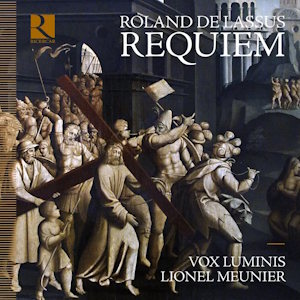
Roland de Lassus (1532-1594)
Requiem
Missa pro defunctis quinque vocum, LV 963
Officium pro omnibus fidelibus defunctis, LV 624
Vox Luminis/Lionel Meunier
rec. 2025, église Saint-Rémi, Franc-Waret, Namur, Belgium, Namur, Belgium
Latin text only
Ricercar RIC493 [75]
Roland de Lassus – the great Franco-Flemish Renaissance composer otherwise known as Orlando di Lasso – composed many masses but only two Requiems for unknown dedicatees. While there are several previous recordings of the later five-part mass LV 963, to my knowledge, the earlier four-part mass for male voices LV 624 has been recorded only once by the Hilliard Ensemble in 1997. This recording of the latter includes a Dies Irae found in a manuscript copy in an Augsburg abbey, which does not appear in the Paris edition of 1577. As the back cover tells us here, “Vox Luminis presents both compositions, highlighting the contrasting colours of the two vocal ensembles: the gravity of the four-part Requiem against the light of the five-part setting.”
Certainly the contrast between the two is quite striking: the five-part mass requires five higher voices in addition to tenors and basses, while the four-part has none and here features nine basses and only three tenors; the difference in weight is obvious. While my own area of interest centres on operatic and Romantic music, I have long enjoyed Renaissance polyphony and am intrigued by how performing style has evolved over the last fifty years or so, since the 20C revival of interest in music of that era.
I am immediately struck by the richness of de Lassus’ polyphonic writing; even though we have upper voices, the emphasis in it is heavily on the bass line and this leads me to a “voice maven” moan: true basses do not growl or resort to what I can only call a kind of infra-vocal-fry which I find irritating because it is not a properly resonated bass sound but “grabbed”. I do not mean that I want to hear inappropriate “operatic” basses but the bass is a rare voice and too many men think they are naturally predisposed to that register when in fact most men are tenors or baritones in accordance with the length, size and thickness of their vocal cords. Listen to the opening of track 3, the Tractus “Absolve Domine”, the “Hostias” at 4:09 in track 4 or the Agnus Dei to hear what I mean – and of course the basses intone start every section of the mass. Concerned that I was being pernickety or hypercritical, I played excerpts from recordings of de Lassus’ music by other ensembles such as the Brabant in his Prophetiae Sibyllarum (review) and earlier recordings such as the Pro Cantione Antiqua Lamentations of Jeremiah and the 3-CD choral set on Decca Eloquence with the choirs of Christ Church Oxford and King’s, Cambridge. I do not find their vocal production problematic, although admittedly there is less occasion for their basses to sing at a low pitch. As the conductor is himself one of the basses, I cannot suppose that he wants a different sound. Apart from that, the singing by Vox Luminis is fine.
I confess, too, that I do not find de Lassus’ style as arresting or varied as, say, his near contemporaries Palestrina or Tallis but the repetitions achieve a kind of mesmeric quality. Obviously, given the context, the writing is sombre and sober but in fact I find the earlier mass musically less spare and more interesting, despite having one part fewer and without upper voices; the problem is, that disposition emphasises further the bass contribution. The long Dies illa is the centrepiece of the mass; its main plainchant refrain will be recognisable to those acquainted with Berlioz’ use of it in the Witches’ Sabbath of his Symphonie fantastique.
If the bass issue does not bother you, you will find this a rewarding pairing but for me it presents an obstacle to enjoyment.
Ralph Moore
Buying this recording via the link below generates revenue for MWI, which helps the site remain free