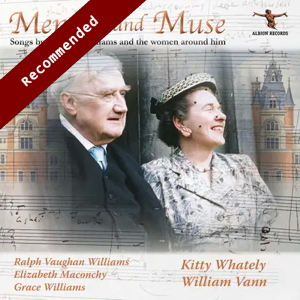
Mentor and Muse
Songs by Vaughan Williams and the women around him
Kitty Whately (mezzo-soprano), William Vann (piano)
rec. 2025, St. George’s Headstone, London, UK
Albion Records ALBCD069 [69]
It is worth stating from the outset that Kitty Whately has a genuinely compelling voice. Her rich, warm mezzo-soprano as well as her dramatic focus and well‑shaped phrasing give her singing a distinctive character. Naturally, William Vann brings his huge talent to bear on each song, providing her with finely judged support.
The recording reflects several years of collaboration between these two musicians. They became increasingly drawn to Ralph Vaughan Williams’s wider musical circle, particularly the women composers and poets who shaped his milieu. The album acknowledges RVW’s role as a mentor to Grace Williams and Elizabeth Maconchy. It also highlights the poetry of his wife Ursula Vaughan Williams and his relative Fredegond Shove, revealing a network of creative relationships that inform the programme and clearly engage the performers.
The recital opens with an old favourite, RVW’s The Sky above the Roof. He wrote it for Mabel Dearmer, setting her translation of Verlaine’s Le ciel est pardessus le toit. He initially resisted the project but relented. The story goes that one day he went up to his study, saw the mess it was in, and wrote the song rather than tidy up. The poem contrasts a serene, sun‑drenched rooftop world with a quieter undercurrent of reflection and regret. Critics often note the technical refinement Vaughan Williams gained from his studies with Maurice Ravel in Paris: it is clearly reflected in this expressive setting.
Simon Heffer’s remark in his 2000 study of the composer describes Fredegond Shove as “a wholly un-exceptional poet”. This is a good example of how certain kinds of literary achievement have been undervalued. Her gifts are quiet, and that quietness has often been mistaken for shallowness. Her poems belong to a small, modest strand of early twentieth‑century English verse – spiritual, diffident in style and limited in scope. It is a mix that seldom draws much notice.
Fredegond Shove, née Maitland, was the daughter of Adeline Fisher’s elder sister, Florence. She and her sister Ermengard served as bridesmaids at their aunt’s wedding to Vaughan Williams in 1897. In the years before the First World War, Fredegond spent periods living with Ralph and Adeline in London while she studied at Newnham College, Cambridge. That proximity informed her early intellectual and poetic development.
A.E.F. Dickinson has noted that the Four Poems of Fredegond Shove bring together four settings of poems from her 1918 published collection Dreams and Journeys. RVW made no attempt to create a song cycle.
Motion and Stillness is not as well-known as the last two songs in the group, but its intensity is unmistakable. It ponders the enduring land and sea set against vanishing clouds and ships – a world caught between calm stability and fading hope. It is a fine fusion of words and music.
Four Nights traces the speaker’s thoughts across the four seasons, moving from spring’s heavenly visions to summer’s unrest, autumn’s fierce turbulence and winter’s deep, angel‑guarded stillness where the soul lies in an enchanted quiet. RVW uses a variety of modal scales and a complex accompaniment that never lacks interest.
The most spartan of this group is The New Ghost where the progress of the song “alternates between recitative and chant espressif”. The mystical poem depicts a soul leaving its body and meeting Christ in a bright, spring‑like vision; their silent embrace marks the ghost’s peace as he follows the Lord into the heavenly realm.
The Water Mill is the best known of these four songs. Shove’s poem offers a kindly, detailed portrait of an old mill and the family who run it. It evokes the steady rhythms and quiet human dramas of rural life where toil, nature and domestic routine flow together in a single unhurried day. Vaughan Williams has provided an onomatopoeic, Schubertian vocal line and accompaniment echoing the mill lade. As a critic has suggested, “though only an English poet would so carefully note that the Miller’s tabby was ‘as lean as a healthy cat can be'”.
Like many listeners of a certain age, I first encountered Elizabeth Maconchy’s music through her remarkable portrait of a river, the overture Proud Thames (Lyrita Records, SRCS 57). Since then, a number of her compositions have been recorded, though much still awaits exploration by performers and record companies. Even so, the existing catalogue is substantial enough to allow an educated assessment of her achievement.
In recent years, two discs of songs by Maconchy and her mentor and teacher RVW have appeared on Resonus (review ~ review). Inevitably, there is overlap between the songs compiled by tenor James Geer and pianist Ronald Woodley and the seven songs on this new album.
In a Fountain Court is set to the words by the Symbolist poet Arthur Symons. The poem evokes a languid June afternoon when nature’s drowsy peace becomes a setting of expectancy, the speaker waiting for the beloved to arrive. Maconchy has not eschewed modal scales and harmonies in this gentle song. Impetuous Heart, Be Still is the earliest Maconchy piece on this disc. It sets a star‑lit yearning verse by W.B. Yeats from his play The Countess Kathleen. This is an impressively confident piece for a composer still in her teens.
The intensely beautiful The Woodspurge was originally a piano solo, written in 1929. Gabriel Rossetti’s poem captures a moment of weariness in which grief reduces everything to one simple, almost accidental observation: the wood spurge’s three‑cupped flower, the single fact that remains when all else is drained away.
The Exequy sets a handful of lines from Bishop of Chichester Henry King’s long elegy Exequy on His Wife, written as he mourned his young spouse. It is not easy to absorb: the musical realisation is often astringent, though at moments unexpectedly exquisite. Its tolling accompaniment offers a discreet nod to Ravel’s Le Gibet from Gaspard de la nuit.
There follow two songs from Four Shakespeare Songs. Come Away, Death (from Twelfth Night, Act II, Scene 4) is intense and marked by rapid shifts of dynamic. King Stephen (from Othello, Act II, Scene 3) is a will‑o’-the‑wisp miniature, its toccata‑like accompaniment sharpening the Bard’s wry admonition against pride.
The last of Elizabeth Maconchy’s songs recorded here is Ophelia’s Song (from Hamlet Act IV Scene 5). In this delicate lament, a grief‑stricken young woman describes her true love’s death with childlike simplicity and haunting tenderness.
Grace Williams is one of the quadrumvirate of composers who dominated Welsh music in the twentieth century, alongside Alun Hoddinott, William Mathias and Daniel Jones. Williams was born in the coastal town of Barry in South Wales. She studied at the Royal College of Music under the auspices of ‘Uncle Ralph’. Her contemporaries included Imogen Holst and Elizabeth Maconchy.
The song cycle for contralto and piano, Billows of the Sea, was commissioned by the Guild for Promotion of Welsh Music for the 1969 Swansea Festival. The English texts centred around themes of the ocean, seafaring and parting. The booklet quotes Kenneth Loveland, for The Times. He recalled that Grace Williams lived by the sea and “that her sea on this occasion is a demanding and angry one, tearing lovers apart […] or claiming them as its prey”.
The first song, to a text by Walter Scott, recounts how the noble Rosabelle, ignoring ominous warnings and portents, crosses the stormy Firth of Forth to visit her mother. She perishes at sea as supernatural fires blaze over Roslin Chapel in a prophetic tribute to her doomed lineage. This dramatic, non-strophic song is operatic in scope. Tennyson’s Sweet and Low was originally part of Williams’s three Songs of Sleep from 1959. In this intense lullaby, the poet is expressing a mother’s hope that the West Wind will bring the child’s absent father safely home, as she lulls her baby to sleep.
The anonymous Galloway ballad in a strophic form, The Lowlands of Holland, nearest approaches folk song. A young woman mourns the loss of her drowned lover, refusing all comfort or future suitors; the music well reflects the tragedy. Black-Eyed Susan is the most approachable stylistically, yet there is suppressed tragedy throughout. In this scena, a young woman finds her sailor lover aboard the fleet, and the pair exchange vows of fidelity before duty forces “Sweet William” to depart and Susan to watch his ship sail away. Almost certainly they never saw each other again: a scene repeated so often in history.
One other number by Grace Williams is included, the gloomy but perfectly judged setting of the anonymous ballad collected by Walter Scott, The Lament of the Border Widow. A woman laments the murder of her beloved knight, burying him with her own hands and vowing never to love again.
For me, the highlight on this disc is Kitty Whatley’s response to RVW’s Four Last Songs.According to Michael Kennedy’s Catalogue of Works, this was not his last work: it seems that The First Nowell was to follow. To be sure, the songs were devised over a four-year period; the last was completed shortly before the composer’s death on 26 August 1958. They are all settings of poems by his wife Ursula. I think that the listener will be struck by the valedictory mood of these songs, as if both partners knew that time together was short and precious.
The first song shows Procris in her last moments after her husband Cephalus struck her with an arrow. Around her, spring is beginning to wake, and its gentle new life makes her fading hope and stillness feel even more tragic. The second song, Tired, creates a quiet, tender closeness in which sleep becomes a refuge, its soft firelit imagery suggesting love expressed through stillness and memory rather than passion.
The notes explain that RVW read Hands, Eyes and Hearts in 1938 and did not understand the sentiment. This setting distils love into touch, vision and inner stillness, each offering a wordless pledge. The final number requires the listener to recall that Menelaus, King of Sparta, had his wife Helen taken by Paris to his native Troy. This is the most dramatic song of the set. Menelaus comes home not to remembered earthly beauty but to a dwelling of timeless welcome, where wind, sea and lamplight settle into a quiet vision of rest and renewal.
I have mentioned the stunning performances at the beginning of this review. They are complemented by an excellent recording, most helpful programme notes and full texts of all the songs. For details of Kitty Whately’s and William Vann’s resumes, see their webpages.
In sum, this Albion release offers a vividly drawn portrait of Vaughan Williams’s creative circle. The performers bring great sensitivity to the songs of Grace Williams, Elizabeth Maconchy and RVW himself.
John France
Buying this recording via the link below generates revenue for MWI, which helps the site remain free

Contents
Ralph Vaughan Williams (1872-1958)
The Sky Above the Roof (Mabel Dearmer) (1908)
Four poems of Fredegond Shove (1925):
Motion and Stillness; Four Nights; The New Ghost; The Water Mill
Elizabeth Maconchy (1907-1994)
In Fountain Court (Arthur Symons) (1929)
Impetuous Heart, Be Still (W.B. Yeats) (1924)
The Woodspurge (Dante Gabriel Rossetti) (1930)
The Exequy (Henry King) (1956)
Come Away, Death (William Shakespeare) (1965)
King Stephen (William Shakespeare) (1965)
Ophelia’s Song (William Shakespeare) (1926)
Grace Williams (1906-1977)
Billows of the Sea (1969):
Rosabelle (Walter Scott); Sweet and Low (Alfred, Lord Tennyson); The Lowlands of Holland (Trad.); Black-Eyed Susan (John Gay)
The Lament of the Border Widow (Anon., collected by Walter Scott) (1952)
Ralph Vaughan Williams
Four Last Songs (Ursula Vaughan Williams) (1954-1958):
Procris; Tired; Hands, Eyes and Hearts; Menelaus