
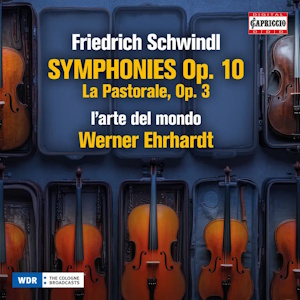
Friedrich Schwindl (1737-1786)
Symphony in C major, Op. 10 No. 1 (Op. 10 publ. 1782)
Symphony in E-flat major, Op. 10 No. 3
Symphony in G major, Op. 10 No. 2
Symphony in D major, Op. 3 No. 2 “La Pastorale” (?1760s)
l’arte del mondo/Werner Ehrhardt
rec. 25-28 November 2024, Bayer Erholungshaus, Leverkusen, Germany.
Capriccio C5558 [51]
Friedrich Schwindl is almost unknown today, but was a highly esteemed violinist and composer in his time. His name crops up with praise in the writings of Charles Burney and Daniel Schubart, with Leopold Mozart rudely lumping him together with other Dutch composers as “mediocrities: half-composer, half-scribbler” in a letter to his famous son in 1778. Not a huge amount is known about his life, but he was born in Amsterdam, and his career can be followed via the court of William V in The Hague, along the Rhine from the Netherlands to Geneva in Switzerland and Karlsruhe in Germany.
Schwindl’s work consists mostly of instrumental music and symphonies in particular. 31 of these are known to have survived, and it is thanks to the efforts of Werner Ehrhart that they have been revived in this excellent recording. Schwindl was renowned in his day for his music for violin, made all the more popular by its being approachable to amateur musicians. In a similar way, his symphonic compositions belong somewhat to the Mannheim School, but with a rustic character that lifts it a touch beyond musicians’ in-jokes and shifts the balance a little closer to the listener. There is no shortage of virtuosity in some movements, and even some moments of sturm und drang such as in a few of the harmonic twists in the Allegro assai final movement of Op. 10 No. 1.
Schwindl was clearly no stranger to the Empfinsamer Stil, with tender melancholy to be found in the Largo introduction to Op. 10 No. 3, but his slow Andante movements tend more to have the atmosphere of formal dances, with a certain amount of bounce in their momentum rather than being searching emotional journeys. The outstanding example here is the second movement of Op. 3 No. 2, which has a few jaw-dropping cadences and some delicious suspensions and interruptions. This symphony earns its nickname ‘La pastorale’ with frequent ‘drone’ tones, and even a pre-echo of Beethoven’s Sixth Symphony in its first Vivace movement. Outer movements throughout are both energetic and charming, filled with the kind of contrast guaranteed to thrill audiences of the day, and with moments of eccentricity and humour that reward closer listening. Take for instance the sprightly notes of the first movement in Op. 10 No. 2, with ‘fun’ accents that initially disorientate the ear and return to tease us throughout the symphony.
This whole collection is beautifully recorded in a spacious acoustic, and superbly played by Ehrhart’s l’arte del mondo, an orchestra that takes full advantage of modern instruments while playing in that crisp style we have come to associate with authentic period practice. I have enjoyed their sound before in symphonies by Carl Stamitz on the CPO label (review). Brand new classical discoveries don’t come along every day, but this one is very much worth becoming acquainted with.
Dominy Clements
Buying this recording via the link below generates revenue for MWI, which helps the site remain free













