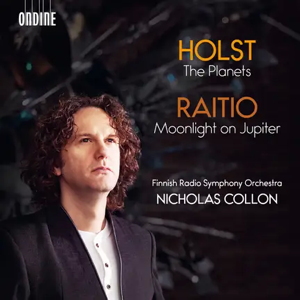
Gustav Holst (1874-1934)
The Planets (1914-1916)
Väinö Raitio (1891-1945)
Moonlight on Jupiter (1922-1923)
Helsinki Chamber Choir, Finnish Radio Symphony Orchestra / Nicholas Collon
rec. 2025, Helsinki Music Centre, Helsinki, Finland
Ondine ODE 1491-2 [63]
British conductor Nicholas Collon may be best known to UK audiences through his work with Aurora Orchestra which he founded, the remarkable ensemble that plays much of its repertoire from memory. He is also the Chief Conductor of the Finnish Radio Symphony Orchestra, and this disc showcases some excellent work with them. This programme comes from a conductor steeped in the British love for Gustav Holst’s Planets who leads an orchestra from a very different tradition. There is an extra sprinkle of Finnish seasoning to end the disc: Väinö Raitio’s Moonlight on Jupiter.
The most important thing is that Collon clearly knows well what he is doing, and the orchestra follow brilliantly. He paces Mars relatively slowly and deliberately; every note of that all-important ostinato is phrased with distinctiveness and clarity. This makes it sound all the more threatening, something helped by the beautifully balanced recording. It is expertly realised across the dynamic range: the bass drum sounds great, for example, as does the snare drum in a central section which builds momentum terrifically. Collon is admirably controlled throughout this, and does not let the momentum run away: the tempo in the recapitulation is the same as it was in the beginning, no small thing in this music!
That control is even more important in Saturn, whose inexorable tread gathers a real sense of darkness as it develops. In fact, there is a desperate edge of melancholy right from the opening notes, and a sense of near-panic when the chime of the bells comes in at the climax. The harp then seems gently to placate this, and the sweetening of the final pages is deliciously realised; the organ plays just the right role in the sound picture. Uranus is a hoot. The wind and harp chuckles at the beginning sound terrifically clean, and the main march is honkytonk without, importantly, ever veering into outright comedy. The organ glissando at the climax is a little bit tricky to make out, but that is a problem in nearly every recording, and in most concert performances.
The orchestra play for Collon with real gusto. There is tremendous bite to Jupiter, with the same clear articulation he deployed in Mars. Here, however, it creates swaggering vigour so that the outer sections feel like a stomping dance, while the majestic central theme broadens out with tremendous self-assurance. Collon’s phrasing is much more flexible here, and the orchestra follow him to give exquisite weight to the unfolding jollity.
In contrast, Venus and Mercury are more delicate and lyrical in their different ways, Venus with calm expansiveness, Mercury with filigree delicacy, wonderfully light on its feet. Neptune, on the other hand, has a sense of weight, almost mild terror, to its mysticism. From the opening wilting wind chords, there is a real sense of strangeness here, and the orchestra leans into that; there is a sense of us being out on the edge of the unknown. The chorus steal in mysteriously at their entrance: they develop into a presence that will be too prominent for some listeners, but they always sound very refined. That apart, however, there is little comfort in this Neptune as we gaze out into infinity, more a sense of our own smallness, without any real resolution.
Maybe that is because here it is not the end of the journey. Collon’s Planets follow in an honourable tradition of discs that add a movement, and it is quite right in this case that it should be by a Finnish composer. Väinö Raitio was inspired to write Moonlight on Jupiter by a dream where he took a voyage through space and saw the many moons of Jupiter. It is a good choice of companion piece, not only for its inter-planetary subject matter. It also uses a Planets-sized orchestra and deploys some of the effects Holst employed. It has a particular affinity for Neptune in its fragmentary structure and in overall mysterious musical tone, full of twinkling effects and orchestral extremes that appear and disappear without much warning.
The work is well worth hearing, and it is played with just as much commitment as Holst’s more famous suite. It is another question whether it will persuade anyone to buy this Planets over more established classics – Boult or Dutoit, or more recently Rattle or Pappano. I found this disc hugely satisfying for the surety of the conducting, the commitment of the playing and the marvellous recorded sound.
Simon Thompson
Buying this recording via the link below generates revenue for MWI, which helps the site remain free