
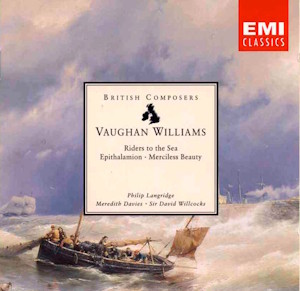
Ralph Vaughan Williams (1872-1958)
Riders to the Sea, Opera in one act (1925-32)
Merciless Beauty (Chaucer) – Three rondels for voice & string trio
Epithalamion (Spenser) – for baritone, chorus, piano, solo flute & string orchestra
rec. 1970 (Riders), 1986 (Beauty), No. 1 Studio, Abbey Road, London
English texts
EMI Classics 7647302 [75]
Despite its reputation as a RVW connoisseur’s piece, this short opera still does not appear that often and it remains more something for the specialist. It has received a number of mentions in earlier MWI reviews and has even been accorded the title of “neglected masterpiece” but I do not think this first recording (sadly no longer available new) has been reviewed on this site – and although a later recordings by Łukasz Borowicz on the Dux label was reviewed, it was considered inferior to both this and Richard Hickox’s recording for Chandos in 1995.
The reasons for its neglect are not difficult to find. Its story is unremittingly grim, bleak and tragic, and its brevity – here, thirty-six minutes – means that to constitute an evening’s entertainment it has to be paired with another short opera. That works for Cav ‘n Pag but its austerity makes it hard to match and I would add that while it makes subtle use of motifs, it isn’t exactly full of rollicking good tunes like those two favourites, for all that they, too, hardly have uplifting endings.
Vaughan Williams set John Millington Synge’s one act play of the same name virtually word for word. The action takes place in a homestead on the wild Atlantic coast of Ireland; the main character is Maurya, an aging mother who has already lost her husband and four sons to the sea, only to learn that her two remaining sons have also drowned. Whether you find the conclusion, in which her grief and sense of loss are transmuted into resignation and the acceptance of mortality via a serene monologue which switches into the key of E major, to be convincing, is a moot point but one thing I can tell you: you would not leave an opera house or eject the CD (a download is currently unavailable) feeling any sense of elation, or whistling the melodies – unless for you its catharsis operates as Vaughan Williams presumably intended.
He does not go in for anything overtly “Irish” in the music and although the text contains some specifically local dialect there is in this recording an element of inconsistency in how the cast members enunciate, their accents veering slightly awkwardly between RP and the odd Irish inflection. The young Margaret Price manages it best while displaying the purity of tone for which she later became famous. However, the singing of her three principal co-singers here is stellar, especially that of the great Welsh contralto Helen Watts, as the “old woman looking for the grave”. While the setting is specifically Irish, thematically it has the simplicity and universality of Greek drama, a quality enhanced by the way it preserves the Unities of time, place and action and the manner in which its tragic conclusion is presented as inexorably and inescapably ordained by Fate.
As you might by now have divined, I respect this work more than I like it. It is atmospherically very strong: the sound of the sea is pervasive throughout the score, supplemented by some sound effects of rushing wind and turbulent waters. The scoring is spare and often prescient of the Sinfonia antartica, especially with regard to the presence of a wordless background chorus; the vocal line winds along often within a limited range of just four tones, recreating a dark, keening mode in natural speech rhythms which is only occasionally breached at more dramatic points. In some ways it is the English equivalent of Bluebeard’s Castle in its claustrophobic intensity but without that masterwork’s melodic breadth or richness of orchestration.
The best music is given to Maurya, even if it is somewhat fragmentary, and Helen Watts sings it with flawless beauty; her narration of her vision of “the dead man with the child in his arms” is chilling and her final prayer moving in its simplicity.
The other works on this disc derive their texts from the English poets Chaucer and Spenser, lamenting and celebrating the power of love respectively. The first two of the three poems attributed to Chaucer are plangent and melancholy, the third much jauntier but still tinged with regret; all are sung elegantly by Philip Langridge. The hymn to married love is Vaughan Williams’ revision of his updated masque The Bridal Day, adapted as a cantata for baritone soloist, chorus, piano, solo flute and orchestra; its high-spirits are welcome after the gloom of the preceding items in the programme. It is somewhat episodic in structure and conventional in content, and while its lack of drama does not make it especially appealing to me, I do not mean to impugn the skill of its choral writing and orchestral colour – but it is not to my taste.
Ralph Moore
Details
Riders to the Sea:
Nora: Norma Burrowes (soprano)
Cathleen: Margaret Price (soprano)
Maurya: Helen Watts (contralto)
Bartley: Benjamin Luxon (baritone)
A woman: Pauline Steven (mezzo-soprano)
with Valerie Hill (soprano), Gloria Jennings (contralto)
Ambrosian Singers
Orchestra Nova of London/Meredith Davies
Merciless Beauty:
Philip Langridge (tenor)
Members of the Endellion String Quartet: Andrew Watkinson, James Clark (violins); David Waterman (cello)
Epithalamion:
Stephen Roberts (baritone)
Howard Shelley (piano)
Jonathan Snowden (flute)
The Bach Choir
London Philharmonic Orchestra/Sir David Willcocks
Availability
Not available new.














I’ve had this disc for a long time (being a VW nut), but rarely listen to the opera, it is so unremittingly bleak. But then, isn’t that the point, and maybe Synge should bear most of the blame? Michael Kennedy, in his book, said ”Riders to the Sea has its place among the half-dozen finest achievements of the composer,’ which is saying something, and when courage can be summoned to listen to it, it grips like a vice and doesn’t let go.
In the unlikely event it ever made it to the opera house, perhaps Holst’s ‘Perfect Fool’ might form a lighter counter; better still, though now impossible, it’s a shame VW or one of his contemporaries never saw fit to opera-tise Synge’s short comedic two-acter ‘The Tinker’s Wedding’.
It’s probably worth mentioning for those who might want to “see” the opera (in comfort!) that it’s available on a Warner DVD as a filmed performance with Sarah Walker as Maurya and conducted by Bryden Thomson. Like the reviewed CD it appears to be no longer in print, but generally available on the s/h market.