
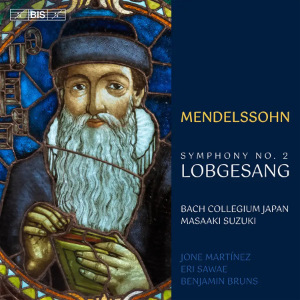
Felix Mendelssohn (1809-1847)
Symphony No. 2 in B flat major, ‘Lobgesang’ Op. 52 (1839/40)
Jone Martínez, Eri Sawae (sopranos), Benjamin Bruns (tenor)
Bach Collegium Japan/Masaaki Suzuki
rec. 2024, Tokorozawa Muse Hall, Saitama, Japan
Reviewed as a download
BIS BIS2761 SACD [62)
Years ago, I was exploring my father’s box set of the Kubelik Mendelssohn Symphonies and – being me – needing to listen to them in order. When it came to the second symphony, the oddly named Lobgesang, (Hymn of Praise), I was enjoying what I was listening to, but then something odd happened; when a loud chorus suddenly broke in, putting me right off. Now, with a newly reawakened love of Mendelssohn, and his symphonies in particular, I possess cycles by Abbado, Dohnanyi, and have heard both complete set by Paavo Järvi and the Tonhalle Orchestra of Zurich, and the recent Andris Nelsons with Mendelssohn’s own Leipzig Gewandhaus Orchestra. In the interim Lobgesang has become both significant and welcome for me. Having been even further enthused by the 2025 BBC Proms performance from the Glasshouse in Gateshead by the BBC Northern Sinfonia, conducted by Dinis Sousa, the work has now become one I actively seek out.
Mendelssohn’s highly religious second symphony (although chronologically his fourth), was written not just to celebrate the glory of God with Lutheran words and setting, but the four hundredth anniversary of Gutenberg’s invention of the printing press and moveable typeface. It was initially performed as part of larger celebrations by Mendelssohn and his own Leipzig Gewandhaus Orchestra on 25th June 1840. With the grandeur of such a work, listeners have come to expect a certain rich and full sound – the sort you might associate with the mass choirs and huge orchestras employed by the likes of Abbado, Dohnanyi and Nelsons.
Of course, there has always been a precedent for ‘thinning down the classics’, with many a success or honourable failure. One that immediately springs to mind is the piano and chorus only recording of Brahms’s German Requiem by Harry Christophers and The Sixteen. It may not be a total success, but its spare and occasionally even fierce quality works in most of the places it needs to, because it is balanced with much needed warmth and generosity. That it fails for me. is more to do with what I have come to expect, than what is actually being delivered.
Lately, the conductor Maasaki Suzuki and the chorus and orchestra of Collegium Japan have recorded their own period instrument takes on Mozart’s Requiem, Mass in C Minor and indeed the German Requiem. I had no idea of this when I first heard their new recording of Mendelssohn’s Symphony No 2 in B. Flat Major, Opus 52, BIS Records, on a streaming service. Having heard the other versions I mentioned above, I immediately realised that I was hearing something special. Only later did I find out how reduced the chorus and orchestra are in comparison to regular forces. It hardly mattered, because rarely have I been taken away by the sweep of anything both the first time and on each subsequent listen. The music, and the sheer thrill of its delivery just seem to sweep you up, so that you are astonished to find that a full hour has past and the great chorale ‘Nun Danke Alles Gott’ is upon us.
Of course, Lobgesang is a uniquely constructed symphony, only the second after Beethoven’s Ninth to feature a choral section. Beethoven’s sombre approach to the beginning of the symphony’s last movement eventually blazes into that joyful climax that changes the nature of what you have heard before for ever, The Cantata section of Mendelssohn’s symphony takes up two thirds of the work.
The symphony is divided into two sections, with the first three movement Sinfonia purely orchestral and the remainder a nine-movement cantata with full chorus and soloists. The Sinfonia is in three sections which, uniquely, are played without an interruption, beginning with a suitably majestic section, which leads in turn to an Allegro, followed by a faster and slightly more agitated Allegretto. The first two movements might tag on to each other, but the third movement reestablishes all that religious majesty and becomes a launchpad for one of the most hair-raising moments in the symphony. The chorus launches into the cantata that follows in a singularly thrilling fashion.
Despite the many qualities which I find in this recording from Suzuki, his orchestra and chorus, there is no doubt that the entrance of the chorus here simply cannot reach the sort of track and the effect it needs with so few voices. What saves them is Suzuki’s ability to build up and steer the orchestra towards that launch so thrillingly, that thrill remains into the cantata. Yes, it is much leaner, but it helps greatly that what is played on either side is so well executed and driven with such enthusiasm from both choir and orchestra that it belies such small forces. For the most part, this has proved to be so right from the beginning, where, once the initial theme has been established, the orchestra and conductor hardly let up. I do have to confess however, that although I understand Suzuki’s use and effectiveness of ‘weeping strings’, at the start of the second movement, I’m not really a fan.
All this would come to nothing if the Cantata section was weakly delivered and sung by the chorus and three soloists, especially the Hanover born Tenor Benjamin Bruns, who has the most weight to carry in what follows. It’s true that both he and soprano Ione Martinez have slightly wayward off- the- note moments, but they are soon past. In Bruns’ case, his finest moments naturally occur in section 7, ‘The Sorrows of Death’, where they need to be at their most effective. In this climactic section with its plaintive question to the Watchman if the night has passed. In “Huter! Is die Nacht bald hier?”, both the tension and the fear are as palpable as they should be. The soprano’s soaring response in the affirmative, “Die Nacht ist vergangen”, should thrill and cap the whole section, and the Basque-born singer Ione Martinez hits this with the right piercing intensity, which, apart from that minor glitch, she does throughout. Her colleague, the Japanese soprano Eri Sawae is equally secure and committed in her smaller contributions, especially her duet with Ione Martinez, where they make a glorious combination. As for the chorus and orchestra, while the first may provide the initial thrilling undercoat, the chorus provides much more than the gloss, bringing extra drive, clear diction and commitment. The ensemble is generally rich and full, despite the small choir.
Having heard several recordings of late, there is much to recommend them. I am less keen on Christoph von Dohnányi, although his singers are certainly fine and it is in many ways very fine indeed. I am also already a fan of Paavo Järvi’s rendition in his box recorded with the Tonhalle Orchestra of Zurich. Equally there is much to recommend about the very recent Andris Nelsons performance with the Leipzig Gewandhaus Orchestra, but while you can get used to the slowing down of the second movement, the continuation into the allegretto seems unforgiveable. It brings the whole thing to 74 minutes, twelve more than Suzuki, Claudio Abbado is also ponderous with his LSO recording. And Christiane Karg, Nelson’s soprano, is also wobbly and unfocussed in music that really should be the opposite. (Deutsche Gramophone CATALOGUE NO 28948 68178.)
Of course there are countless live performances out there, both official and pirated. My local charity shop came up trumps the other day when I was able to obtain a wonderful live performance with the Welsh National Orchestra conducted in 2002 by Richard Hickox. Veronique Gens gives a wonderful, soaring performance all the way through and the late great Robert Tear sings what is clearly meat and drink to him with his familiar clarity and intensity. If only I could count it!
So, then, to my conclusions. If you are familiar with Mendelssohn, but not so keen on the idea of another choral symphony, then you might hesitate to purchase this. Likewise, the idea of a reduced chorus and orchestra from a period instrument specialist like Suzuki might be a little off-putting. II can only say that I too had those qualms, but quickly overcame them due to the sheer thrill, verve and commitment of the performance. I am eager now to hear Suzuki and his choir and orchestra in their Mozart and Brahms recordings.
Steve Gladwin
Previous reviews: David Barker and John Quinn
Buying this recording via the link below generates revenue for MWI, which helps the site remain free













