
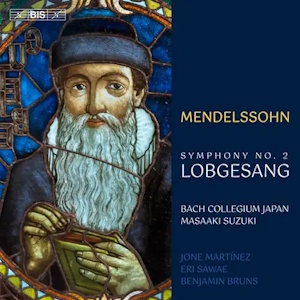
Felix Mendelssohn Bartholdy (1809-1847)
Symphony No 2 in B flat major, Op 52 MWV A 18 ‘Lobgesang’ (1839-40)
Jone Martinez (soprano I); Eri Sawae (soprano II); Benjamin Bruns (tenor)
Bach Collegium Japan choir and orchestra/Masaaki Suzuki
rec. 2024, Tokorozawa Music Hall, Saitama, Japan
German text & English translation included
BIS-2761-SACD [63]
The booklet accompanying this SACD includes a very thorough essay by Horst A Scholz, in the course of which he explains the background to the composition of ‘Lobgesang’. In 1840 the city of Leipzig held a three-day festival to celebrate the 400th anniversary of the invention of the printing press with moveable type by Johannes Gutenberg (c1400-1468). Gutenberg neither lived nor worked in Leipzig but his invention was very highly regarded there, and throughout Protestant Germany, since printing made possible the much wider dissemination of the Bible, which was a key aim of the Protestant Reformation. The climax of the Leipzig festival was a concert in the Thomaskirche which Mendelssohn was invited to conduct and for which he wrote ‘Lobgesang’. As Scholz puts it, Mendelssohn determined to “present Gutenberg’s achievement as the victory of lightness over darkness”. Later in the essay, he comments that Mendelssohn ignored the secular importance of the invention of printing; he was only concerned to celebrate the part that Gutenberg’s work came to play, years after his death, in the success of the Reformation by making the Word of God more accessible to lay people.
Structurally, the symphony is quite an odd work and I remember reading elsewhere that even Mendelssohn didn’t know how to classify it; eventually, at the suggestion of a friend, he dubbed it a ‘symphony-cantata’. The work is definitely symphonic in nature and one could say that it follows the precedent set by Beethoven in his Ninth symphony of following three orchestral movements with an extended choral finale. However, Mendelssohn’s work doesn’t exactly follow the Beethoven model in the sense that his orchestral movements are fairly short – here, they play for 24:22 – which is much less than in the Beethoven Ninth. On the other hand, the cantata-like finale is much more extended than in Beethoven’s composition – in this performance the vocal part of the work takes just over 38 minutes. It’s also worthy of note that in his finale Mendelssohn doesn’t attempt symphonic development in the way that Beethoven does; nor does he build his movement round one text; instead he sets a number of different texts drawn from various scriptural sources, and there are no fewer than nine separate sections, which play continuously. Though numbered as Mendelssohn’s Second symphony, ‘Lobgesang’ actually post-dates his Fourth symphony (1833) and Fifth (1832)
A few years ago, I heard and admired a live recording of the work in which Sir John Eliot Gardiner conducted the Monteverdi Choir and the London Symphony Orchestra (review). In many respects, that performance isn’t really comparable with the Suzuki: for example, Gardiner had 44 singers in his choir, whereas Suzuki’s ensemble has just 23 (6/5/6/6). In addition, Gardiner’s orchestra, which plays on modern instruments, of course, is much larger than Suzuki’s. The Japanese string choir numbers 24 (6/6/5/4/3) whereas the LSO string section has 50 players (14/12/10/8/6); both orchestras have similarly-sized woodwind and brass contingents. Incidentally, though Gardiner’s LSO is much bigger numerically, his is not a heavy performance. One point that I noticed, though, was that in the Suzuki performance the organ part registers impressively – and very pleasingly – at several key junctures whereas the organ is almost inaudible in the LSO performance. As I say, the respective size and nature of the two ensembles mean comparisons aren’t always appropriate; nonetheless, I found that the Gardiner provided an interesting point of reference at times.
Before we get to the vocal contributions, there’s a three-movement Sinfonia in which the three movements follow each other attacca. I took part in a performance of ‘Lobgesang’ many years ago; I remember thinking then that the chorus has to sit and wait rather a long time before getting a chance to sing. You could argue, of course, that they have to wait even longer in a performance of the Beethoven Ninth but in all honesty, I don’t think the orchestral music in Mendelssohn’s Sinfonia is as interesting to hear. Mendelssohn opens with a motto theme, heard on the trombones, which he devised for the words ‘Alles, was Odem hat, lobe den Herrn’ (All that has life and breath sing to the Lord). This motto has quite a bit of heavy lifting to do, especially in this first movement. I rather like the way Suzuki’s trombonists deliver the motto; it’s noble and sturdy and the conductor’s pacing is intelligent; he avoids portentousness, noting – as does Gardiner – that the marking is Moderato con moto. The main Allegro bowls along nicely, the textures light and airy. Gardiner, who gets the LSO to restrict their vibrato throughout the performance, is even faster in this section. This movement gives way, after a short clarinet cadenza derived from the motto theme, to a scherzo-like movement (Allegretto un poco agitato). The music is light and graceful, though I don’t find it desperately interesting. However, there’s a feature of Suzuki’s performance that I find very off-putting. He has the strings playing with a great deal of portamento, to the extent that one almost has the impression that there’s a slide into every note. This may be authentic but I find it affected. It’s noticeable that Gardiner doesn’t resort to the slides; I much prefer his approach. The last purely instrumental movement is Adagio religioso. Neither of our conductors takes the music too slowly – which is the right decision, I’m sure – but both of them invest it with a suitable degree of solemnity.
The remainder of ‘Lobgesang’ involves the singers. The texts are mainly drawn from the Old Testament. In the first section, ‘Alles, was Odem hat, lobe den Herrn’, I feel that the chorus is rather swamped when the full orchestra is playing loudly. Having said that, either the balance problems reduced as the cantata progressed or else my ears adjusted. In general, though, I would have liked a bit more choral weight in relation to the orchestra. In that context it’s noticeable that on the Gardiner recording the balance is much more satisfactory; admittedly, Gardiner has a larger choir at his disposal but they are singing “against” an orchestra which is larger than Suzuki’s and which is playing on modern instruments. I must hasten to add, though, that there’s much to admire in the overall choral contributions from Bach Collegium Japan
The Basque soprano, Jone Martinez makes a very good impression throughout; her voice is clear, bright and well-focused. Her Japanese colleague, Eri Sawae is involved in just one section, the well-known duet ‘Ich harrete des Herrn’. Here, the two solo voices blend very successfully. In this section I have a strong preference for Suzuki over Gardiner. The tempo marking is Andante and, for my money, Suzuki gets the pacing just right, whereas Gardiner is much slower – he takes a whole minute longer than Suzuki’s 4:24 – and as a result the music drags. Suzuki’s third soloist is the German tenor, Benjamin Bruns. He’s excellent, especially in his aria and recitative ‘Stricke des Todes hatten uns umfangen’; the recitative section is particularly intense.
It has to be said that one or two of the movements outstay their welcome a little – though this is not the fault of the performers. The section for soprano and chorus, ‘Die Nacht ist vergangen’ goes on a bit; some pruning by Mendelssohn would not have come amiss. An editorial pencil might also have benefitted the soprano/tenor duet ‘Drum sing ich mit meinem Liede’, though I enjoyed the very good blend between Martinez and Bruns. The final chorus opens excitingly (‘Ihr Völker! bringet her dem Herrn Ehre und Macht’). The BCJ singers enunciate the music very positively and there’s excellent definition as the various parts enter the contrapuntal mix. The Monteverdi Choir is absolutely electrifying hereabouts; some may feel the attack is overdone but I love it. When the Piú vivace is reached, Suzuki accelerates to excellent effect and the second fugue, when it arrives, is vigorous and clear. The last few pages are exhilarating and jubilant before Mendelssohn rounds off the work with one last grand choral and orchestral statement of the motto.
There’s much to admire in this performance of ‘Lobgesang’. The work is uneven and needs conductor and performers to make the strongest possible case for it. In many respects, Suzuki achieves that, though I think that the Gardiner recording makes a stronger impact.
The recorded sound is very good but, by BIS’s high standards, not outstanding; I don’t feel the choir makes a sufficient impact, though that may be the result of Suzuki’s decision to use a small, flexible group. The documentation is good.
Other reviews: John Quinn and Steve Gladwin
Previous review David Barker
Buying this recording via the link below generates revenue for MWI, which helps the site remain free













