
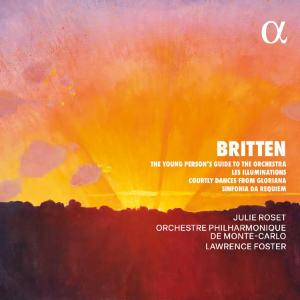
Benjamin Britten (1913-1976)
Variations and Fugue on a Theme of Purcell Op.34 (1946)
Les Illuminations Op.18 (1939)
Courtly Dances from Gloriana Op.53a (1954)
Sinfonia da Requiem Op.20 (1941)
Julie Roset (soprano)
Orchestre Philharmonique de Monte-Carlo/Lawrence Foster
rec. 2025, Auditorium Rainier III, Monaco
Text and English translation included
Alpha Classics 1226 [69]
The sleeve says on the front The Young Person’s Guide to the Orchestra. On the back, it adds more cautiously the alternative title: Variations and Fugue on a Theme of Purcell. Strictly, the first title only applies when there is narration, which is how I (and many others) first heard it and so started learning about the orchestra. But here there is no narration, so the second title applies. Be that as it may, this is a sparkling performance. Of course, the percussion version of the theme is a tour de force, as is their variation later on, but all the playing is good. I would like to single out the woodwind, and especially the first oboe, whose solo was a thing of great beauty. The fugue is nicely done, and I was again amused by Britten’s cheeky ending, a take-off of the ending of Götterdämmerung. Purcell’s theme on the brass stands in for Valhalla, and the fugue dances around it for the Rhinemaidens.
We have been used to hearing the song cycle Les Illuminations performed by tenors, and indeed Britten recorded it with Peter Pears. Actually, however, Britten wrote it for a high soprano, specifically Sophie Wyss. The words are taken from the prose poems of Arthur Rimbaud, the French symbolist who wrote his dazzling works in his teens and then abandoned literature altogether. Britten’s settings, wonderfully evocative, are finely realised by Julie Roset, who navigates the high-lying, chromatic and often tricky vocal line with aplomb. The way she takes et je danse at the end of Phrase does not banish memories of Pears but is just as good, and Being Beauteous is precisely realised. I think I now prefer to hear this with a soprano, as Britten originally imagined it.
The Courtly Dances were taken from the opera Gloriana, commissioned to celebrate the coronation of Queen Elizabeth II. It has never recovered from its unsuccessful premiere at a Royal Gala. This was a disastrous decision by the authorities: galas are fund-raising events, and the programme is usually a medley of popular numbers planned for the taste of a generous but non-specialist audience. A new modern opera hardly had a fair chance. The Courtly Dances are written in Elizabethan forms such as Pavane and Galliard. They are, however, not exactly pastiches of Elizabethan music, and, of course, they are played on modern instruments. They are nicely done but I cannot help feeling that, apart from the delightful Morris Dance, they are not top-drawer Britten.
The Sinfonia da Requiem most emphatically is. Britten only purely orchestral symphony, it was originally intended for the Japanese, with whom Britain was not yet at war. Not surprisingly, though, they rejected it because it is not a festive work, and furthermore the individual movements have titles taken from the sections of the Requiem Mass. In fact, Britten wrote the work in memory of his parents. The orchestra adds two horns, a piano and an alto saxophone to the normal complement, and the scoring is very rich and full. The opening Lacrymosa is a full-throated lament. The fast-moving Dies irae begins with flutter-tonguing on the flutes. Later, there is an eloquent solo on the saxophone. In the final Requiem aeternum, quite short, one can hear echoes of Stravinsky and Berg.
Lawrence Foster secures admirably clean and clear playing from the Orchestre Philharmonique de Monte-Carlo. I do not know how much experience they had had with these scores, but they certainly play idiomatically. Britten himself recorded Variations and Fugue on a Theme of Purcell and Sinfonia da Requiem, and Les Illuminations with Pears. His versions are benchmarks, but I do not think that in classical music there is such a thing as a definitive performance, and one of its glories is its openness to new interpreters. The performances here are all good, and so is the recording. There is no exact equivalent to this programme, so if it suits, go for it.
Stephen Barber
Buying this recording via the link below generates revenue for MWI, which helps the site remain free













