
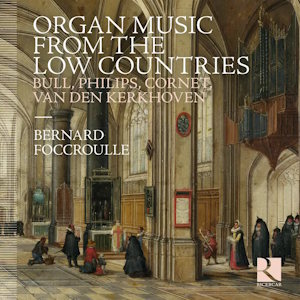
Organ Music from the Low Countries
Bernard Foccroulle (organ)
rec. 2024, Sint-Martinuskerk, Cuijk, Netherlands; Sint-Jacobuskerk, Sint-Truiden, Belgium; Sint-Jan-de-Doper, Groot Begijnhof, Leuven, Belgium
Reviewed as a download
Ricercar RIC478 [69]
The title of the disc, ‘Organ Music from the Low Countries’, is a little misleading; many people will immediately think of Jan Pieterszoon Sweelinck. He, however, was the main composer of keyboard music around 1600 in the Northern Netherlands, also known as the Republic of the United Provinces; this programme recorded by Bernard Foccroulle rather focuses on the southern or Spanish Netherlands, the region now known as Belgium (but including some parts of what are now the Netherlands in the north and France in the south).
Few composers from that part of the Netherlands are known or turn up regularly in recordings and concert programmes, except for two immigrants: John Bull and Peter Philips. Obviously, organists know the homegrown composers Peeter Cornet and Abraham Van den Kerckhoven. Both have left exclusively music for organ and because of their quality, their organ works are part of the standard repertoire of organists who play early music. However, the southern Netherlands were also important because of the standard of organ building. Not only were their instruments in demand because of their excellent construction, but also for stylistic reasons, especially the variety of the stops. Bernard Foccroulle is an expert in music of this period and has a thorough knowledge of the organ landscape of the 16th and 17th centuries. In the liner-notes to a previous production, devoted to Francisco Correa de Arauxo (review), he pointed out that Spanish composers of that time used to play instruments which stylistically have their roots in organ building in the Netherlands. “[The] instruments that Correa played and heard in Seville were mainly Flemish organs: Cabezón had invited the Brebos family from Antwerp to build the four organs of the Escorial, after which organ builders from Flanders and Northern France had come to most of the major Spanish cities to build instruments that revolutionised the late medieval organ.” In the liner-notes to the present recording he states that their influence was not confined to Spain. “Although no 16th-century organs have survived in Belgium (…) and very few instruments from the early 17th century have been preserved, the reputation of this school can be gauged by the number of organs built during this period by Flemish and Walloon organ builders in Spain, France, Italy, Sweden and other countries.” In his programme he especially connects the southern Netherlands to France, as he often uses stops of the kind we find later in the ‘classical’ French organ, such as the cornet, or combinations of instruments, known later as plein-jeu or grand-jeu.
The two English-born composers, John Bull and Peter Philips, became acquainted with organs of a kind they had not known in England. Both were Catholics who left their country, but for different reasons. In the case of Philips, his faith was the main reason. He was a pupil of William Byrd and left England in 1582. After a short stay in Brussels, he travelled to Italy, where he came under the spell of the Italian style, which left its mark on his development as a composer of vocal music. His motets and madrigals reflect the influence of what he had heard and learnt in Italy. In Rome, he was under the protection of Cardinal Alessandro Farnese, and acted as an organist at the English College. From 1585 he travelled through Europe with another English refugee, Lord Thomas Paget. In 1591 Philips settled in Antwerp, where he was teaching the keyboard, married and established relations with key figures in society. In 1597 he became organist to Archduke Albert, governor of the southern Netherlands, in Brussels. There he met Girolamo Frescobaldi in 1607/08. Philips has not left that much keyboard music, and most of it is intended for the harpsichord. Veni sancte Spiritus is one of the very few organ works; it is a liturgical piece, a sequence for the masses at Whitsun. It was originally called Veni Creator Spiritus, the title of the first section, and one may assume that it was intended for the alternatim practice. However, the hymn consists of ten stanzas of three lines each, and Philips has set them all. If it was intended for the alternatim practice, the organist may have had the choice which of the stanzas should be played and which should be sung. In all sections, the melody of the sequence is in the bass, as the foundation of four-part harmonisations.
When John Bull left England, settled in the Spanish Netherlands, and looked for a job, he stated that he had done so for religious reasons, being a Catholic. Although it is certainly true that the situation of Catholics under the firmly Protestant Elizabeth I was precarious, it is unlikely that this had any influence on Bull’s career. It is even questionable whether he was a Catholic while living in England. Soon being recognized as a keyboard virtuoso, he was appointed organist at Hereford Cathedral, where he previously had entered the choir; a few years later he also became master of the choristers. In 1586 he entered the Chapel Royal as a Gentleman, and acted as the queen’s – and later King James’ – organist. In addition, he made a career in science as he gained doctorates at the universities of Cambridge and Oxford. It was in fact his fiery temperament that resulted in conflicts with his employers, and his immoral behaviour, including frequent adultery, that led to his downfall. In Brussels he was engaged by Archduke Albert as organist. King James insisted that Bull should be dismissed; this intervention was successful but Bull did not return to England. He went to Antwerp where he was appointed organist at the Cathedral. He held this post until his death.
Although Bull left some vocal and consort music, the largest part of his oeuvre consists of keyboard works. Foccroulle observes a difference between the organ works from his English period and those he wrote on the continent. The former are mainly fantasias for an organ with a single manual, whereas some of his later works require two manuals and use split registers in the bass and treble. His Salve Regina is certainly intended for the alternatim practice. Here Foccroulle uses registrations we know from later French music. For instance, the first section is played with plein-jeu, the third as a basse de trompette. I don’t know what made Foccroulle choose some registrations. Has he tried to adapt them to the text? The use of the cornet stop certainly fits the second section, Ad te clamamus (To thee do we cry), as does the more intimate registration of O clemens (O clement, O loving, O sweet Virgin Mary).
The two variations on two Christmas carols on Dutch texts attest to Bull’s adoption of traditions in his new environment. Laet ons met herten reijne is interesting in that the score includes an indication of the registration: in bar 35 the right hand should play the cornet, the left hand the crumhorn. La Guamina is based on a canzona by the Italian composer Gioseffo Guami. The second section includes a solo line. Bull met Jan Pieterszoon Sweelinck, and the two composers held each other in high esteem. Bull undoubtedly intended his Fantasia on a theme by Sweelinck as an epitaph: he composed it shortly after Sweelinck’s death. It is fittingly dominated by a chromatic subject.
Peeter Cornet is the least-known composer in the programme. He was born in Brussels, where he worked all his life. He was from a family of musicians, some of whom were members of the Capilla Fiamenca in Madrid. Around 1606 he became organist to Archduchess Isabella; he was also active as an organ builder. He has left a small oeuvre which consists of a number of fantasias, two courantes, a toccata and some liturgical works. One of the latter is Regina caeli, one of the Marian antiphons. All the four lines are set by Cornet; if it is intended for the alteratim practice, the organist may choose which ones to play. Again, Foccroulle largely uses registrations known from French organ music. For the second verse (For He whom you did merit to bear), he chose flute stops. The use of the cornet in the right hand fits the text of the third verse: “[He] has risen, as he said”. Tantum ergo is the title of the last two stanzas of the eucharistic hymn Pange lingua. Foccroulle also included two of the fantasias, one of which is based on a canzona theme.
Abraham Van den Kerckhoven is of a later generation than the three composers just discussed. He was a pupil of Peeter Cornet’s nephew Franciscus. In 1632, at the age of just fifteen, he was appointed organist at the church of Sainte-Catherine in Brussels; he held this post until his death. According to New Grove he has not left many organ works, but Foccroulle mentions that most of the 361 organ works in the Manuscript II 3326, preserved in the Bibliothèque Royale in Brussels, are attributed to him. The Fantasia 353 pro duplici organo is specifically intended for an organ with two manuals. Towards the end Van den Kerckhoven uses them to create echo effects, something that was very popular in the 17th century. The last work in the programme, the Fantasia 356 in D minor, is his best-known composition, which is a récit de cornet; the cornet is in the right hand. Foccroulle sees a similarity with the Spanish tientos written in his time.
Bernard Foccroulle’s many recordings attest to his comprehensive knowledge of the organ music and instruments of this period and this disc is another excellent example of that. His style of playing is engaging; he plays three different instruments, each with its own character and the booklet includes all the technical details. He knows exactly how to use them to do justice to the character of each piece. The registration of each work – specified in the booklet – is well thought out and always makes sense. This disc is also very interesting from a historical point of view, as it shows the roots of music of later times, especially in France, which may be much better known. Lovers of the classical French organ music may find this disc especially interesting. However, it also contributes to our knowledge of music life in the southern Netherlands in the 17th century, which too often overlooked. If I may express a wish: more Van den Kerckhoven would be very welcome.
Johan van Veen
http://www.musica-dei-donum.org
https://twitter.com/johanvanveen
https://bsky.app/profile/musicadeidonum.bsky.social
Buying this recording via the link below generates revenue for MWI, which helps the site remain free
Contents
[Cuijk]
John Bull (1562/63-1628)
Salve Regina. Misere Cordi
Prelude and Carol Laet ons met herten reijne
La Guamina
Peter Philips (1560/61-1628)
Veni sancte Spiritus
Abraham Van den Kerckhoven (c1618-1702)
Fantasia 353 in D pro duplici organo
[Sint-Truiden]
Peter Philips
Fantaisie de Pietro Philippi (9)
Peeter Cornet (c1570/80-1633)
Regina caeli
anon [Liber Fratrum Cruciferorum Leodiensium, 1617]
[Fantasia]
[Toccata]
[Leuven]
Peeter Cornet
Tantum ergo
Fantasia 8. toni [Canzona]
Fantasia 8. toni
John Bull
Een Kindeken is ons geboren
Fantasia on a theme by Sweelinck
Abraham Van den Kerckhoven
Fantasia 356 in D minor













