
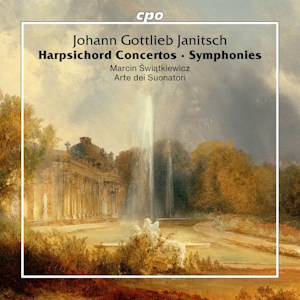
Johann Gottlieb Janitsch (1708-1763)
Symphony in F major JWV 7:F6
Concerto in F major JWV 6:F1
Symphony in E flat major JWV 7:Es3
Concerto in A flat major JWV 6:As1
Arte dei Suonatori/Marcin Świątkiewicz (harpsichord)
rec. 2024, Concert Hall of the State Music School in Jastrzębie-Zdrój, Poland
cpo 555 772-2 [54]
Johann Gottlieb Janitsch was born in Schweidnitz, then in Silesia, and now Świdnica in Poland. He studied law and in 1733 was employed as secretary to the Prussian state and war minister Franz Wilhelm von Happe in Berlin, but music was always a significant part of his life and from 1736 onwards he was to be found playing double bass in ensembles including the Berlin Court Orchestra, with duties including commissions for new music for the aristocracy, and programmes for Freitagsakademien or Friday academies in which concerts were given by both professional and amateur musicians.
Many of Janitsch’s manuscripts are to be found in the archive of the Sing-Akademie in Berlin, and his works were a popular part of the Berlin variant of the fashionable ‘galant style’ of his day. He has however been overshadowed by better-known contemporaries, and Marcin Świątkiewicz’s booklet notes suggest that these recordings are very likely to be world premieres. Composers that fall in between the clearer definitions of Baroque and Classical style are often at a disadvantage, and Janitsch’s work is ripe for discovery and a revival that can only be assisted by excellent recordings such as this CPO album.
The ‘galant’ nature of these pieces provides them with a superficial ease and fluency that would have given them greater currency as entertainments of the period compared to the reception of today’s overloaded ears and minds, but as with all fine music the closer you listen the more there is to discover. Powerful emotions are held in reserve, but listen to the Adagio of the Concerto in F major JWV 6:F1 and you will find a whiff of familiarity in a theme that anticipates the Lacrimosa from Mozart’s Requiem. There is a refreshing directness to all of the music here. Outer movements have a lively character, but there are harmonic surprises to be found such as the sliding chromatics in the opening Andante of the Concerto in A flat major JWV 6:As1. The concertos have the fun of that added layer of virtuoso keyboard playing, but the two Sinfonias recorded here are no less fascinating, with movements such as the opening Allegro of the Symphony in E flat major JWV 7:Es3 having plenty of that explosive dynamic character that makes C.P.E. Bach such a favourite.
I have long had a soft spot for the sound of Arte dei Suonatori in their recordings for the BIS label (review), and they are as crisp and colourful here as you could want, with good sonics as ever from cpo. Marcin Świątkiewicz directs with alert attention to details and contrasts that make the most of each score, and the Christian Fuchs copy of a Ruckers harpsichord that he plays works superbly both as a continuo and solo instrument. There are many scores by this composer yet to be unearthed and for one I will be keeping an eye out for more recordings.
Dominy Clements
Buying this recording via the link below generates revenue for MWI, which helps the site remain free













