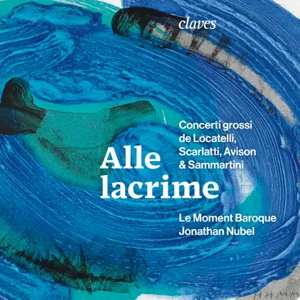
Alle lacrime. Concerti grossi de Locatelli, Scarlatti, Avison & Sammartini
Le Moment Baroque / Jonathan Nubel
rec. 2024, Aula du Lycée cantonal, Porrentruy, Switzerland
Reviewed as a download
Claves CD 50-3130 [62]
There are few composers who have had such a huge influence on the course of music history as Arcangelo Corelli. With his trio sonatas he set the standard of the genre, and his sonatas for violin and basso continuo Op. 5 were elevated to cult status soon after their publication. They were seen as models of the genre of the solo sonata, and they became available in various adaptations and arrangements, including concerti grossi. The latter represented a genre that closed the series of publications of Corelli’s oeuvre: in 1714 a set of twelve concerti grossi Op. 6 were published posthumously. They inspired composers across Europe to write such concertos.
This disc offers specimens of the genre which show that composers did not imitate Corelli, but were willing to follow their own path in the genre. Pietro Antonio Locatelli is a case in point. Three concerti grossi are included here. Two are from his first published set of works, twelve concertos Op. 1, which were printed by Le Cène in Amsterdam in 1721. A reprint dates from 1729, the year Locatelli seems to have settled in Amsterdam, where he would stay for the rest of his life. The Op. 1 concertos – consisting of eight concerti da chiesa and four concerti da camera – strongly adhere to the tradition established by Corelli. However, Locatelli follows his own path in that he extends the concertino from three to four by including a viola part. In two of the concerti grossi he even adds a second viola part; one of them is the Concerto No. 7 in F. The middle movement, a largo, is notable for its unusual harmonic progressions.
The last printed edition of Locatelli’s music was the Op. 7, a set of six Concerti grossi, published in Leyden by Adriaen van der Hoeven. The concertino is usually made up of two violins, viola and cello; one concerto omits the viola. The last concerto is the most unusual and – because of that – the one which is most frequently performed. It is a kind of instrumental cantata, called Il pianto d’Arianna. The fate of this mythological figure who is left by her lover Theseus was the subject of many cantatas and operas in the baroque era. Locatelli did not add any description, so it is left to the listener to connect the various movements to episodes in the story. The turmoil of Ariadne’s emotions is vividly depicted with purely instrumental means, but Locatelli makes use of vocal devices, such as the recitative. The fact that this is a descriptive work, that it consists of ten movements, and the first violin has a solo part in several movements indicates to what extent Locatelli here departs from the Corellian concerto grosso.
The popularity of the concerto grosso also comes to the fore in the oeuvre of Charles Avison. He has become known as a great admirer of the Italian style and especially the oeuvre of Francesco Geminiani, whom he compared favourably to Handel. He was also one of many in England who were impressed by the keyboard sonatas of Domenico Scarlatti. He decided to transcribe a number of them for strings and basso continuo. In 1744 he published Twelve Concertos in Seven Parts … Done from Two Books of Lessons for the Harpsicord Composed by Sig. Domenico Scarlatti. One year before he had already published one concerto and announced the publication of the complete set if there were at least one hundred subscriptions. The fact that there were no fewer than 151 subscribers attests to the popularity of concerti grossi and of Domenico Scarlatti in particular. Not all the movements are based on Scarlatti’s sonatas; if Avison could not find a sonata which he could use, he added something original of his own. That is the case with the Concerto No. 5 in d minor. The first movement is original Avison; the other three movements are transcriptions of Scarlatti’s sonatas K 11, 4 and 5 respectively.
These concertos are not his only involvement with music of the Scarlatti family. The programme opens with the Concerto in F by Francesco Scarlatti, the younger brother of Alessandro. He settled in England in 1719, where he stayed until 1733, when he went to Dublin. This piece is part of Avison’s Workbook I, which was discovered in 2000. Avison attributed this piece to Alessandro, but in 2016 Michael Talbot, the well-known expert on Italian music, wrote that it was in fact written by Francesco, although it seems an adaptation of a sonata in four parts by his brother.
The remaining item is the Concerto grosso in A from the Op. 2 by Giuseppe Sammartini. He settled in London in 1727, and made a career as an oboist. The music historian Sir John Hawkins called him “greatest [oboist] that the world had ever known.” His Op. 2 consists of six concerti grossi; it has been preserved in a reprint from 1738. Like Locatelli, he added a viola to the concertino of two violins and cello. What is remarkable in the Concerto in A is that the first movement is a French overture. Elements of the French style in Italian music are rare. In this case the use of the form of an overture may be explained by the French heritage of the Sammartini family. Giuseppe’s father was also an oboist, who was born in France with the family name Saint-Martin. The remaining movements are entirely Italian. This mixture of two styles makes this concerto an example of the ‘mixed taste’.
Concerti grossi are generally considered ‘orchestral music’. However, in the baroque era there was no formal distinction between orchestral and chamber music. The number of players participating in a performance could greatly vary. It is known that in Rome Corelli sometimes performed his concerti grossi with a large orchestra. On the other hand, the fact that the concertino was usually made up of two violins and cello also invited to perform them as trio sonatas. In this recording the concerti grossi are performed with one instrument per part. The virtue of this line-up is the transparency of the ensemble. It certainly does not compromise the impact of these works. In Locatelli’s Il pianto d’Arianna the dramatic aspects come off impressively, also thanks to the declamatory way of playing and the strong dynamic contrasts. The latter is one of the nice features of this recording. Locatelli’s Concerto in F opens with three chord blocks, and thanks to the forte playing they don’t miss their effect. Add to that a very good sense of rhythm, which is important given that many movements are based on dances.
This is the first time I have heard the ensemble Le Moment Baroque, and it has been a most pleasant acquaintance; I hope to hear more of it. This disc is a fine demonstration of the variety within the genre of the concerto grosso.
Johan van Veen
http://www.musica-dei-donum.org
https://twitter.com/johanvanveen
https://bsky.app/profile/musicadeidonum.bsky.social
Buying this recording via the link below generates revenue for MWI, which helps the site remain free
Contents
Francesco Scarlatti (1666-1741)
Concerto in sette parti No.3 in F
Charles Avison (1709-1770)
Concerto grosso after Domenico Scarlatti No.5 in d minor
Pietro Antonio Locatelli (1695-1764)
Concerto à 5 in F, op.1,7
Giuseppe Sammartini (1695-1750)
Concerto grosso in A, op.2,1
Pietro Antonio Locatelli
Concerto à 5 in c minor, op.1,11
Concerto grosso in E flat, op.7,6 ‘Il pianto d’Arianna’