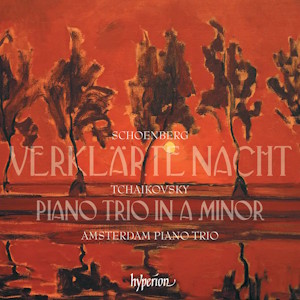
Pyotr Tchaikovsky (1840-1893)
Piano Trio in A minor, Op 50 (1882)
Arnold Schoenberg (1874-1951)
Verklärte Nacht, Op 4 (1899, arr. Henk Guittart)
Amsterdam Piano Trio
rec. 2025, St Silas the Martyr, Kentish Town, London
Hyperion CDA68485 [75]
This might seem an unusual coupling, but the argument is made that a line of continuity can be drawn between Tchaikovsky’s acutely emotional expressiveness and the psychological power of the young Schoenberg’s pre-serial Verklärte Nacht, linked in a Venn diagram of period cultural atmosphere by Gustav Mahler’s predilection for conducting Tchaikovsky and his absorption of the dramas inherent in the great Romantic master’s works. In any case, this piano trio setting for both pieces in this programme brings them into a close enough alignment, and this recording also serves as a reminder that both works belong to the same decade.
The last time I came across Tchaikovsky’s Piano Trio was on an ECM recording with Gidon Kremer and friends (review) back in 2011. I stand by my comment that this “may deliver as many quirks as it does calibre when delved into in detail” and, despite an eloquent and convincing performance the somewhat artificial nature of the recording remains offputting to my ears. The Kempf Trio on BIS (review) is very good indeed, and with a more integrated sound quality. This trio comes in at around 52 minutes to Gidon Kremer’s 50, which makes the Amsterdam Piano Trio’s 46 minutes intriguingly compact by comparison.
The opening Pezzo elegiaco drives forward with considerable energy, but gentler moments are observed with a decent amount of contrast, and this performance is musically very satisfying while at the same time perhaps putting a little extra emphasis on virtuosity and excitement than might be found elsewhere. The following Theme and variations is admirably transparent, with the synergy between these players creating stylish sparks throughout. If you only have time to take a brief sample then listen to track 7, Variaziones 4-6, which runs the full emotional gamut from expressive eloquence in the opening, that playful music-box ballet section, and an exquisite sense of joie de vivre in the waltz. I was initially a little concerned that the piano seems a little recessed in terms of the recorded balance, but things tend to sort themselves out as the collective dynamics rise, and the sound is both transparent and has plenty of dynamic punch where necessary. With subtle musicianship from all concerned this is a performance that would surely have gained sincere plaudits from the composer himself, and what more can you ask.
Arnold Schoenberg’s Verklärte Nacht op. 4 was originally composed for string sextet, and was published in 1917 in an arrangement for string orchestra by the composer. Schoenberg published a new version for large string orchestra in 1943, and this version includes improvements based on performance experience. Henk Guittart has commented on his version as being based on the Gesamtausgabe edition, but that it is “a departure from that of Eduard Steuermann for piano trio (1932, first published 1979). After having heard many performances of his version, and after having coached it with several piano trios, I found myself unconvinced by many of his choices; this ultimately led me to make my own arrangement, borrowing from my experience performing the sextet version on many occasions as a member of the Schoenberg Quartet, as well as conducting several performances of the 1943 version.” Guittart further adds that, beyond a few details, he has tried to stay as close as possible to the original sextet score.
The Eduard Steuermann piano trio version of Verklärte Nacht has appeared on CD a few times before (review), but I wasn’t able to find much in the way of alternatives to this recording of Henk Guittart’s arrangement. The string versions have their own special intensity and atmosphere and, if forced to chose, I would tend to prefer the sheer doom-laden tragedy of the best string orchestra or sextet recordings, including that with the Schoenberg Quartet on the Chandos label (CHAN9939-43 alas not currently available), and a more recent and excellent string orchestra recording with the BBC Symphony Orchestra conducted by Edward Gardner (review).
This said, taken on its own terms there is much to be said for Verklärte Nacht in its piano trio setting. Combined with its literary references, the music has its own special character whatever the medium. It has to be said that some moments can take on a more charming salon-style mood than you get with strings only, but the Amsterdam players dig deep and mix that sense of ardent longing with an essentially creepy nocturnal feel very well. Dynamic contrasts are acutely observed, with Schoenberg’s quicksilver changes of pace taken with convincingly passionate emphasis throughout. That ending – triumph undermined or overrun by beauty – is played with stunning economy by these musicians, and this whole production is
Dominy Clements
Buying this recording via the link below generates revenue for MWI, which helps the site remain free