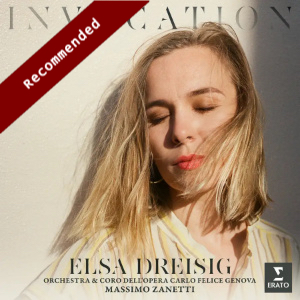
Elsa Dreisig (soprano)
Invocation
Orchestra and Chorus of the Teatro Carlo Felice di Genoa/Massimo Zanetti
rec. 2024, Teatro Carlo Felice di Genoa, Italy
Texts with English translations supplied
Erato 2685409371 [79]
Since her 2019 debut album for Erato, Miroir(s) (review), Elsa Dreisig has achieved great things on CD with the lovely recital album Morgen coming next, and now this new release, Invocation.
Dreisig is one of the younger generation of singers who has consistently impressed me. She seems to have a very clear idea of what parts will suit her the most. Her 2024 appearance at the Salzburg Festival in a concert performance of Richard Strauss’ Capriccio as the Countess Madeleine may not have pleased admirers of Lisa Della Casa and Elizabeth Schwarzkopf but after hearing the radio transmission of it, I found her portrayal of the amorously conflicted heroine to be extremely touching.
On this CD, which is a collection of prayers and other invocatory scenes, her singing goes beyond the merely beautiful to encompass characterization and word illumination of a level of achievement which is most impressive. In the opening “Song to the Moon” from Rusalka Dreisig’s limpid, slightly monochromatic tone seems tailor-made for Dvořák’s gentle water nymph. She wins points with me for the subtle variation in her phrasing of the various repetitions of the main theme. In Jenůfa’s prayer for her child Dreisig is sincere and touchingly expressive. One looks forward to hearing her take on this complete role at some point.
In the most common chestnuts arias from Gianni Schicchi and Norma, Dreisig offers a beautifully sculpted line in the former, while in the latter, the lengthy aria tests her a little bit. However, she is provides some sublimely delicate vocalise in the wordless tracery between the verses, and she concludes the aria with the lower alternative note, which is not often used by sopranos anymore and always seems to make more dramatic sense to me.
Among the less commonly heard items there is a magnificent performance of the Scène de la Crau from Mireille. This lengthy aria doesn’t quite fit the bill as an invocation when it is really more of a sun-drenched mad scene. Who would complain about that when Dreisig gives it such a marvelous intensity of expression which rivals Montserrat Caballé’s equally superb 1970 recording of this aria.
Among several unfamiliar items on the program there is a premiere recording of an aria (with cabaletta) from a recently unearthed 1835 opera Anna di Resburgo by Caroline Uccelli. Strangely for such an unknown piece, there is absolutely no mention made of it in the booklet, or why it was included at all. It certainly doesn’t fit into the invocation theme of the album and despite Dreisig’s fine singing, I feel that the aria, while not unpleasant, is not really of sufficient musical interest to justify its inclusion here. I would much rather that Giulietta’s prayer-like scene from Bellini’s I Capuleti e I Montecchi had been chosen instead, as the role was a major success for Dreisig at the Salzburg Festival in 2023.
There are so many fine tracks on this recital that there isn’t space within the confines of a review to do justice to all of them. Among those which stand out to me are a two glorious performances which highlight Dreisig’s ability to communicate the meaning of the words which, when allied with her acute attention to diction, seemed to be the best examples of what this album has to offer. The first is “Solveig’s Song” from Grieg’s Peer Gynt , where Dreisig ‘s word pointing and meaningful dramatic approach reminds one that there is more to this piece than just being a lovely tune. In Dreisig’s interpretation the second verse transforms itself and becomes a prayer, which is in line with the words of this piece. While in Elisabeth’s prayer from Wagner’s Tannhäuser, Dreisigdemonstrates how much more effective this aria becomes when a singer really makes each word count for something. Once more I find myself longing to encounter Dresig in this complete role some day.
Incidentally there should be no fear that Dresig wouldn’t be able to do full justice to the scene from Gounod’s Sapho, which is really the property of mezzos, and the much rarer voice type of the soprano falcon (like Jessye Norman). While Dreisig is definitely not a soprano falcon her singing of this aria takes the listener on the full dramatic journey through Sapho’s depair and suicide. I suspect that she might not be able to achieve the same level of impact with this scene in an auditorium during a live performance; however, the exceptional Erato engineering ensures that every nuance of Dreisig’s performance registers for the listener. One is also keenly aware of the fine conducting of Massimo Zanetti and the orchestra does quite well for him. However, one notes that the tenor section of the Genoan chorus experience a crucial moment of ensemble difficulty in their important opening verse to Verdi’s “La vergine degli angeli”.
Mike Parr
Buying this recording via the link below generates revenue for MWI, which helps the site remain free
Contents
Dvořák:”Mĕsíčku na nebi hlubokém” (Rusalka)
Janáček:”Kde to jsem?” (Jenůfa)
Puccini: “O mio babbino caro” (Gianni Schicchi)
Verdi: “La vergine degli angeli” (La forza del destino)
Bellini: recitative and aria “Casta Diva” (Norma)
Gounod: “Voici la vaste plaine” (Mireille)
Grieg: Solveig’s Song. “Kanske vil der gå både Vinter og Vår” (Peer Gynt)
Heise: “Jeg beder for hver en vejfarende sjael” (Drot og Marsk)
Beach: 3 Songs, Op. 11: No. 2, “Extase”
Uccelli: recitative, aria and caballetta “Ma dopo tanti sospiri e pianti” (Anna di Resburgo)
Rossini: “Juste ciel ! Ah, ta clémence” (Le siège de Corinthe)
Wagner: “Allmächt’ge Jungfrau! Hör mein Flehen” (Tannhäuser)
Gounod: “Où suis-je ?… Ô ma lyre immortelle” (Sapho)
Bizet: “ô doux souffle de l’ange !” (Clovis et Clotilde)
Puccini: “Vissi d’arte” (Tosca)
Verdi: “Ave Maria, piena di grazia” (Otello)
Flotow: “Letzte Rose” (Martha)