
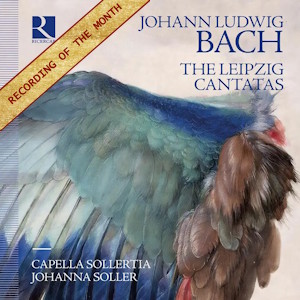
Johann Ludwig Bach (1677-1731)
The Leipzig Cantatas
Anna-Lena Elbert, Tabea Mitterbauer, Carine Tinney, Flore Van Meerssche (sopranos), William Shelton, Tobias Knaus (countertenors), Michael Mogl, Richard Resch (tenors), Sebastian Myrus, Micha Matthaus (basses)
Capella Sollertia / Johanna Soller
rec. 2022-2025, Himmelsfahrtskirche, München-Sendling, Germany
German texts with English & French translations
Ricercar RIC482 [4 CDs: 319]
Johann Ludwig Bach was a second cousin, I believe, of Johann Sebastian Bach. Born at Thal, near Eisenach, Johann Ludwig was the eldest son of Johann Jacob Bach, an organist, who guided his son’s early musical studies. It was probably in 1699 that he entered the service of Bernhard, Duke of Saxe-Meiningen, as a violinist. In 1711, after various promotions, Johann Ludwig was appointed to the post of Kapellmeister, a role he fulfilled until his death. My first exposure to Ludwig Bach’s music was in 2011 when I heard the Trauermusik of 1724 on an outstanding Harmonia Mundi disc (review). Two years later, I reviewed a three-disc set, this time issued by Capriccio, which included another performance of the Trauermusik, eight motets, a Mass setting and three cantatas; those three cantatas are also included in this Ricercar set.
Ricercar’s album is graced by a very fine essay by Peter Wollny on which I draw in the next three paragraphs in order to sketch in the background to these works and how it is that they have come down to us via Sebastian Bach. Wollny states in his essay that “Johann Ludwig’s rapid rise in the hierarchy of the court ensemble is clear proof of his great talent and excellent musical training”. As Kapellmeister, he was required to compose for the duke, of course, and his output was sufficiently well regarded by his more illustrious cousin, Johann Sebastian, that the latter had a number of Ludwig’s compositions in his personal music library. Between February and September 1726, Sebastian Bach directed no fewer than eighteen cantatas by Johann Ludwig at Sunday services in Leipzig; it’s those cantatas which Johanna Soller and her colleagues have recorded in this album; most of them, I’m sure, are here receiving their first recordings.
Peter Wollny observes that probably a substantial amount of music by Johann Luwig, in a variety of genres, has simply not survived. He has established from documentary evidence that Ludwig Bach composed a full annual cycle of church cantatas, running from the First Sunday in Advent, 1718 to November 1719. This cycle apparently comprised around 70 cantatas but only 18 survive – those here recorded – and those have come down to us only because Sebastian Bach had copies in his own library. Wollny explains in some detail that for his texts Ludwig Bach turned to an earlier cycle of cantatas composed in 1704/05 by one of his predecessors as Meiningen Kapellmeister, Georg Caspar Schürmann (1672-1751). The texts, by a variety of hands, seem to have been well-regarded by the Meiningen court so it was logical for Ludwig Bach to recycle them. Peter Wollny tells us that it is uncertain how Sebastian Bach came into possession of the cantatas. However, he prepared most of the full scores himself and then had the parts written out by his copyists. The first 13 cantatas were presented at Leipzig services “in quick succession” between early February and mid-May 1726. The other five cantatas were used in June, July and September of the same year.
In the contents list at the foot of this review, I’ve included details of the Sunday for which the cantata in question was intended and the date in 1726 on which Sebastian Bach included his relative’s music in the Leipzig services. As well as coming into possession of his cousin’s cantatas, it seems that Sebastian Bach acquired at the same time at least some, if not all of the texts which Georg Caspar Schürmann set in 1704/05. I say this because in his magisterial book The Cantatas of J S Bach, Alfred Dürr references no fewer than eight cantatas which Sebastian Bach composed in 1726, all of which use texts from the Meiningen collection. These include the Ascension cantata, Gott fähret auf mit Jauchzen, BWV 43 and the celebrated solo alto cantata Vergnügte Ruh, beliebte Seelenlust, BWV 170, Interestingly, BWV 170 was first heard at Leipzig services on 28 July 1726; Dürr suggests that on account of its relative brevity Bach performed his own cantata in addition to Ludwig Bach’s Ich will meinen Geist in euch geben, JLB 7. I think we can safely say, therefore that Sebastian Bach had a high regard for his cousin’s work
It’s worth mentioning the structural scheme of the cantatas, which Peter Wollny lays out for us. First comes an Old Testament Verse (‘Dictum’); then there’s a recitative followed by an aria. The second part of the cantata opens with another Dictum, this time from the New Testament, followed by two more movements (recitative and aria). At the end of each cantata there’s a final chorus, which usually begins as a freely composed chorus which moves into a chorale. Sometimes the Dicta are sung by one or more solo voices but in several of the cantatas the Dicta are entrusted to the choir, sometimes in partnership with one or more solo voices. Usually, Ludwig Bach’s instrumental scoring was quite modest and restricted to strings and continuo. In several of the cantatas, however, he enriched the textures by using a pair of oboes. One cantata benefits from the inclusion of a pair of recorders and in one case highly effective use is made of a pair of horns. The arias are generally quite brief – only a couple last for more than five minutes. The arias are consistently interesting and attractive but they differ from those of Sebastian Bach in one important respect; only on a couple of occasions does Ludwig Bach write an instrumental obbligato part. I found the recitativo movements very interesting because frequently Ludwig Bach’s recitatives are quite florid in nature and often they tend almost towards arioso style.
With eighteen separate cantatas and over five hours of music to consider, a discussion of each cantata would make for an excessively long review. I hope readers will therefore understand if I focus on just a few. However, I should stress that it should not be thought that any cantata which is not individually discussed is musically inferior; such is not the case. I can also offer an assurance that the standard of performance is uniformly excellent throughout. I will mention several of the soloists as I go along but I ought to single out the bass, Sebastian Myrus for two reasons. Firstly, he is a soloist in all but one of the cantatas; his singing is consistently first-rate and it seems to me that his voice is ideally suited to the music. But the reason I single him out in priority to all his fellow soloists is that he has also made a significant contribution to the project as an editor. No fewer than eleven of the cantatas are performed in editions which he has created.
Sebastian Bach included the first cantata by his cousin on 2 February 1726, the Feast of the Purification. Mache dich auf, werde licht, JLB 9 opens with an extended Dictum sung by the solo bass. This is noteworthy, not least for the way Ludwig Bach uses the pair of oboes to illustrate the portions of text which refer to light and then adopts very different instrumental colourings when images of darkness are voiced. The third movement, an alto recitativo, offers a typical example of how both the composer and the performers bring the text vividly to life. The cantata concludes with an exuberant chorus. The very next day was the Fourth Sunday after Epiphany; the Leipzig congregation heard another of Ludwig Bach’s works, Gott ist unser Zuversicht, JLB 1. Here, it’s the choir which sings the opening Dictum – though solo voices are deployed at times; the music is elaborate. The soprano aria, marvellously sung by Anna-Lena Elbert, speaks of waves and winds. The vocal writing and the string parts vividly illustrate these turbulences, but equally successful is the calm music to which Bach sets the concluding lines, illustrating that Divine Grace has calmed the tempests.
I mentioned earlier that occasionally Ludwig Bach added extra instruments to his orchestra. One of the most striking examples of this is the Easter cantata Denn du wirst meine Seele nicht in der Hölle lassen, JLB 21 which Sebastian Bach used in the Easter Day services on 21 April 1726. Alfred Dürr says that for a long time this cantata was thought to be by Sebastian Bach himself and was erroneously listed as BWV 15. It’s a rather splendid affair, calling for a trio of trumpets and also timpani. The first Dictum opens in a rather unusual way. Instead of the expected full-blast rejoicing, the movement begins with hushed, slow music for the strings. After a few bars, however, the piece explodes into life with resplendent trumpets and drums. I suspect that what Bach was illustrating, most effectively, was the gloomy darkness following the Crucifixion which was then dispelled by Christ’s Resurrection. By ‘keeping the congregation waiting’ in this fashion, Ludwig Bach makes a great impact when the Easter rejoicings actually begin. The cantata also includes a highly virtuosic soprano recitativo, which Carine Tinney sings most imaginatively. The concluding chorus, in which the full orchestra is involved, is joyful and exuberant.
Ludwig Bach really pushed the boat out with this splendid Paschal cantata. Sebastian Bach immediately treated the Leipzig congregation to two more of his cousin’s cantatas on successive days. On 22 April he presented Er ist aus der Angst und Gericht genommen, JLB 10. This, again, is richly scored; on this occasion, the strings and continuo are reinforced by pairs of oboes and recorders. The next day, Er machet uns lebendig, JLB 11 was heard. This is more conventionally scored for strings and continuo but it’s no less impressive. I much enjoyed the opening Dictum, which is sung by the chorus to music that is joyful, quick and, in this performance, full of energy. Pleasingly, Bach reprises this music for the closing chorus.
In one of the cantatas Ludwig Bach deployed a pair of horns. This is Ich will meinen Geist in euch geben, JLB 7, a cantata for the Sixth Sunday after Trinity. The horns are heard immediately; they strongly colour the opening Dictum, which is a duet for soprano and alto soloists This elaborate movement is very well sung by Tabea Mitterbauer and William Shelton. The horns reappear to accompany Mitterbauer in a lively, lilting soprano aria; before that comes a world-weary bass aria in which the soloist (the excellent Sebastian Myrus) portrays the weakness of a penitent soul seeking God’s help. The cantata closes with an extended chorus which becomes increasing festive as it unfolds; the horns add their splendid sound to the celebratory chorale.
Bach’s solo movements are all impressive in their different ways but several soprano solos particularly pleased me. One is the aria ‘Meine Seele erhebt den Herren’ in the Cantata for the Feast of the Visitation of Mary, Der Herr wird ein Neues im Lande erschaffen, JLB 13. This aria has for its text the first verse of the Magnificat. Mostly, it’s an extrovert, virtuoso piece but I very much like Bach’s slow, meditative central section in which the humility of Mary is pondered. This aria, wonderfully sung by Carine Tinney, is a highlight of the set, both as music and also in terms of the performance.
I’ve really enjoyed experiencing these cantatas by Johann Ludwig Bach. Peter Wollny is right to say that these works “may seem simpler and somewhat backward-looking when compared to the bold and uncompromising art of Johann Sebastian Bach’s Leipzig vocal works, although their own qualities emerge clearly when they are viewed in the context of the repertoire commonly performed in Thuringian courts and city churches”. Wollny speaks from a much greater knowledge of that Thuringian repertoire than I possess, so I completely accept his judgement. I’d add, however, that Sebastian Bach must surely have respected his cousin’s music. Had he thought less highly of it, he might have used just one or two of the cantatas on isolated occasions to give him a break from the responsibility of providing cantatas week in, week out. But to perform eighteen of them over just a few months surely speaks to a serious respect. Assuming I’m right about that, Sebastian Bach was correct to regard Ludwig’s work highly. These cantatas contain a significant amount of first-rate music. The cantatas speak directly to the listener, I think, and they display a consistently high degree of musical invention.
Ludwig Bach’s cause is helped immeasurably by the very high standard of these recorded performances. The soloists are all excellent, the choir sings very well indeed and the instrumental contributions are highly accomplished and sensitive to the varied nature of the music throughout these works. Johanna Soller directs the performances admirably. I particularly appreciate the fact that under her direction the musicians invest the words with meaning.
Ricercar’s production values are very high. The recordings were made in the same venue, over six separate sessions between February 2022 and May 2025. Karsten Zimmermann’s recordings are consistently excellent; there’s clarity and presence to the sound. The documentation, which is provided in German, with English and French translations, is comprehensive and includes all the sung texts as well as the first-class essay by Peter Wollny.
My concluding thoughts are of gratitude. Johann Sebastian Bach left us an incomparable legacy with his own music but we should also be grateful for the fact that, thanks to him, these eighteen cantatas have come down to us. And, of course, we are particularly indebted to Johanna Soller and her colleagues for bringing the music so vividly to life and to Ricercar for issuing the recordings.
This outstanding set enables us to enjoy and appreciate the church music of Johann Ludwig Bach.
John Quinn
Buying this recording via the link below generates revenue for MWI, which helps the site remain free
Contents
Ja, mir hast du Arbeit gemacht, JLB5 Quinquagesima Sunday (Performed in Leipzig 3 March 1726)
Denn du wirst meine Seele nicht in der Hölle lassen, JLB21 Easter Sunday (21 April 1726)
Er ist aus der Angst und Gericht genommen, JLB10 Easter Monday (22 April 1726)
Durch sein Erkenntnis, JLB15 11th Sunday after Trinity (1 September 1726)
Die mit Tranen saen, JLB8 Second Sunday after Easter (12 May 1726)
Darum saet euch Gerechtigkeit, JLB4 Sexagesima Sunday (24 February 1726)
Gott ist unser Zuversicht, JLB1 Fourth Sunday after Epiphany (3 February 1726)
Und ich will ihnen einen einigen Hirten erwecken, JLB12 Second Sunday after Easter (5 May 1726)
Wie lieblich sind auf den Bergen, JLB6 First Sunday after Easter (28 April 1726)
Darum will ich auch erwahlen, JLB3 Septuagesima Sunday (17 February 1726)
Die Weisheit kommt nicht in eine boshafte Seele, JLB14 Fourth Sunday after Easter (19 May 1726)
Er machet uns lebendig, JLB11 Easter Tuesday (23 April 1726)
Der Gottlosen Arbeit wird fehlen, JLB2 Fifth Sunday after Epiphany (10 February 1726)
Ich will meinen Geist in euch geben, JLB7 Sixth Sunday after Trinity (28 July 1726)
Mache dich auf, werde licht, JLB9 Feast of the Purification (2 February 1726)
Der Herr wird ein Neues im Lande erschaffen, JLB13 Feast of the Visitation of Mary (2 July 1726)
Siehe, ich will meinen Engel senden, JLB17 Feast of John the Baptist (24 June 1726)Ich aber ging fur dir uber, JLB16 Thirteenth Sunday after Trinity (15 September 1726)













