
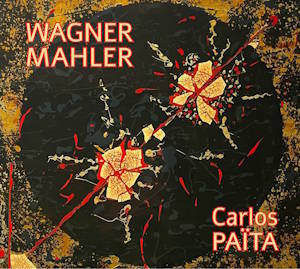
Richard Wagner (1813-1883)
Götterdämmerung: Siegfried’s Rhine Journey, Siegfried’s Funeral March (1874)
Gustav Mahler (1860-1911)
Symphony No. 1 (Titan) (1884-8)
Philharmonic Symphony Orchestra (Wagner), Royal Symphony Orchestra (Mahler)/Carlos Païta
rec. 1977/82, Kingsway Hall, London
Le Palais Des Dégustateurs PDD052 [77]
Back in the 1970s, Decca issued a handful recordings in its Phase Four line featuring the Argentinian conductor Carlos Païta. The consensus was mixed – some attention to detail and colour, particularly in lighter passages; some indifferent, even casual ensemble elsewhere – and, at least in the U.S., the company cut the series short. Later, these recordings and more appeared on LPs from Lodia, a German audiophile company; the current program draws from those early series.
The Rhine Journey, leading off, is emblematic of the enterprise. While the opening wind chord is slightly smudged, dark, vibrant cellos attract the ear; so does the restrained, sensitive clarinet solo. But, as the textures fill out, ensemble becomes less sure, along with the general sense of direction. Païta hustles the climactic tutti along, not to its advantage; the balances are iffy later in the piece, as the delivery grows increasingly arthritic. The sonorities remain undistinguished in the Funeral March, as it’s billed here, and the basically fine sonics don’t expand at the peak moments.
You might expect more from the Mahler symphony; Païta’s reading, unfortunately, is one of the most perverse on disc (Imagine Bernstein’s mannerisms in his first, Sony, version on exponential steroids.) In the atmospheric introduction, I liked the way the woodwind entry almost blended into the sustained string harmonic. But the main theme jerks faster on arrival, somewhat beclouded by a few internal adjustments; with the exposition repeat, it all happens twice. The development turns droopy, until the horn fanfare races ahead, and things keep racing.
The Ländler begins forthrightly, but the Trio is a mess. Not only does the conductor adjust the tempo between phrases: he makes tiny little adjustments left and right within them, without providing enough of a framework to unify everything. All the nudging sounds self-conscious rather than expressive.
Oddly, the wild tempo shifts are mostly held in check in the latter two movements, which offer equal opportunity for such chicanery. I was surprised to hear the Bruder Martin/Frère Jacques movement played so straight – even the klezmer episodes aren’t excessively parodic. The Finale has its share of Punch-and-Judy antics – particularly, the contrast between the introduction, with its blazing violin runs, and the weighted, held-back main theme. The second theme flows, though it doesn’t sing. I was pleased that the piano brass fanfare – the one that everyone but Horenstein slows down for, unrequested – marches straight on in the established tempo. The rest is plausible, though it’s too late to save the whole.
The orchestral billing is dubious. Several of Païta’s original Lodia recordings credited the “Philharmonic Symphony Orchestra” – a nom de disque, I imagine,for a pickup ensemble of the National Philharmonic variety. The original LP of the Mahler billed its orchestra as the Royal Philharmonic, which is probably correct; oddly for a Phase Four issue, the wind soli are less spotlighted than in most other recordings! In the Wagner selections, the bassi come up with a nice, buzzy resonance, and the brass choir has depth.
Unless your wish to satisfy your morbid curiosity, pass this one by.
Stephen Francis Vasta
stevedisque.wordpress.com/blog
Other review: Ralph Moore
Availability: Le Palais Des Dégustateurs












