
Philip Glass (b. 1938)
Hourglass
The Hours Suite (2002, arr. Michael Reisman)
Piano Concerto No. 1 “Tirol” (2000)
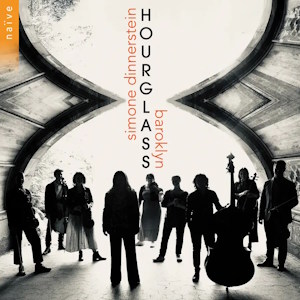
Baroklyn/Simone Dinnerstein (piano)
rec. 2025, Merkin Hall, Kaufman Music Center, New York City
Naïve V9238 [57]
Simone Dinnerstein came to the attention of classical music listeners two decades ago with the release of her first album, rather ambitiously Bach’s Goldberg Variations. She self-published it and it was then picked up by Telarc for wider release. It divided opinions, with plenty of reviewers not liking the slowness and Romanticisation. Our reviewer was internally divided, praising it as “excellent”, but also feeling it “lacked overall balance” (review). It sold very well, being No. 1 on the classical charts, and was nominated in several influential “Best of 2007” lists. Since then, she has continued to concentrate on Bach; her booklet notes state that “Delving into Bach’s music is my life’s work for reasons that I feel deeply but can’t fully explain”. Her explorations beyond Bach have been quite varied: from Beethoven to Ravel and some contemporary works, including Philip Glass. This is the first recording of hers to be dedicated to Glass alone.
The music for The Hours must be one of the best soundtracks to not win an Oscar. Indeed, I find hard to believe that it lost out in 2003 to Elliot Goldenthal’s Frida. Has anyone heard music from that movie since then? Meanwhile The Hours music lives on in numerous recordings, particularly in piano arrangements, but also in this Suite, a piano concerto in all but name, arranged by long-time Glass collaborator Michael Reisman. It is a quite wonderful adaptation of the music, creating a fully formed work, with great momentum and internal structure.
There is a recording of The Hours Suite on Orange Mountain Music (Glass’s own label) with Michael Reisman at the piano. Our reviewer praised the recording very highly, so I sought it out (review). Dinnerstein is far less percussive than Reisman – no great surprise – and three minutes slower – again, no great surprise. I found her delicacy and passion far more persuasive than Reisman’s, which seemed a little cold in comparison. I also greatly liked the hesitancy Dinnerstein employs in the first movement which, remembering the film, seems to be very appropriate.
It is an intelligent piece of programming to pair The Hours suite with the concerto, because the slow movement of the latter contains a number of melodic ideas that Glass reused in The Hours. Mind you, Glass cynics might suggest that everything he writes has been recycled from somewhere else in his output. In this case, why wouldn’t he – it is so gloriously good. However, at over sixteen minutes, the slow movement is significantly longer than the two outer movements combined (thirteen), and this rather unbalances the work. That said, the outer movements – not Hours-related – are good contrasts, the final movement jaunty and witty.
Again Dinnerstein has competition from a recording from Orange Mountain Music (OM161), featuring the young British pianist Martin James Bartlett. Dinnerstein is slower in the faster movements, and quicker in the lengthy slow movement, where the almost eighteen minutes taken by Bartlett and colleagues is just too long. Dinnerstein is absolutely magnificent in the slow movement, but Bartlett’s greater energy wins out in the third movement.
Baroklyn is Dinnerstein’s own chamber ensemble – eleven strings – and while it was created to play Bach, the transition to Glass is handled very well. Where this new recording clearly wins out over its two Orange Mountain rivals is in the sound quality. Dinnerstein’s notes are a very personal commentary on the music, and her journey from Bach to Glass.
This is the second album in succession that I’ve reviewed with a runtime under an hour, and there are some very obvious works that could have been chosen to make this a more generous offering, a selection of Glass’s Etudes, for example. I’m saying this because I enjoyed this album very much and would have loved to have heard Dinnerstein play a couple of the more introspective Etudes, as she did with her recording of the Schubert B flat sonata.
David Barker
Other review: Dominic Hartley
Buying this recording via the link below generates revenue for MWI, which helps the site remain free
Previous review: Dominic Hartley













