Déjà Review: this review was first published in June 2011 and the recording is still available.
Cesare Negri (1535-1604)
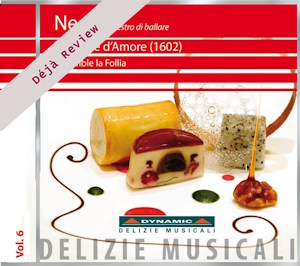
Le Gratie d’Amore (1602)
Ensemble La Follia
rec. 1995, Saturnana, Italy
Dynamic DM8006 [52]
Everyone knows the French King Louis XIV was an excellent dancer. That accomplishment in itself was nothing remarkable: all members of the higher echelons of society were expected to master the art of dancing. This was one of the main occupations of members of royalty and aristocracy. As a result there was much employment for dancing masters. One of the most famous was Cesare Negri, who worked in Italy in the second half of the 16th century. In 1602 he published a treatise entitled Le Gratie d’Amore which was reprinted two years later. This book includes biographical information which gives us some idea about the activities and social status of dancing masters in his time.
In his treatise Negri informs the reader about the various steps and movements and describes the styles and techniques in vogue in his time. He also gives directions for a number of choreographies, both for individual dances and for two or four couples. His information about allegorical processions in which dancers took part is interesting. This is especially important in regard to the kind of dances which were performed and the instruments used.
The liner-notes for this disc give a broad outline of Negri’s treatise. However the listener is left in the dark about the music. The eighteen pieces are selected from the treatise, but who are the composers? Negri wasn’t a composer himself, but neither the track-list nor the liner-notes make us any the wiser. The only piece I recognized was Sò ben mi chi ha bon tempo, a canzonetta by Orazio Vecchi (1550-1605), a composer from Modena. From Julia Sutton’s article on Negri in New Grove we learn that these musical pieces are pasticcios of a sort which Negri put together from several sources and adapted to match the various dances. He must be considered the editor rather than the composer of this music.
What is worse the booklet fails to tell us which dances the musical items are supposed to illustrate. This way an opportunity has been missed to give the listener some insight into the connection between music and dances, and the rhythms which go with them. As this music was really meant to be danced – unlike the mostly stylized dances of the 17th and 18th centuries – I would have liked the issue of tempo to have been addressed in the booklet. Julia Sutton writes: “Negri did give the precise number of leg gestures within a fixed span of time (for example, ‘this variation is done quickly, and has 25 strokes in four musical measures’), thus making it possible to establish norms of tempo.” I would have liked to know whether the musicians have taken this information into account and whether they have rehearsed with dancers. Again, the liner-notes maintain a dogged silence about the subject.
I have already referred to the information in the treatise about processions which included performances of dances. I would have liked to know more about the instruments which, according to Negri, were involved. On this disc the dances are performed in various combinations of strings and wind, plucked instruments and harpsichord. Does this reflect Negri’s descriptions?
The lack of information on some important issues is a real pity. Cesare Negri deserves better, and so do the musicians of the Ensemble La Follia. Rhythm is everything in this repertoire and that is what these artists are very good at. They play the music in such a way that it could move listeners to dance or at least tap their feet. They show that there is no need to pepper such music with percussion. The various combinations of instruments work quite well, and the balance is mostly satisfying.
This is all highly entertaining stuff, and in particular if you are interested in early dance this disc is not to be missed. It is just a shame the documentation is so poor.
Johan van Veen
Buying this recording via the link below generates revenue for MWI, which helps the site remain free

Contents
Balletto detto lo Spagnoletto
Brando di Cales
Leggiadra Marina
Bizzarria d’Amore
Il Grazioso
Il Torneo Amoroso
Sò ben mi chi ha bon tempo
Il Bigarà
Cortesia Amorosa
Bassa Gioiosa
Alta Somaglia
Ballo fatto da sei Cavalieri
Il Bianco Fiore
Il Pastor Leggiadro
Il Cesarino
Fedeltà d’Amore
Performers
Paolo Faldi (recorder, bombardon), Paolo Fanciullacci (cornett, violone), Mauro Morini (sackbut), Paolo Biordi (viola da gamba), Marzio Matteoli (lute), Daniele Poli (guitar), Andrea Perugi (harpsichord)