
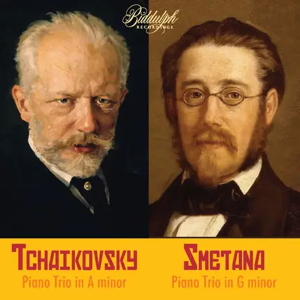
Pyotr Ilyich Tchaikovsky (1840-1893)
Piano Trio in A minor Op. 50 (1882)
Bedřich Smetana (1824-1884)
Piano Trio in G minor Op.15 (1855 rev.1857)
Louis Kaufman (violin), Kurt Reher (cello, Tchaikovsky), Willem van den Burg (cello, Smetana), Theodore Saidenberg (piano, Tchaikovsky), Rudolf Firkušný (piano, Smetana)
rec. 1947 (Tchaikovsky), 1948 (Smetana), Vox Studios, USA
Biddulph 85069-2 [62]
These two Vox recordings date from 1947-1948. The earlier is Smetana’s Piano Trio, a 78rpm set, with Louis Kaufman (violin), Willem van den Burg (cello) and pianist Rudolf Firkušný whilst the Tchaikovsky Trio, played by Kaufman, Kurt Reher (cello) and pianist Theodore Saidenberg was one of Vox’s earliest LPs, though still released on shellac. Biddulph has selected astutely here, as I don’t recall seeing either in prior CD transfers.
After many years as one of the most illustrious soloists in the film studio orchestras Kaufman was by now a strong presence in the recording studios and had resumed his concert career. As ever, he is an adornment to any ensemble of which he was a member, with his rich tonal lustre and instinct for the romantic very much to the fore. Vox’s studio had a rather boxy acoustic which doesn’t always benefit ensembles, but the Kaufman-Reher-Saidenberg trio largely overcome it with the richly communicative nature of their playing in the Tchaikovsky Trio. Given that this is a work I dislike intensely, I was delighted to see that they whipped through it in record time – 39 minutes is a good ten minutes shorter than most recordings – until I realised that they had taken some of the composer-sanctioned cuts. This means that the finale and coda, which usually takes 12 minutes is here cut in half. Surprisingly, perhaps, in view of the need to fit the performance onto a LP with time constraints much shorter than was to be the case later, they do play the fugal variation that the composer sometimes allowed to be cut in performance.
In any case, this is a richly communicative reading with fine ensemble virtues. High among them is Reher’s eloquent cantilena and Seidenberg’s noble statement of the Theme of the second movement. Given it’s cut, though, there’s no point citing the other classic recordings of the piece by Kogan-Rostropovich-Gilels et al. It’s a curio but a splendid one and some contemporary ensembles do indeed still make some cuts.
Whereas the Smetana Trio is a different affair entirely, a concise three-movement work, elegiac in concept but full of internal contrasts, drive and drama. The 78s used have some audible wear but are otherwise well focused. The recording is less good than the Tchaikovsky, Firkušný’s piano sounding very slightly brittle. In some ways this suits the terseness and turbulence of the first movement though not necessarily the central Allegro, expressively rich as it is. This is a work strongly anchored by the pianist and Firkušný proves an admirable exponent, driving the ensemble in the finale with passionate clarity. Once again Kaufman is an admirable foil, suave and full-toned, and if van den Burgh has a dryer tone than Reher, he phrases ardently with the violinist.
Both trios share a commemorative element. Tchaikovsky’s was written ‘to the memory of a great artist’, the pianist Nikolai Rubinstein. The Smetana was written in the wake of the death of his daughter, Bedřiška. David Hermann’s transfers have been well done and the digital mastering has been carried out by Dennis Patterson. Wayne Kiley’s booklet notes are admirable. This is a fine disc, which will be of interest to the historically-minded collector.
Jonathan Woolf
Buying this recording via the link below generates revenue for MWI, which helps the site remain free













