Richard Wagner (1813-1883)
Orchestral Music
Cleveland Orchestra/George Szell
Philadelphia Orchestra/Eugene Ormandy (Tannhäuser)
rec. 1959, Broadwood Hotel, 1964, Town Hall, Philadelphia; 1965, Severance Hall, Cleveland, USA. ADD
Sony Classical SBK 62 403 [70]
Urged by a comment on my review of Szell’s recital of Wagner’s orchestral music, I moved on to its companion disc which contains more of his work in the same genre paired with Ormandy’s roughly contemporaneous recordings with the Philadelphia Orchestra of two extracts from Tannhäuser and the third act Prelude from Lohengrin.
This was a Golden Age of American orchestral playing with conductors such as Szell, Ormandy, Bernstein, Reiner and Leinsdorf heading great orchestras which were well funded, televised, and recorded by the big labels.
The Tannhäuser overture is – initially, at least – given a grander, slower and statelier performance than I am used to with the famous Solti complete recording with the VPO but it is nonetheless well played and Ormandy certainly works up a real head of steam for the climax; the swirling strings and blaring brass are magnificent. The “Festmarsch” is remarkable for its deep, lush sonority, especially for a recording made over sixty years ago; balances are remarkably good, so detail emerges despite the amplitude.
Szell takes over for the Lohengrin Prelude. Again, I am conditioned by Kempe’s ethereal version in the complete EMI recording made a couple of years earlier but Szell’s cool, controlled precision, although slightly more austere, is very satisfying; over a span of nine minutes, the music builds inexorably then fades serenely. Ormandy’s Act II Prelude is from as early as 1959 but once more the sound is very rich and present and the delivery animated.
The three remaining overtures from Szell and the Cleveland Orchestra are equally impressive. The Flying Dutchman overture is played with plenty of drive and momentum, with flawless horns. Szell brings out the tragic, brooding quality of the music and you can just hear him exhorting the orchestra to greater intensity at the start of the coda beginning at nine minutes. Rienzi survives on the modern concert platform only through two excerpts: “Allmächt’ger Vater”, as a recital aria for tenor and this overture, both of which are by far the best things in the work and this recording makes the best case for the latter, which has its pomposities but also some grand tunes, often somewhat reminiscent of Mendelssohn’s “Lobgesang” symphony as well as evincing the more obvious influence of Meyerbeer. I admit to being none too familiar with the Faust Overture; its dark, unsettling nature is expertly encompassed by Szell, who seems both to bring out its kinship with Berlioz and allow it to point forward to the more mature psychodramas, first Der fliegende Holländer, then of course, eventually, Tristan und Isolde, of which there are several pre-echoes. It is rather diffuse and rambling but if anyone could impose coherence upon it, it was the disciplined Szell and it gets best advocacy. One does not get many opportunities to hear it and for me it has been an interesting discovery.
You will have to find this on the used market and there don’t currently seem to be as many copies about as there are of the companion CD. I don’t think it is quite as special as that other Wagner selection but it is still a splendid bargain, showcasing two great orchestras at their best in a particular epoch.
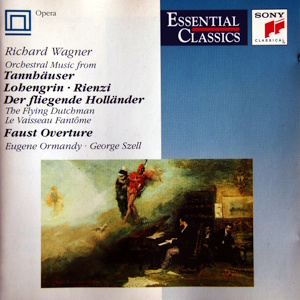
(I have lost count of the number of recordings connected with the Faust legend which employ Mariano Fortuny y Marsal‘s painting Fantasia sobre Fausto from the Prado on the cover…)
Ralph Moore
Contents:
Tannhäuser*
1. Ouvertüre
2. Festmarsch
Lohengrin
3. Vorspiel Zum I. Aufzug
4. Vorspiel Zum III. Aufzug†
Der fliegende Holländer
5. Ouvertüre
Rienzi
6. Ouvertüre
7. Eine Faust-Ouvertüre
*Town Hall
†Broadwood Hotel