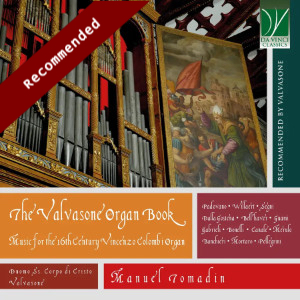
The Valvasone Organ Book
Music for the 16th century Vincenzo Colombi organ
Manuel Tomadin (organ)
rec. 2025, Duomo del Santissimo Corpo di Cristo, Valvasone, Italy
Reviewed as a download
Da Vinci Classics C01151 [77]
Italy can be proud of a rich heritage of historical organs. Some of these are very well-known and regularly used for recordings, such as those at the Basilica Santa Barbara in Mantua and the San Petronio basilica in Bologna. This disc brings us to a lesser-known instrument of much more modest proportions. In 1532/33 an organ was erected in the Duomo del Santissimo Corpo di Cristo in Valvasone in the Veneto, northeast of Venice. It was built by Vencenzo Colombi at the behest of the Counts of Valvasone. In the course of time, it underwent several changes, and after World War I it became even unplayable. In modern times it has been restored, first in the 1970s, and later in 1999 by the firm Francesco Zanin.
In its present state, it consists of a single manual of 47 keys (F-1 to F4) and a pull-down pedalboard of twenty notes (F1 to D2). The stops form a typical Italian plenum composed of individual principal-scaled ranks. The organ has a tremulant, labelled “Fiffaro” under its switch. The organ is winded by three wedge bellows, and the wind pressure is 43 mm (water column measurement). The temperament is 1/4-comma meantone, with the pitch of A at 492.5 Hz at 22°.
Given the fact that Valvasone is close to Venice, Manuel Tomadin demonstrates the organ with a repertoire of pieces by Venetian composers or composers whose works were published in Venice. The main genres of keyboard music from the 16th and early 17th centuries are represented, and the programme is ordered chronologically, which allows the listener to follow the stylistic developments of the various genres.
The programme opens with a toccata by Annibale Padovana, who was organist at St Mark’s (and later moved to the court of the Habsburgs in Graz). The toccata is rooted in the common practice of improvisation, and is the freest form of keyboard music, without a clear structure. The composer/performer can do exactly what he likes. That explains the strong differences between specimens of the genre. Padovana’s toccata consists of chord blocks in one hand to which diminutions and scales are added by the other hand. In the Toccata per organo by Vincenzo Bell’haver (or Bellavere) the chord blocks alternate with diminutions. Gioseffo Guami’s toccata shows an increase in virtuosity, with scale passages and broken figures. The toccatas of Claudio Merulo are generally considered the pinnacle of the genre in Venice; his Toccata I dell’undecimo detto quinto tuono is a brilliant piece, dominated by virtuosic diminutions, which alternate with more solemn and static episodes. He was organist at St Mark’s from 1557 to 1584 and had many students from across Europe.
Close to the toccata is the fantasia, also a form based on improvisation. The Fantasia I by Giovanni Battista dalla Gostena is part of a series of 25 which have been preserved in versions for lute. It is assumed that these are transcriptions, and may originally have been intended for organ. They have been recorded complete by Irene De Ruvo (review). In this Fantasia Dalla Gostena makes use of chromaticism. Andrea Gabrieli’s fantasia has strong toccata-like traces.
The longest works in the programme are the ricercares. They are dominated by counterpoint and mostly have a rather solemn character. The first is the Ricercare in E by Adrian Willaert, for most of his life maestro di cappella at St Mark’s. Giulio Segni da Modena’s Ricerchare per musica ficta in Sol per la via de G sol re ut explores the features of the meantone temperament. Musica ficta is a term used in the Middle Ages and Renaissance for notes that did not fit within the hexachordal system devised by Guido d’Arezzo in the eleventh century. In his Ricercar del primo tuono Aurelio Bonelli, an organist from Bologna whose only collection of music was printed in Venice, alternates imitative passages with toccata-like episodes. The last ricercare is of the pen of Giovanni Gabrieli, who transposes the practice of writing in polychoral style to the keyboard.
The fourth and last genre is the canzona. It has its roots in vocal music, and the first items in the programme are transcriptions of chansons; hence the name canzona francese. The first are two chansons by Willaert; he is named as the composer, but the transcriptions are probably made by an unknown person, as the work-list of Willaert does not include any canzonas. Three such arrangements by Dalla Gostena are known, based on chansons by Lassus, Crecquillon and Costeley respectively. The latter is included here. With time the canzona moved away from vocal models, but mostly kept its vocal character. The other ricercares in the programme bear titles, which may refer to persons in the composer’s environment. Some canzonas can be playful; a good example is Adriano Banchieri’s Canzona XI with the title La Organistina bella. The addition ‘in echo’ refers to a very popular practice at the time across Europe; one can think here, for instance, of Sweelincks Echo Fantasia. Banchieri’s piece includes passages in which the last notes of the phrase are repeated. Manuel Tomadin has chosen to play them in a different registration, and as the organ has only one manual, he needs the help of an assistant. Whether such people were active at Banchieri’s time is open to debate. In the last item, another canzona, this time by Vincenzo Pellegrini, the registration is also changed in the course of the work.
However, in most pieces Tomadin plays in the same registration from start to finish. Although he covers a wide repertoire (he has also recorded music by Josef Rheinberger), early music is his speciality, and he knows his way in the Italian organ landscape. It is impressive how he is able to create so much variety in registration on an instrument with just eight stops. He has the help of a unique document, preserved in the parish archive, which mentions combinations of stops to be used for different genres. In Giovanni Gabrieli’s Ricercar I Tomadin uses the fiffaro stop to good effect, and in Bell’haver’s Toccata one can admire the ripieno of the organ in full glory. Tomadin is the best possible guide through this fascinating repertoire.
Italian organs of the 16th and 17th centuries and the repertoire written for them can cause someone to become addicted; that is at least my experience. I can listen to this combination for hours, and Tomadin and the organ of Valvasone make that very easy. I thoroughly enjoy this disc, and I am sure many organ lovers will, too. I look forward to further recordings of this kind.
Johan van Veen
www.musica-dei-donum.org
twitter.com/johanvanveen
https://bsky.app/profile/musicadeidonum.bsky.social
Buying this recording via the link below generates revenue for MWI, which helps the site remain free
Contents
Annibale Padovano (1527-1575)
Toccata d’Annibale Padovano del ottavo tono
Adrian Willaert (1490-1562)
Canzona francese Mon cueur en vous – Canzona francese Vignon mignon vignette
Ricercare in E
Giulio Segni da Modena (1498-1561)
Recerchare per musica ficta in Sol per la via di G sol re ut
Giovanni Battista Dalla Gostena (c1558-1593)
Canzone francese Mais que sert la richesse a l’homme (Costeley)
Fantasia I
Vincenzo Bell’haver (Bellavere) (?-1587)
Toccata per Organo
Andrea Gabrieli (1533-1585)
Fantasia Allegra del duodecimo tuono
Gioseffo Guami (1542-1611)
Canzona francese La Guamina
Toccata per organo
Aurelio Bonelli (c1569-1620)
Ricercar del primo Tuono
Floriano Canale (1541-1616)
Canzona La Nuvolina
Claudio Merulo (1533-1604)
Canzon La Zambeccara
Toccata Prima dell’Undecimo detto quinto tuono
Adriano Banchieri (1568-1634)
Canzon Undecima ‘La Organistina bella in Echo’
Giovanni Gabrieli (1557-1612)
Ricercar primo
Antonio Mortaro (?-1620)
Canzon La Zucchella
Vincenzo Pellegrini (c1562-1630)
Canzon detta La Capricciosa