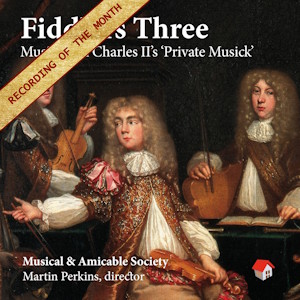
Fiddlers Three – Music from Charles II’s ‘Private Musick’
Musical & Amicable Society
Recording details not supplied
Reviewed as a download
Barn Cottage Records [79]
Shortly after 1600, a new musical style that had emerged in Italy, known as stile nuovo or seconda pratica, quickly disseminated across Europe. However, it was not embraced everywhere. In England, the stile antico still reigned supreme during the first half of the 17th century. It was only after the middle of the century, and in particular after the Restoration, that the style now generally known as Baroque, gradually overshadowed English traditions. One of these was the writing of music for a consort of instruments, such as viols or recorders, which were treated on equal footing. The most prominent exponent of the Italian style, the violin, was known and used, but mainly as a consort instrument, as an alternative to the treble viol.
The influx of some violinists from the continent had a lasting effect on violin playing in England. Two names are especially associated with this development: Thomas Baltzar from Germany and Nicola Matteis from Italy. The changes in the English music scene of the second half of the 17th century can be (and have been) approached from different angles. In 2019 the label Audax released “The London Album” of the Ensemble Diderot, which included trio sonatas written in England in the third quarter of the 17th century. The programme consisted of pieces by John Blow, Gerhard Diessener, Giovanni Battista Draghi, Johann Gottfried Keller, Robert King and, inevitably, Henry Purcell. Only the latter also figures in the programme that was recorded by the Musical & Amicable Society.
This ensemble approaches the English music scene in this period from a different angle. Most pieces are scored for three violins and basso continuo, which seems a rather English speciality. Henry Purcell was one of the composers who wrote pieces for this scoring: the programme opens with one of his best-known and most brilliant instrumental works, Three Parts upon a Ground. Halfway the programme we get a different piece by him: the Pavan in G minor, which is rooted in the consort music tradition. But Purcell would not be Purcell if he had lost his sense of harmonic adventure, which manifests itself abundantly.
These two pieces are the best-known items in a recording which focuses on little-known pieces, some of them recorded for the first time. Most composers are known, but not by the pieces included here. That goes, for instance, for the above-mentioned Thomas Baltzar, whose best-known work are variations on “John come kiss me now”. Here we get the Pavan which opens his Suite in C, a brilliant piece which one makes curious about the entire suite. More of his oeuvre should be available on disc. Nicola Matteis’ oeuvre has been the subject of quite some recordings in recent years. Here we hear little-known pieces, which both pay tribute to the English tradition of writing music on a ground – the English term of what is generally known as a basso ostinato. His Ground on La Folia is comparable with the better-known variations by Corelli and Vivaldi. Whereas this piece is scored for solo violin – like most of Matteis’ works – the Ground in D minor which concludes the programme is one of the pieces for three violins.
The important role of this scoring comes also to the fore in two other pieces. The Bohemian-born Gottfried (Godfrey) Finger settled in 1687 in London and became a member of the Catholic Chapel of James II. Shortly after his arrival, he published his Op. 1, a set of twelve sonatas for different scorings. Three of these were set for three violins and basso continuo, among them the Sonata IX included here. The second work is the Sonata in D minor by Lambert Pietkin, a Flemish composer and organist. Only two of his instrumental works are known, among them this sonata. It is scored for three violins as well, but Martin Perkins, in his liner-notes, mentions that the way it is written suggests that the original scoring was for two violins, viola, cello and basso continuo. The ‘new scoring’ may well be an adaptation by Edward Lowe, professor in Oxford, who copied out music for performance at the University’s Music School. There were close links between the musical community in Oxford and the court, and therefore works in Lowe’s collection were written for performance at the court.
The court is the second factor which played a major role in the development towards the baroque style. Charles II, having spent the years of his captivity in France, where he became acquainted with the latest fashions in music, wanted to imitate music life at Louis XIV’s court. The Twenty-four Violins were modelled after the Quatre-vingt Violons in France.
One of its members was Davis Mell, who was often compared with Baltzar. The Suite in D minor, which is for violin solo with scordatura, may have been written in rivalry with Baltzar, who wrote a similar work. Mell was probably the first English-born violinist who made use of this way of tuning the violin.
Two well-known composers in the programme have not yet been mentioned: one is Christopher Simpson, who has become famous as a virtuoso on the viola da gamba and as the author of The Division-Viol of 1659. It offers instructions on how to improvise divisions on a ground, and this is taken by the performers to include improvised divisions on a ground in F. The other composer is, obviously, John Jenkins. He can hardly be omitted in any programme of English music of the 17th century, not only because of the sheer volume of his output, but also because he – due to his exceptionally long life – experienced, and partly shaped, the musical developments. His oeuvre shows a remarkable versatility: whereas in his early works he uses the violin as a consort instrument, as mentioned at the start of this review, he later wrote pieces which are close to the kind of trio sonatas which we know from Italian composers.
This programme is very interesting from a historical point of view but there are also some aspects of performance practice which should be mentioned. One, is the role of the guitar and the harp. It is known that the guitar was quite popular at the time, especially among female members of the aristocracy. An important source is the Elizabeth Cromwell Guitar Book from 1683-85; two pieces in the programme are taken from this source. The harp also played a role in music. Best-known are the Harp Consorts by William Lawes, in which an Irish harp is required. The cover of this disc shows a painting, known as The Cabal. It is assumed that the central figure is Thomas Baltzar. The liner-notes refer to this painting to argue that the Italian harp was known. Unfortunately, only a part of the painting is used, and the harp is not visible. The harpist on the painting may be Charles Evans, ‘Musician in Ordinary for the Italian Harpe’. The role of guitar and harp have been used as a reason to include both instruments in the basso continuo.
This disc has everything to justify a special recommendation. I already mentioned the historical aspects. All the music played here is of excellent quality, and the fact that a large part of the programme consists of little-known pieces and even first recordings, underscores its value. The third reason is the level of playing. In the past I have heard recordings of comparable repertoire, which I found rather flat and colourless. Nothing of that kind is the case here. The players deliver outstanding and engaging performances, which are dynamically differentiated and fully explore the character of each piece. The whole is accompanied by very informative programme notes, a bibliography and a list of sources.
In short, this is an exciting recording and an exemplary production.
Johan van Veen
www.musica-dei-donum.org
twitter.com/johanvanveen
https://bsky.app/profile/musicadeidonum.bsky.social
Contents
Henry Purcell (1659-1695)
Three Parts upon a Ground (Z 731)
John Jenkins (1592-1678)
Fantasia Suite No. 4 in A minor
Christopher Preston (?-bef 1690)
Suite in G minor
anon
Divisions on I am the Duke of Norfolk
Thomas Baltzar (1631-1663)
Suite in C:
Pavan
Davis Mell (1604-1662)
Suite for violin in scordatura in D minor
Henry Purcell
Pavan in G minor (Z 752)
Gottfried (Godfrey) Finger (1655/56-1730)
Sonata IX a tre in D
anon (Elizabeth Cromwell Guitar Book)
Menuets
Chaconne
Nicola Matteis (I)
Ground on La Folia
Christopher Simpson
Improvised divisions on a ground in F
Lambert Pietkin
Sonata in D minor
Bartholomew Isaack (1661-1709)
Ground in A minor
Nicola Matteis (I)
Ground in D minor