
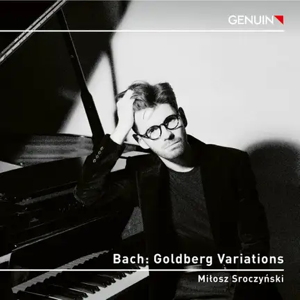
Johann Sebastian Bach (1685-1750)
Goldberg Variations BWV 988
Miłosz Sroczyński (piano)
rec. 2025, Festeburgkirche, Frankfurt am Main, Germany
Genuin GEN26957 [82]
…and still they come: an unending steam of recordings of this most irresistible of keyboard compositions which must be performed and set down by every harpsichordist and pianist worth his or her salt – and indeed in arrangements for other instruments, such as the recent issue for violin, French horn, bass clarinet, and marimba…
Utterly irreconcilable reviews, mine and my colleague David Barker’s, of Yunchan Lim’s live performance in Carnegie Hall recently generated some interesting reflection upon how the Goldberg Variations should be played and how we hear and respond to differing interpretative styles. So, I approached this one with a certain apprehension, and with a mental reservation regarding whether I should even be attempting to review yet another version.
The pianist’s own note to the recording does not help: it is a strong contender for the strangest and most tendentious commentary on the Goldbergs in my acquaintance. It politicises the work as an anti-capitalist statement, “an act of quiet resistance: in a world that measures the worth of a moment solely by what can be ‘extracted’ from it”. I have tried not to let such pretentious twaddle influence my response to Sroczyński’s artistry.
So putting all that aside, I just played it.
I can only say that I was immediately irritated by the pulling about of tempo in first exposition of the aria: long pauses, hesitations, self-conscious ornamental twiddles; I began to wonder if we were ever going to get to the end without yet the pianist making another “musical point”. Sroczyński takes a full 6:05 over it, which is about two minutes longer than favourite recordings by such as Alexandre Tharaud, Murray Perahia, Tatiana Nikolayeva, Grigory Sokolov, the young Konstantin Lifschitz, Hannu Alasaarela – and yes, Yunchan Lim! – all of whom take within a few seconds of four minutes. It is also a minute longer than Beatrice Rana, Vladimir Feltsman, the later Lifschitz and even Evgeni Koroliev, who takes 85 minutes and two CDs over the work; all of them despatch that opening aria in five minutes – and of course Glenn Gould was essentially twice as fast. Are they all “wrong”? Overall, Sroczyński’s timings are unremarkable, if a little on the slow side, but the wilfulness of that beginning is enough to test my patience and beyond.
And yet… the first variation is delightful and from then on, the playing is warm, relaxed and humane. The Steinway piano tone itself reflects that: perhaps the darker, lower frequences are a little over-pronounced but it emphasises warmth over brilliance and precision, such that the runs do not come across as so sharply articulated as, for example, Lim’s. Some might even find them a tad blurry – not, I hasten to add, because of any flaw in Sroczyński’s technique. The difference may also derive from the generally accepted contrast between, say, the clarity and refinement of a Bechstein, compared with the richer, more powerful and “Romantic” Steinway here. I personally prefer it.
All proceeds well for me until Variation IX (track 10) when suddenly we revert to the self-consciously portentous mode which blights the opening aria; there is none of the lilt and spring we hear in Lim’s or Rana’s more “poetic” renderings; then Variation X is plonking and graceless. We then revert to what I hear as a truly “musical” affect before a soporific and stilted Variation XIII which takes over seven minutes compared with Rana’s flowing 4:17 and Lim’s a minute longer. Nor am I very excited by Variation XIV, which should almost reap the whirlwind and skirt chaos; this is rather tidy. I hear little of the regal pomp and grandeur required in the flourish which opens Variation XVI; it is rather stolid. The “Black Pearl” No.25 is taken very fast in comparison with most other recordings; it avoids ponderousness but its corollary effect is one of perfunctoriness. The remaining variations are enjoyable, but I miss a certain abandon, joie de vivre, and then the da capo of the aria manages to be just as mannered as its first statement.
You see the pattern here: variations which delight alternate with others far more controversial. For that reason, it is not a reading I shall return to, when there are so many, more satisfying options.
Ralph Moore
Buying this recording via the link below generates revenue for MWI, which helps the site remain free













