
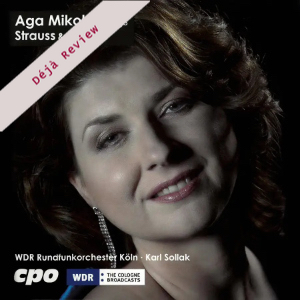
Déjà Review: this review was first published in May 2011 and the recording is still available.
Richard Strauss (1864-1949)
Four Last Songs
Es gibt ein Reich (from Ariadne auf Naxos)
The Countess’s final scene (from Capriccio)
Wolfgang Amadeus Mozart (1756-1791)
Cavatina (from Le Nozze di Figaro)
E Susanna non vien (from Le Nozze di Figaro)
In quali eccessi (from Don Giovanni)
Come scoglio (from Così Fan Tutte)
Aga Mikolaj (soprano)
WDR Rundfunkorchester Köln/Karl Sollak
rec. 2009, Stadthalle Bergheim, Cologne, Germany
cpo 777 641-2 [68]
This is Polish soprano Aga Mikolaj’s first solo CD. Previously she appeared twice on Naxos discs of choral works by Krzysztof Penderecki (review) and on a rare Phoenix disc of Schubert Singspiele (Phoenix 144). Her repertoire includes both opera and concert works, ranging from Drusilla in Monteverdi’s L’Incoronazione di Poppea to Eva in Wagner’s Die Meistersinger von Nürnberg, and from Vivaldi’s Gloria to songs by Lutoslawski. Last autumn she appeared as Alice Ford in Verdi’s Falstaff alongside Bryn Terfel.
The programme on this disc Mikolaj describes in her notes as constituting a musical self-portrait. These are pieces that have been recorded dozens of times before by every soprano anxious to show off her voice and technique to the public, but on the evidence of this disc this singer certainly deserves to be heard alongside the greats – one of whom, Elisabeth Schwarzkopf, was tutor and friend to Mikolaj.
She opens in sublime style with Richard Strauss’s Four Last Songs and responds magnificently to its demands, particularly in the achingly beautiful ‘Beim Schlafengehen’ and the timeless serenity of ‘Im Abendrot’. Ditto Strauss’s operatic extracts: the mammoth final section from his majestic swansong, Capriccio, is reminiscent of the Four Last Songs in its lyrical depth and measured pathos, and Mikolaj’s voice soars lark-like throughout the scene.
Already from the Strauss pieces it is clear Mikolaj possesses marvellous intonation, a mellow-roasted, lyrical voice, generally exquisite phrasing and a well-trained squilla over the orchestra. The only trace of an accent comes from a tendency to pronounce the short German ‘a’ sound – which is also the first element of the common diphthong written ‘ei’ – just a trifle too far back in the mouth and with slight lip-rounding, giving an occasional Austrian inflection.
Mikolaj is equally at ease with the different demands of Mozart’s Italian operatic masterpieces. In her two selections from Le Nozze di Figaro she sings the part of the Countess Almaviva: the cavatina is the famous lyrical love-lost aria ‘Porgi, amor’ from the start of Act II, which she follows with the Recitative and Aria form Act III, Scene 8, ‘E Susanna non vien!’ and ‘Dove sono i bei momenti’. From there to Act II of Don Giovanni, for Donna Elvira’s Recitative and Aria, ‘In quali eccessi’ and ‘Mi tradi quell’alma ingrata’, the lovely spinto song in which Elvira wrestles with feelings of pity and revenge. For the final scene Mikolaj dons the still faithful Fiordiligi’s wig in Act I Scene 3 of Così Fan Tutte for one of Mozart’s finest arias, and a traditional coloratura showpiece for sopranos, the virtuosic ‘Come scoglio’. All of these, once again, are beautifully rendered by Mikolaj, whose Italian accent is even better than her German – she betrays her foreignness only in very rare slip-ups like “io son ridotto” for “io son ridotta”.
The WDR Radio Orchestra furnishes some fine solo cameos in Strauss’s music, and Kurt Sollak conducts throughout with a sure hand. The recording is generally good, especially of Mikolaj – the orchestra itself sometimes sounds a bit on the muddy side, at least in the lower registers, but on the other hand there is virtually no background noise.
The booklet is crammed with information – with detailed conductor’s notes (wrongly translated as “Comments on the conducting of…”) by Sollak, further input from Aga Mikolaj, biographies, and full texts of the songs in English, German and Italian. In ‘Es gibt ein Reich’, the acting instruction ‘Gets up off the ground while speaking” has amusingly become part of the aria, whilst the English translations of the Italian from Mozart’s operas are slightly unhinged in places – well worth a read!
Byzantion
For a very different response to this recording, see Ralph Moore’s survey.
Buying this recording via the link below generates revenue for MWI, which helps the site remain free














I had not come across this singer before, but was totally bowled over by this recording. As Byzantion says this recording of the Strauss Four Last Songs “deserves to be heard alongside the greats”. In addition, the Mozart arias are quite perfect. How sad I was to learn that she died during Covid. I would have loved to have seen her sing on stage.