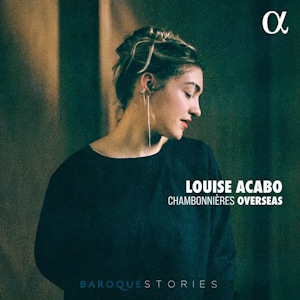
Jacques Champion de Chambonnières (c. 1601-1672)
Overseas
Louise Acebo (harpsichord)
rec. 2024, West vest 90, Schiedam, The Netherlands
Reviewed as a download
Alpha Classics 1156 [74]
Jacques Champion de Chambonnières is considered the father of the French harpsichord school. It is therefore rather surprising that his music is not given that much attention by modern performers. Pieces by him regularly appear in anthologies, and some discs have been entirely devoted to his oeuvre. However, to my knowledge it has never been recorded complete; not even Brilliant Classics, known for its release of complete collections of keyboard music, has such a recording in its catalogue. The disc under review does not change that, but rather than offering another selection from his oeuvre, it puts him into a historical perspective, showing his influence on other composers, in France and elsewhere.
He was born in a musical family of harpsichordists and organists. His grandfather, Thomas Champion, was appointed first organist of the royal chapel and chamber in 1578. His son, Jacques Champion, was organist and valet de chambre of Henri III. Jacques junior took the name ‘Chambonnières’ from his mother’s father, sieur de Chambonnières. This seems to have been part of his attempts to improve his social status. At some point, he started calling himself marquis. He was a child prodigy: at the age of ten he received the reversion of his father’s position at the court of Louis XIII as organist, valet de chambre and joker destinate. He played at court and started to compose, but he also danced, first before Louis XIII, later on with Louis XIV and Jean-Baptiste Lully. It is interesting that he was probably the first in France to organise paying concerts, as he established the Assemblée des honnestes curieux in 1641. Twice a week, public performances took place, apparently with two singers, a viol player and him at the harpsichord. He was also the first French composer to publish music especially written for the harpsichord. In 1670, two books with harpsichord pieces were printed. One of the reasons was that “shoddy copies, full of mistakes” were circulating. By publicising them Chambonnières could be sure that his works were offered to the public in versions which he approved of. The circulation of his compositions is a sign of their great popularity. He had plenty of admirers; one of the most ardent was the Dutch playwright and poet Constantijn Huygens, who was mainly responsible for the dissemination of Chambonnières music outside France. It is through him that Johann Jacob Froberger became acquainted with Chambonnières’ works.
Eight years after his death Jacques Le Gallois wrote about Chambonnières: “He had a delicacy of hand that others lacked, in such a way that if he played a chord and someone else imitated him in doing exactly the same, one perceived nevertheless a great difference – and the reason is, that he had a different manner of approaching the keyboard and of placing his fingers on the keys that was unknown to others”. He also made a comparison between Chambonnières and Louis Couperin who had been introduced to the court by Chambonnières: “Their two styles of playing had different characteristics, and it could be said that one touched the heart and the other touched the ear. (…) They pleased, but pleased differently, because of the varied beauties of their styles of playing”.
Louise Acebo has put together a programme of pieces by Chambonnières, some of his contemporaries, and Jean-Henry D’Anglebert as a representative of the next generation. They are ordered in four suites of different keys. At the time, it was mostly left to the performer to select pieces and order them to a suite, so such suites could be very different, sometimes including several dances of the same type. That justifies the way the four suites on this disc are structured. The main difference is that here they consist of pieces by different composers.
Acebo was particularly interested in Chambonnières’ influences in England. This is expressed in the title of this disc: “Overseas”. In the booklet she writes: “Although he never left France, his work crossed borders, oceans, and time – even before the publication of his pieces in 1670. So I have been pursuing Chambonnières in a sort of paper chase, exploring and comparing the pieces written in his own hand, as well as those copied down by others.”
One of the composers who transported the French style to England was Johann Jacob Froberger, who visited England, arriving penniless after being robbed by pirates between Calais and Dover, as memorialized in the Plainte fate à Londres pour passer la mélancholie. Whether Froberger met Matthew Locke is unknown; it seems that he was not in London when Froberger was there. However, his harpsichord works, published in the collection Melothesia (1673), shows the influence of the French style, which is all the more remarkable as he is known to have been not very receptive to ‘foreign’ influences: “I never yet saw any foreign composition worthy an English man’s transcribing.”
In this collection one can also find pieces by other composers, such as John Roberts and Christopher Preston, two composers who are virtually forgotten. Roberts seems to have been mainly active as a harpsichord teacher in London in the third quarter of the 17th century. His extant oeuvre consists of two suites and a number of separate dances. Preston was appointed to the royal household as a musician-in-ordinary for the virginals in 1668, and took Christopher Gibbons’ place at the latter’s death in 1676. Melothesia includes six pieces of his pen, and that is all that he has left.
Another English composer who figures in the programme is Albertus Bryne, described by contemporaries as “that famously velvet fingered organist” and “an excellent musitian”. He had the bad luck to be active during the political upheaval which led to the Commonwealth, and resulted in his being dismissed from his post as organist at St Paul’s, a position he held since 1638 as a successor to his teacher, John Tomkins. He survived by teaching the keyboard but after the Restoration returned to his old post, which he lost again in the wake of the Great Fire of 1666. In the last two years of his life, he worked as organist of Westminster Abbey. When he died in 1668, he was succeeded there by John Blow. Bryne was one of the first English composers to organise his dances into suites by key. In 2006 Terence Charlston recorded his complete oeuvre (review).
Lastly is Jean-Henry d’Alembert, who is assumed to have been one of Chambonnières pupils. He was born in Bar-le-Duc, a village west of Nancy. Nothing is known about his early musical education and we also don’t know when he came to Paris. Here his first official position was that of organist to the Jacobins in the rue Saint-Honoré (1660). In 1662 he became ordinaire de la musique de la chambre du roi pour le clavecin. The only publication of his keyboard works was the Pièces de clavecin which were printed in 1689. These were dedicated to the Princesse de Conti (legitimated daughter of Louis XIV and Mlle de la Vallière), for whom he composed most of his harpsichord music.
Whether he was a pupil of Chambonnières or not, there can be no doubt that he greatly admired the master. One token of appreciation at the time was the writing of a double on a piece by a colleague. This means that more or less elaborate ornamentation is added to the original melody, while the supporting harmonies remain the same (New Grove). D’Anglebert wrote several such doubles, among them two on pieces by Chambonnières. The most impressive expression of his admiration, though, is the Tombeau de Mr de Chambonnières, a kind of musical epitaph. Such pieces are among the most expressive specimens of French music of the 17th and the first half of the 18th century, and could be scored for various (combinations of) instruments. D’Anglebert’s Tombe au closes the programme and is also one of the highlights. Others are D’Anglebert’s Chaconne rondeau, Froberger’s Plainte and Chambonnières Pavane dite L’entretien des dieux. The rest of the programme consists mostly of dances, the preferred genre of instrumental music at the time. The various characters and rhythms of these dances guarantee quite some variety.
The first time I heard Louise Acebo was during a recital at the Festival Early Music Utrecht 2022, where she made a strong impression in music by two other French composers: Élisabeth Jacquet de La Guerre and Gaspard Le Roux. She seems to feel like a fish in water in such music, as this disc demonstrates once again. The dances come off according to their character; Acebo shows a perfect sense of rhythm, and the choices of tempo are always spot on. The more substantial items are played majestically, with the help of a beautiful instrument, a copy of an anonymous harpsichord dated 1679, and a very good recording which reveals all the details and thus displays the richness of the scores.
This is an impressive recording, musically compelling and historically interesting. Now that the complete keyboard works of two composers connected to Chambonnières – Louis Couperin and Froberger – are available on disc, it is high time that Chambonnières’ oeuvre is recorded complete as well. Louise Acebo seems the right person to realize such a recording.
Johan van Veen
www.musica-dei-donum.org
twitter.com/johanvanveen
https://bsky.app/profile/musicadeidonum.bsky.social
Buying this recording via the link below generates revenue for MWI, which helps the site remain free
Contents
[Suite in D minor]
John Roberts (Fl 1650-1670)
Prelude
Almain
Jacques Champion de Chambonnières
Alaine (courante)
Sarabande
Gigue (la madeleine)
Jean Henry d’Alembert (1629-1691)
Prelude
[Suite in a minor]
Jacques Champion de Chambonnières
Allemande la Rare
Courante
Matthew Locke (c1621-1677)
Saraband (art William Thatcher)
Albertus Bryne (c1621-1668)
Ayre
Saraband
Jacques Champion de Chambonnières
La Vielle (gigue)
Johann Jacob Froberger (1616-1667)
Plaint (fate à Landres pour passer la Melancholia)
[Suite in C]
Matthew Locke
Prelude
Almain
Jacques Champion de Chambonnières
Courante (Iris)
Matthew Locke
Country dance
Jacques Champion de Chambonnières
Pavane (diet Lienteries des adieux)
Johann Jacob Froberger
Suite XVIII in G minor (Few 618)
Jean Henry d’Alembert
Chaconne rondeau
[Suite in G]
Christopher Preston (?-beef 1690)
Prelude
Jacques Champion de Chambonnières
Allemande
Jean Henry d’Alembert
Sarabande Chambonnières (avec Double)
Jacques Champion de Chambonnières
Courante
Jean Henry d’Alembert
Double (de la courante)
Jacques Champion de Chambonnières
Sarabande
Jean Henry d’Alembert
Tombe au de Mr de Chambonnières