
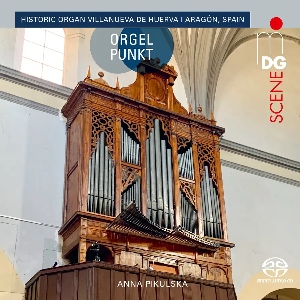
Orgelpunkt – Historic Organ Villanueva de Huerva
Anna Pikulska (organ)
rec. 2024, Iglesia de Nuestra Señora de los Ángeles, Villanueva de Huerva, Spain
Reviewed as a download
MDG 951 2389-6 SACD [69]
For many centuries the organ was one of the main instruments in Europe. There is no European country which does not have any important instruments, which reflect its importance in the liturgy (and often also outside of it). However, the organ landscape is very different. The United Kingdom, for instance, has very few organs from the pre-Romantic era. In contrast, Germany and the Netherlands are full of organs from the Renaissance and Baroque periods, and most of them are in excellent shape.
Spain is a different story. It has many precious instruments on its soil, but for a long time they were often not used and as a result they are in pretty bad shape. The organ that is in the centre of the recording to be reviewed here, dates from the late 16th century, and has been restored by Christine Vetter. In the booklet she states that many Aragonese organs, especially in rural areas, were “abandoned, neglected and forgotten”. In 2005 she started the restoration of the organ in Villanueva. “There were rat nests between the pipes, hence many pipe feet and even pipe bodies themselves were alas eaten away by these rodents and had to be replaced – a major challenge for the first organ I restored on my own”.
Listening to this disc one has to conclude that she has done a brilliant job. The restored organ is presented in full glory in a programme that demonstrates various combinations of stops. Obviously it includes music by Spanish masters, but also pieces from the Netherlands and Italy, which underlines that organs, despite all their regional peculiarities, also had something in common. A particular feature of many Spanish organs is the reed stops, often en chamade. This means, as Wikipedia says, “that (they) have been mounted horizontally, rather than vertically, in the front of the organ case, projecting out into the church or concert hall.” This is a pretty well-known feature, but too often Spanish organs are identified with it, which results in a one-sided view on such instruments. One of the virtues of the present disc is that it shows that Spanish organs have more to offer than brassy noises.
Even in one of the most popular genres of the 17th century, the batalla, the reed stops are used discriminately. In the Spanish specimens of this genre, they are applied, but not from start to finish, and in Storace’s Ballo della Battaglia they are not used at all. That makes sense; he was an Italian composer, and Italian organs did not have such stops. This piece is not specifically intended for the organ: in other recordings it is played on the harpsichord. That does not mean that it cannot be played on the organ; the choice of instrument was mostly left to the performer.
The same goes for the Canzona IV by Frescobaldi and the pieces by Jan Pieterszoon Sweelinck. Three of the latter’s works are series of variations on then popular tunes. Sweelinck was known for his love of the genre of the variation: when playing the harpsichord for friends and acquaintances, he hardly could stop improvising variations. The pieces included here give a good idea of his art of varying a tune. There is no objection against performing them on the organ. Sweelinck may have done so himself; as organist of the Oude Kerk in Amsterdam he did not accompany the congregation in worship – it sang only psalms, unaccompanied – but, being in the service of the town, he was expected to play on weekdays, for people walking through the church on market days.
Returning to the Spanish repertoire, we get three batallas. They were popular, just like other sorts of imitation. It was a challenge to imitate other instruments, birds or natural phenomena. Whether batallas (or battaglias in Italian) were always connected to military battles, is impossible to say. The image of the battle was also used in the realm of love and as an image of the struggle in matters of faith: the battle against evil or the Devil in person. However, given that the 17th century saw quite a number of wars, these may have been indeed a major source of inspiration.
Many Spanish composers wrote tientos, which one can define as fantasies. They could take very different shapes, and often composers designated one part specifically for the left or the right hand, indicated by the addition “de medio registro” (as here the Tiento by Francisco Correa de Arauxo). Manuals of Spanish organs were often split into two halves, with different stops. Sebastian Durón also makes use of it in Gaitilla de mano izquierda, a series of variations for the left hand. He has become mainly known for his songs and theatrical works. However, he was an organist by profession.
A typical Spanish genre was the ensalada, literally: “salad”. It is a kind of quodlibet, in which composers could bring together texts of different kinds, sacred and secular, and mix different musical styles. The champion of the ensalada was Mateo Flecha (1481? -1553?). Sebastián Aguillera de Heredia was inspired by this genre writing an organ piece which includes a variety of styles and thematic material. The colour palette of the organ in Villanueva allows to convincingly bring out that variety.
The programme is not played in chronological order. As a consequence, at the end of the programme a toccata by Sweelinck is followed by the Tocata para Órgano by José de Nebra. These two pieces are stylistically worlds apart. The latter piece very much reminds me of the organ music written by Italian composers from the second half of the 18th century, which are strongly under the influence of opera. One could say that their music shows the ‘secularization’ of the organ. Whether Nebra’s piece was intended for liturgical use, I don’t know.
This is the second disc on which the Polish organist Anna Pikulska plays a historical organ in Aragon, in the northeast of Spain. The first earned much praise, and rightly so (review). This is again a fine demonstration of her skills as a player, but also as a specialist in Iberian organ music. She is currently working on her dissertation project on the performance practice of Juan Cabanilles’ organ works (to which her previous disc was devoted). She uses the possibilities of the instrument to good effect, in a stylistically differentiated manner. By including pieces from other parts of Europe, she puts the organ and Spanish organ music in a historical perspective, demonstrating the similarities and differences. She plays the Spanish pieces in a fully idiomatic way, but is equally convincing in Frescobaldi and Sweelinck.
This disc is a fine contribution to our knowledge of Spanish organs and organ music, which deserve to be better known.
Johan van Veen
www.musica-dei-donum.org
twitter.com/johanvanveen
https://bsky.app/profile/musicadeidonum.bsky.social
Contents
Pedro de Araújo (?– ca. 1704)
Batalha de Sexto Tom
Jan Pieterszoon Sweelinck (1562–1621)
Variations on Mein junges Leben hat ein End’ (SwWV 324)
Sebastián Durón (1660–1716)
Gaitilla de Mano Izquierda
Bernardo Storace (ca. 1637–ca. 1707)
Ballo della Battaglia
Manuel Narro (1729–1776)
Batalla
Jan Pieterszoon Sweelinck
Variations on Unter der Linden grüne (SwWV 325)
Sebastián Aguilera de Heredia (1561–1627)
Obra de Octavo Tono Alto, Ensalada
Jan Pieterszoon Sweelinck
Variations on Est-ce Mars (SwWV 321)
Jusepe Ximénez (ca. 1600–1672)
Batalla de Sexto Tono
Girolamo Frescobaldi (1583–1643)
Canzona Quarta (Il secondo Libro di Toccate)
Francisco Correa de Arauxo (1584–1654)
Tiento de medio registro de tiple de Octavo Tono
Jan Pieterszoon Sweelinck
Toccata (SwWV 288)
José de Nebra (1702–1768)
Tocata para Órgano
Buying this recording via the link below generates revenue for MWI, which helps the site remain free













