
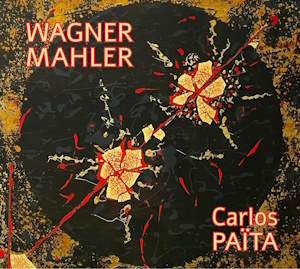
Wagner, Mahler – Carlos Paita
Richard Wagner (1813-1883)
Götterdämmerung – orchestral extracts
Siegfried’s Rhine Journey
Death of Siegfried & Funeral March
Philharmonic Symphony Orchestra (?)/Carlos Païta
rec. 1982-1983, Kingsway Hall, London
Gustav Mahler (1860-1911)
Symphonie n° 1 “Titan”
Royal Symphony Orchestra (?)/Carlos Païta
rec. 1976, Kingsway Hall (?), London
Le Palais des Dégustateurs PDD052 [77]
First, some housekeeping. Oddly – rather disingenuously, in fact – the label here makes absolutely no mention of the recording’s origins with Decca Phase 4 and its subsequent issue on the conductor’s own label, Lodia (which ceased trading twenty years ago). Nor do the notes explain that both the “Royal Symphony Orchestra” and the “Philharmonic Symphony Orchestra” must have been the aliases of ad hoc pick-up bands drawn from freelancers and/or the ranks of major London orchestras – presumably the RPO, LSO and LPO – assembled uniquely for recording purposes. Finally, the recording date is given vaguely as 1977 and the location as Kingsway Hall, whereas in fact there is no information to be found anywhere to confirm the latter – it might just as easily have taken place in the Walthamstow Assembly Hall, for example – and the Mahler Foundation website quotes from the Lodia CD catalogue, no. LOCD 776, giving the specific recording dates of 11, 13 & 15 November 1976, as per Lee Denham’s comprehensive survey of this symphony. I confidently refer you to it for his response, which details why he found this recording to be a frustrating experience.
The symphony is so well balanced and beautifully scored that it really does not require any kind of major intervention; it simply needs to unfold as naturally as one movement leads into another, moving from primaeval mystery to the gentler charms of Mother Nature through rustic Arcadian innocence to mankind’s more complicated relationship with the natural world and beyond; the problem with Païta is that he can’t stop point-making where none is required. To some extent, our eternal appetite for novelty and appreciation of the cutting-edge sonic engineering here can mask or distract from the self-consciousness of his approach, but it won’t do as a satisfying account of Mahler’s early masterpiece – in many ways my favourite, despite my love of his other great symphonies. As such, however, I can see how it fits in with this label’s brief for reviving neglected recordings of note, because it is certainly sui generis.
The depth of sound and the spaciousness of the stereo separation are immediately noticeable – as is something being dropped at 2:09 and the etiolation of tempi to enhance the sense of opening out before the bucolic romp begins four minutes in – but then the alternation of sudden braking and rushing can be quite unsettling and there is a definite loss of impetus around the 8:45 when the timpani reproduce the sound of distant thunder preceding another bout of acceleration and deceleration in the ensuing passage before the trumpet calls; I find it all very erratic and agree with Lee that with regard to the orchestra “you can virtually hear their uncertainty at what the conductor is doing and will/might do next.” The constant resorting to extremes continues with the second movement: the opening is taken too fast then the trio ploughs into the sand with some absurdly exaggerated rallentandi before a markedly rushed reprise of the first subject. The opening of the Huntsman’s Funeral is again decidedly hurried and at the start I am conscious of the channel separation being too extreme. We are then again subjected to almost arbitrary fluctuations in tempo which disrupt any sense of line. The reboot of the melody at 7:31 is much steadier and more satisfying and the opening of the finale excellent – suffused with drama and tension, even if it is close to the edge of harried. It is given the most straightforward and uncontentious delivery, direct and heartfelt. The orchestral playing here is especially rich and homogeneous; perhaps they felt more at home when not being required to make so many unpredictable gear changes – but then Païta’s besetting fault of exaggerating switches of tempo intrudes and the coda loses momentum.
The two Wagner excerpts are vivid but to my ears there is an element of self-conscious portentousness about the opening of the Journey down the Rhine. Having said that, the outburst of the Big Tune at 3:40 is glorious – then again, I am conscious of the degree to which Païta pulls the tempo about from bar to bar and the playing becomes very muddy and untidy as his players try to keep up with him; the constant slowing down is counterproductive to cohesion. The central “galloping” section is thrilling but frantic rather than majestic, then the marked slowing down for the conclusion jars. The opening of the Funeral Music is graced by extraordinarily sonorous horns but then, yet again, the music almost grinds to a halt for the march. On the other hand, the timpani are wonderfully prominent and percussive and again the horns excel and the listener may revel in the sheer impact of the aural experience while simultaneously balking at the lethargy of the pulse. My own feeling is that there is a happy medium between sonic grandeur and steady propulsion that is reached by such as Karajan and the BPO in this music and which eludes Païta.
Ralph Moore
Other review: Stephen Francis Vasta
Availability: Le Palais des Dégustateurs












