
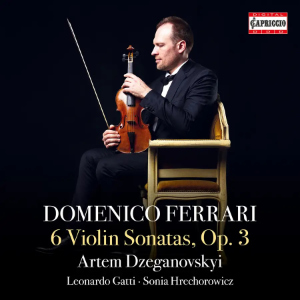
Domenico Ferrari (1722-1780)
6 Violin Sonatas Op. 3
Artem Dzeganovskyi (violin)
Leonardo Gatti (cello), Sonia Hrechorowicz (harpsichord)
rec. 2024, Episcopal Chapel of St. Egidio, Fontanella, Italy
Reviewed as a download
Capriccio C5553 [69]
Lovers of pre-Romantic violin music have nothing to complain about; in recent years quite a number of discs with sonatas by little-known composers have been released, which has given them the opportunity to extend both their knowledge and their collection of recordings. It cannot be appreciated enough when performers are willing to leave the trodden paths and explore unknown territory. The present disc is a good example. As far as I have been able to check, only one sonata by Domenico Ferrari has appeared on disc as part of an anthology, until Artem Dzeganovskyi recorded these six sonatas Op. 3. That is all the more surprising, as Ferrari was one of the best pupils of Giuseppe Tartini, and has left more than forty sonatas for his own instrument.
Ferrari was born in Piacenza, and became one of Tartini’s pupils. That in itself says much, as Tartini accepted only the most talented. After his studies, Ferrari settled in Cremona. In 1749 he presented himself as a virtuoso at the court in Vienna. In 1753 he entered the service of the Württemberg court in Stuttgart, where he collaborated with Pietro Nardini, another brilliant Tartini student (they were born in the same year: 1722). In 1754 he made an appearance at the Concert Spirituel in Paris, and although some years later he visited Stuttgart, he remained in Paris until the end of his life.
The first pieces by Ferrari published were four trio sonatas in a collection of six, printed in London in 1757. Between 1758 and 1762 he published six collections of six sonatas each for violin and basso continuo in Paris. Around 1765 a set of duets for two violins by Ferrari (four) and Nardini (two) appeared in London. One can easily imagine that they have played such pieces together in Stuttgart. Another set of six sonatas which appeared in Amsterdam as his Op. 2 is probably not authentic. He seems to have written only one piece for a larger scoring: a concerto for violin and strings.
In all his sonatas Ferrari sticks to the baroque habit of adding a basso continuo, and the movements are in binary form. On the other hand, the sonatas Op. 3 show traces of the upcoming classical style. All the sonatas are in three movements, mostly fast – slow/moderate – fast. The Sonatas III and IV are different, in that they open with an andante and andantino respectively, followed by a fast movement: allegro moderato and allegretto respectively. In line with the fashion of the time, three of the sonatas close with a minuet. One of them is a minuet with variations, a very popular form in the mid-18th century, especially used in music written in the galant idiom. The latter manifests itself in Ferrari’s sonatas in the relatively short melodic phrases as in the fact that all the sonatas are in major keys.
These sonatas are not overly virtuosic. Notable, for instance, is the relatively modest application of double or multiple stopping. Ferrari uses it mostly at the opening or close of a section or a phrase. On the other hand, almost every sonata includes indications that a cadence can be included. Very wide intervals are avoided, and the sonatas don’t move into extreme positions (unlike the sonatas Op. 1 by Ferrari’s fellow Italian Felice Giardini, which I reviewed recently). From that angle we may assume that Ferrari’s sonatas were within the capabilities of the more advanced amateurs. The influence of Tartini can be noted in the titles of some movements: andante cantabile and minuetto affectuoso. Naturalness and expression were among Tartini’s ideals; he disliked virtuosity for its own sake. Ferrari here shows himself to be a follower of the master.
Ferrari was admired by some notable contemporaries, such as Charles Burney, Carl Ditters von Dittersdorf and Christian Friedrich Daniel Schubart. The latter wrote about Ferrari’s way of playing (quoted in the booklet): “Ferrari doesn’t play forcefully, but just touches the strings, leaving out the lower part of the bridge and using only the higher one, producing tones that resemble those obtained by delicately touching glasses, so as to hear the sound of the crystal”.
It is not easy to describe a sound in words, and therefore we may never really know how he played. However, I can imagine that Dzeganovskyi’s style of playing gives some idea of what it was like. I can’t remember having heard him before, although he has been active in the early music scene for quite some time. Part of his activities took place in his homeland Ukraine, but he has made an international career. I am glad to have had the opportunity to hear him in these fine sonatas by Ferrari, which have never a dull moment. That is also due to Dzeganovskyi’s performances, which are differentiated, for instance with regard to dynamics. He shows his inventiveness in the cadences. This is the best possible case for Ferrari’s oeuvre, which deserves more interest. Dzeganovskyi has the assistance of the Italian cellist Leonardo Gatti and the Polish harpsichordist Sonia Hrechorowicz, who realize the basso continuo with much drive.
Interestingly, two sonatas are preceded by short improvisations on violin and harpsichord respectively. This is in line with a common practice in the baroque period, but today seldom applied.
To conclude, this is a lovely disc, which invites repeated listening.
Johan van Veen
www.musica-dei-donum.org
twitter.com/johanvanveen
https://bsky.app/profile/musicadeidonum.bsky.social
Buying this recording via the link below generates revenue for MWI, which helps the site remain free
Contents
Sonata I in F
Sonata II in B flat
Sonata III in E
Sonata IV in G
Sonata V in A
Sonata VI in E













